
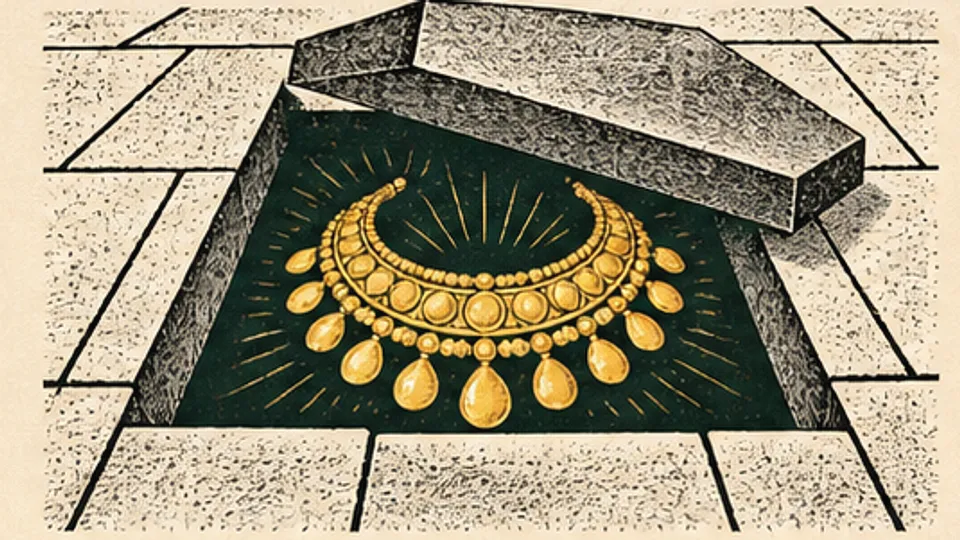
The kings of Assyria were determined to be remembered. Their victories covered palace walls, their names filled cuneiform tablets and colossal stone guardians flanked the gateways of their cities. The women who shared their royal world, by contrast, survived in the records as little more than shadows. That changed dramatically beneath the floors of the Northwest Palace at Nimrud, in northern Iraq, where Iraqi archaeologists working in the late 1980s uncovered a series of royal burials containing Assyrian queens, surrounded by gold jewellery, precious stones, vessels, seals and ornaments that had lain undisturbed for roughly 2,700 years.
The discovery ranks among the richest ever made in the ancient Near East. The University of Chicago’s Institute for the Study of Ancient Cultures, which published the tombs together with Iraq’s State Board of Antiquities and Heritage, concluded that the gold jewellery and other objects rivalled those from Egyptian royal tombs in both quality and quantity. The comparison invites thoughts of Tutankhamun, but Nimrud’s story is different. Rather than one young pharaoh preserved in a single famous burial, the palace had concealed generations of royal women whose names—Yabâ, Banītu, Ataliya and Hama among them—suddenly re-emerged from beneath the floors of the Assyrian court.
Digging down, not out
Ancient Kalhu, as Nimrud was then known, became an Assyrian royal capital under Ashurnasirpal II in the ninth century BC. His vast Northwest Palace had drawn archaeologists since the nineteenth century; its carved reliefs, ivories and monumental architecture made it one of the best-known buildings of the Assyrian world. Yet its greatest secret lay below ground. When the Iraqi archaeologist Muzahim Mahmoud Hussein and his team examined the palace’s domestic quarters in 1988 and 1989, irregularities in the floors led them downward into stone-built burial chambers hidden beneath rooms once occupied by the royal household—under a building generations of excavators believed they already knew.
Tomb II, the richest of the burials, held two female bodies amid hundreds of objects, many of gold, arranged in and around layers of clothing. A gold bowl inscribed with Queen Ataliya’s name rested on the breast of the upper body. Near the skulls lay a crown and an extraordinarily elaborate gold diadem; earrings, a gold neck torc, finger rings, bracelets and anklets completed an ensemble that had once covered the body from head to foot. The diadem alone testifies to the court’s craftsmen: woven gold bands joined stone-set decorated sections, while dozens of tiny gold braids ended in pomegranate-shaped beads, with rosettes, granulation and delicate hinges.
The bracelets could be just as intricate, depicting kneeling supernatural figures beside sacred trees—palace art in miniature—with coloured inlays. Gold appliqués shaped as rosettes, stars and leaves presumably once glittered on garments long since decayed. Agate, carnelian and lapis lazuli ran through the adornments, materials that reached Assyria through trade, tribute and imperial networks stretching far beyond Mesopotamia. The Metropolitan Museum of Art has described the Nimrud jewellery as among the most impressive surviving groups of ancient Near Eastern jewellery. The tombs show not just wealth but how the women at the summit of the Assyrian court presented royal identity.
Three queens, two bodies, one puzzle
The names attached to Tomb II complicate rather than settle matters. Objects in the burial refer to Yabâ, wife of Tiglath-Pileser III; Banītu, wife of Shalmaneser V; and Ataliya, wife of Sargon II—three kings who ruled Assyria in succession during the eighth century BC. Yet archaeologists did not find three neatly labelled burials. Two principal female bodies occupied the sarcophagus, while objects bearing different queens’ names lay together, a puzzle scholars still interpret through skeletal evidence, inscriptions and the positions of grave goods. One possibility is that prized royal possessions passed from one woman to another before entering the tomb; researchers have also debated whether remains in containers elsewhere in the chamber might belong to another queen. Elsewhere in the complex, an extraordinary burial has been connected with Hama, queen of Shalmaneser III.
The women of Nimrud clearly understood that treasure attracts visitors. One of the most memorable finds was an inscription associated with Queen Yabâ placing a curse on anyone who disturbed her grave or installed another person within it. In Assyrian belief such protection mattered deeply; the threat of supernatural punishment extended it beyond the reach of any living king. The irony is hard to miss, given the tomb’s multiple occupants and its eventual reopening by researchers rather than robbers.
The treasure’s modern history has been nearly as dramatic as its ancient one. Plans to exhibit the finds internationally collapsed amid war and sanctions, leaving the collection far less familiar to the public than Egypt’s treasures despite its exceptional quality. Iraqi authorities eventually locked the most valuable objects in underground vaults at Iraq’s Central Bank. When Baghdad descended into chaos in 2003 and the Iraq Museum suffered catastrophic looting, many feared the Nimrud gold had vanished with the rest.
That the palace’s women are known at all—by name, by their jewellery, by their anxieties about the afterlife—is a rare victory of spade over oblivion. Kings wrote history; the queens, it turns out, simply buried themselves inside it. Historians of the ancient world rarely get such luck.