
For about 19 hours on November 16, 178 organisations — the BBC, CNN, Zoom, Salesforce, GitLab, HSBC, Equifax, IKEA, Air France-KLM, Ledger, Peacock, TalkTalk among them — served malware to their own site visitors, from infrastructure the organisations themselves did not control and had no reason to distrust. The code arrived from cdn.optimizely.com, signed by a certificate belonging to Optimizely, the website-personalisation and A/B-testing vendor those 178 companies all pay. Security researcher Scott Helme, of Report URI, found the malicious code in 188 of 1,611 Optimizely JavaScript snippets his team checked — a sample, not a census, so the true count of affected sites could run higher.
A write-access bug, not a delivery bug
Optimizely’s product works by injecting a JavaScript snippet into every page a customer serves. The snippet carries Optimizely’s own code plus whatever the customer has put in an optional field called Project JavaScript — the place a marketing team pastes a tracking pixel or a custom experiment. Researchers named the flaw OPTIMJACK: a bug in Optimizely’s Experimentation account sign-up flow let an unauthenticated attacker write into the Project JavaScript field of customer accounts that had nothing to do with the attacker’s own, across companies that share no relationship beyond buying the same vendor’s software. That is the part nobody involved has yet explained. Helme wrote that “we don’t know how the attacker got write access to so many unrelated customer projects: a compromised Optimizely system, a compromised credential with cross-customer access, or something else. That’s for Optimizely to explain.” Optimizely’s own public statement, posted to X, says only that it “identified and contained a security incident affecting some Optimizely Web Experimentation customers” and that “the vulnerable path is blocked, the injected code was removed, and customers have been contacted directly.” It has not described the root cause.
This distinction matters because it rules out the more familiar failure mode. A CDN cache-poisoning attack tricks a content delivery network into caching a response it was never meant to serve. Helme was explicit that OPTIMJACK is not that: Optimizely’s CDN served exactly what its own systems told it to serve. The attacker didn’t break the delivery pipe; they wrote directly into the content the pipe was built to deliver, using the account mechanism customers normally use themselves.
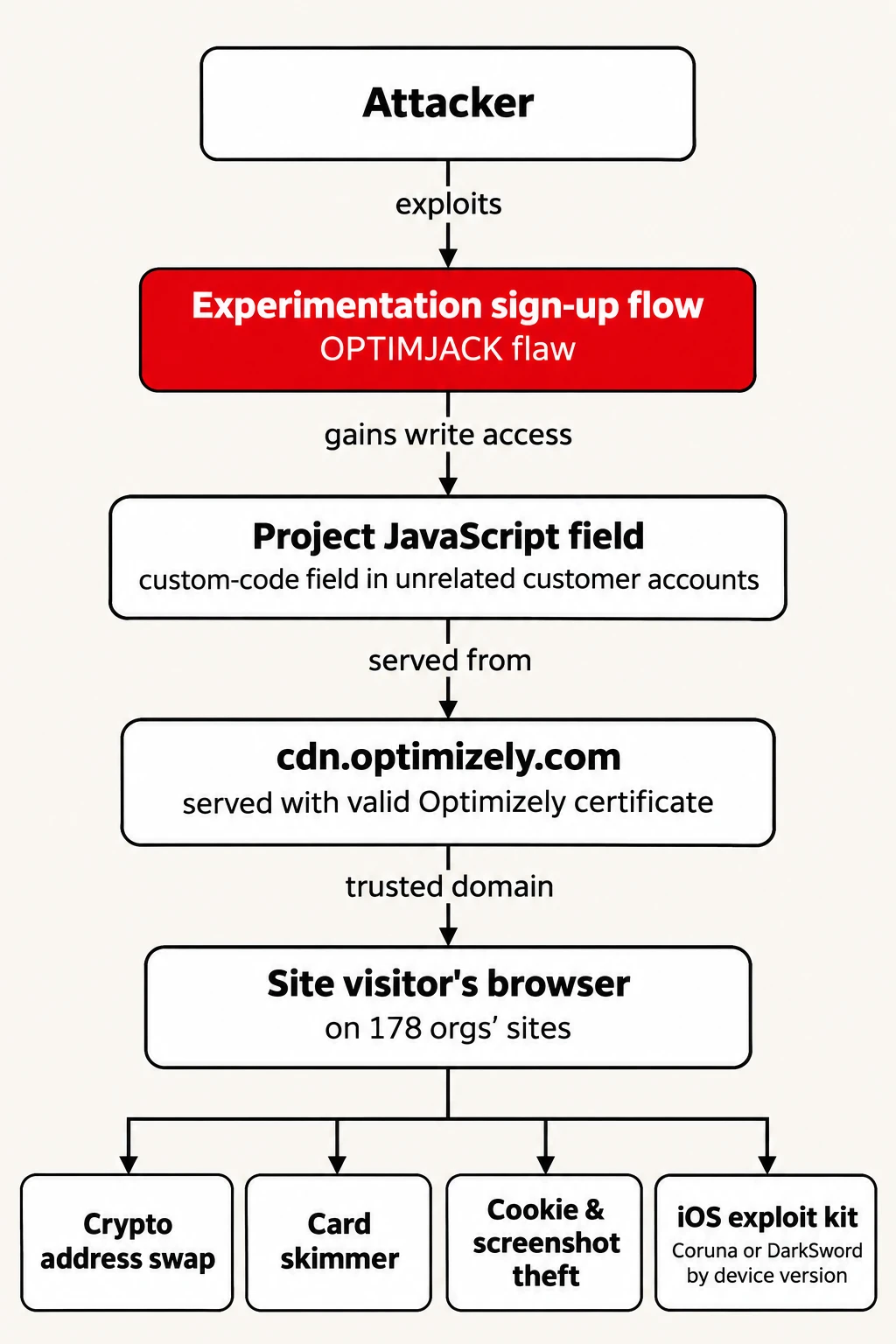
| From | To | How |
|---|---|---|
| Attacker | Experimentation sign-up flow (OPTIMJACK flaw) | exploits |
| Experimentation sign-up flow (OPTIMJACK flaw) | Project JavaScript field (custom-code field in unrelated customer accounts) | gains write access |
| Project JavaScript field (custom-code field in unrelated customer accounts) | cdn.optimizely.com (served with valid Optimizely certificate) | served from |
| cdn.optimizely.com (served with valid Optimizely certificate) | Site visitor's browser (on 178 orgs' sites) | trusted domain |
| Site visitor's browser (on 178 orgs' sites) | Crypto address swap | |
| Site visitor's browser (on 178 orgs' sites) | Card skimmer | |
| Site visitor's browser (on 178 orgs' sites) | Cookie & screenshot theft | |
| Site visitor's browser (on 178 orgs' sites) | iOS exploit kit (Coruna or DarkSword by device version) |
Based on Report URI / StepSecurity
Allow-listing the vendor’s own domain didn’t help
A Content Security Policy (CSP) is a header a website sends telling browsers which domains its scripts are allowed to load from. The standard advice for any third-party script is to list only the hosts you need. Here that advice collided with the mechanism of the attack: the malicious code came from cdn.optimizely.com itself, the same host every customer’s CSP already trusted. Listing Optimizely’s domain in your allow-list, the normal, recommended control, gave you nothing.
Helme’s team checked the CSP headers of roughly 159 of the affected organisations’ sites. Sixty-eight had no Content Security Policy at all. Fifty had a policy that still let the malicious script run and phone home. Seventeen blocked the data-theft calls but still let the wallet-address-swapping script execute, because that part didn’t need an outbound network call to work. Twenty-four sites — 15% of the sample — had a policy strict enough to stop the attack outright, generally because they had avoided two settings: ‘strict-dynamic’, which extends trust to anything the legitimate snippet itself loads, and ‘unsafe-eval’, which Optimizely’s own documentation recommends enabling and which let an inline fallback payload run via eval() even on sites that blocked the primary script tag.
| Sites (sites) | |
|---|---|
| No CSP at all | 68 |
| CSP allowed the attack | 50 |
| Partial (data theft blocked) | 17 |
| Fully blocked | 24 |
Source: Report URI (Scott Helme)
Four payloads, 26 rebuilds in one day
The first injected code appeared at 04:21 UTC on November 16, loading from a domain called webshell[.]lol inside a BBC snippet; the attacker’s own domain, 1688360[.]cc, was registered two hours later. The payload script, named track.js, was rebuilt 26 separate times over the day starting at 08:10 UTC, growing from roughly 28,900 bytes to 30,400 bytes as features were added and never removed, according to StepSecurity’s analysis. The attacker shipped it in three forms simultaneously — a plain script tag, a base64-obfuscated version, and a fallback executed inline via eval() — so that blocking any one delivery method left the others running.
The final payload did four things. It swapped cryptocurrency addresses copied to a victim’s clipboard for the attacker’s own, with checksum validation across eight chains including bitcoin, ether, litecoin, Tron, Solana, TON, bitcoin cash and dogecoin. It skimmed card numbers, expiry dates and security codes from forms and XHR requests, a component added at 13:43 UTC, validated with a Luhn check — though StepSecurity notes it could not read card fields entered inside a payment processor’s own cross-origin hosted iframe, the one defence that held regardless of CSP. It stole cookies and screenshots. And between 17:13 and 17:57 UTC it began injecting an iframe that delivered one of two iOS exploit kits depending on the visiting device’s software version: Coruna for iPhones and iPads on iOS 13.0 through 17.2.1, DarkSword for iOS 18.4 through 18.7.
Helme traced roughly $7,040 moving into the attacker’s wallets as of November 16, across bitcoin, litecoin, Tron-based stablecoins, ether and BSC tokens; a late 1.7-litecoin payment, about $75, arrived the following morning after the attacker’s infrastructure was already offline, possibly a victim paying a wallet address that had since been swapped back. A separate estimate from Galaxy Digital researcher Alex Thorn put the real haul closer to $2,300, on the view that most of the bitcoin tracked was the attacker’s own money recycled through the wallet to make the campaign look more profitable than it was — a reminder that attacker-supplied blockchain addresses are not a reliable ledger of what a crime actually earned. Cleanup across the 178 organisations ran from roughly 20:40 to 21:10 UTC; the last infected snippet, reportedly TalkTalk’s, stayed live until 21:52 UTC, and Helme’s team confirmed every tracked file clean by 23:11 UTC.
Coruna and DarkSword were already loose
Neither exploit kit is new to this incident. Google’s Threat Intelligence Group and the mobile-security firm iVerify first disclosed Coruna in a joint report published March 3, describing five complete exploit chains and 23 individual exploits built to break WebKit, bypass Pointer Authentication, escape the iOS sandbox and defeat the Page Protection Layer on iPhones running iOS 13.0 through 17.2.1 — a four-year span of hardware Apple has otherwise patched. Google traced its origin to a commercial surveillance vendor’s client in early 2025, then watched it move to a suspected Russian espionage group, UNC6353, used against Ukrainian targets, and from there to a Chinese financially motivated group that scaled it globally through fake cryptocurrency-exchange lures. Some of the underlying bugs, Google found, trace back to Operation Triangulation, the iOS espionage campaign Kaspersky exposed in 2023. DarkSword, disclosed roughly two weeks later as a six-vulnerability chain targeting the newer iOS 18.4 through 18.7, shares infrastructure with Coruna and surfaced in its own watering-hole campaign days before the Optimizely incident: security firm Sekoia reported on November 4 that a group linked to Russia’s SVR had used a leaked copy of DarkSword against visitors to a lookalike of a London hotel’s website, a campaign covered previously. Apple has shipped patches covering both kits’ vulnerabilities in its current releases, iOS 26.3.1 and 18.7.6; the exposure that remains sits entirely with devices that never installed them.
Four of Optimizely’s affected customers have said what they did about it. Zoom disabled Optimizely across its production environment as a precaution and said it had found no evidence of customer-data impact. Equifax said it “ceased our use of Optimizely” after investigating. Salesforce told Reuters it had disabled the affected scripts while it investigated unauthorised changes. Optimizely itself has not said how many of its customers run the Experimentation product in total, nor whether the write-access bug could have reached further than the 178 organisations anyone has so far found. The 1,611 scripts Helme’s team checked were not the whole of Optimizely’s customer base; what the unchecked remainder looked like on November 16 is still an open count.