
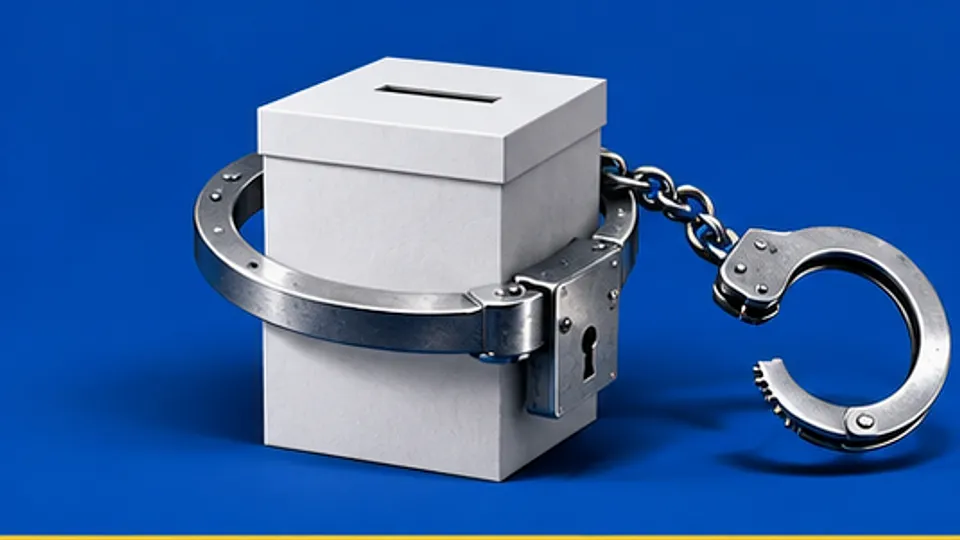
The California Supreme Court has told a sheriff to return 650,000 ballots he took from Riverside County, and to stop investigating them. The ballots were cast in a 2025 special election on a state redistricting referendum. Sheriff Chad Bianco seized them in March, on a warrant, to investigate allegations of vote “discrepancies” — allegations that had already been debunked. The court said the seizure was unlawful and that Bianco had broken the law by ignoring orders from Attorney General Rob Bonta, who had told him to wait, according to CNN’s reporting on the case.
The timing put election officials everywhere on edge. Bianco’s raid came on the heels of an FBI search warrant in January that took 2020 ballots from Fulton County, Georgia — the county at the centre of President Trump’s false claims that his defeat was rigged. Trump has since instructed the federal government to make voter probes a priority. Both seizures concerned elections already over. The fear was the next one would not be: that agents, federal or local, would come for live ballots while the 2026 vote was still being counted and certified.
The court saw the fear plainly. “Allowing law enforcement unfettered access to ballots, or the ability to handle and count them in secret based on unregulated protocols, itself creates a substantial risk to election integrity,” it wrote.
Bianco’s plan, had he been allowed to proceed, was to have his own investigators recount the ballots. His lawyer told CNN in March the office had consulted “experts” and looked at “protocols,” and declined to say more. The sheriff, who was running in a GOP primary in which Trump’s endorsement was still up for grabs, responded to the ruling with a video. The court, he said, had “ruled against lawful investigations,” and he was weighing an appeal to federal courts. “When reasonable evidence is brought to law enforcement and lawful investigations are shut down by the courts, how do you expect people to have faith in our systems,” he asked. The opposite question cuts harder: what faith survives a sheriff counting other people’s votes in private?
What the ballot box has to do with custody
Election officials worry most about the chain of custody. State and local rules set out strict procedures for handling ballots, on purpose: a ballot that passes through unnamed hands, by unregulated methods, stops being proof of anything. Hand the box to a sheriff and you may get the box back. You do not get the proof back.
That is why the response since the two seizures has been brisk. California’s legislature passed laws narrowing the circumstances in which law enforcement can obtain ballots, and making it a crime to take part in an unlawful removal of ballots from election officials’ custody. California and Connecticut now also require local officials to notify the state quickly if they learn of a warrant or other action targeting election materials. Several states instruct local administrators to raise the alarm if investigators demand voting materials.
Judges have been drawn in, too. Richard Hasen, an election law professor at the University of California-Los Angeles, published a white paper with other scholars and former judges to guide bench officers weighing applications for ballots. One recommendation is simple: give investigators copies, not the ballots themselves, so custody is never broken. Election law scholars have been briefing judges on the same point.
A California case with a national echo
The ruling binds California’s lower courts and no one else; other states have different laws. Justin Levitt, a Loyola University law professor who has worked on voting issues for Democratic administrations, nonetheless told CNN that the fight and the “clarity” of the decision will travel. “I don’t think there’s a magistrate (judge) in the country who’s going to not think twice about a search warrant” related to elections, he said.
“Election officials are planners. And so, they have to consider possibilities even if they’re not going to happen — to be ready in case they do,” said David Becker, a former Justice Department voting section attorney who now advises election administrators of both parties. “They’re considering wild possibilities that they wouldn’t have had to before.” Tammy Patrick, a former Maricopa County election official now with the National Association of Election Officials, described administrators meeting with attorneys general and county and city lawyers “to make sure everyone understands who actually has authority” over each stage of the vote.
Bonta’s office, which has led litigation against Trump’s efforts to meddle in election administration, says it is in conversation with other states ahead of the midterms. “This is a time for sharing best practices to flagging threats and risks to our shared democratic election system, and to be prepared across state boundaries for what might come next,” Bonta said this week.
The silver lining, officials in other states told CNN, is that the tactic was first tried in a state ready to fight it in court. Becker thinks the episode and the answer to it will deter copycats. “I think it’s nearly impossible we’re going to see another one of those, particularly in the post-election environment,” he said, adding that officials are preparing anyway. November will test which of the two men is right.