
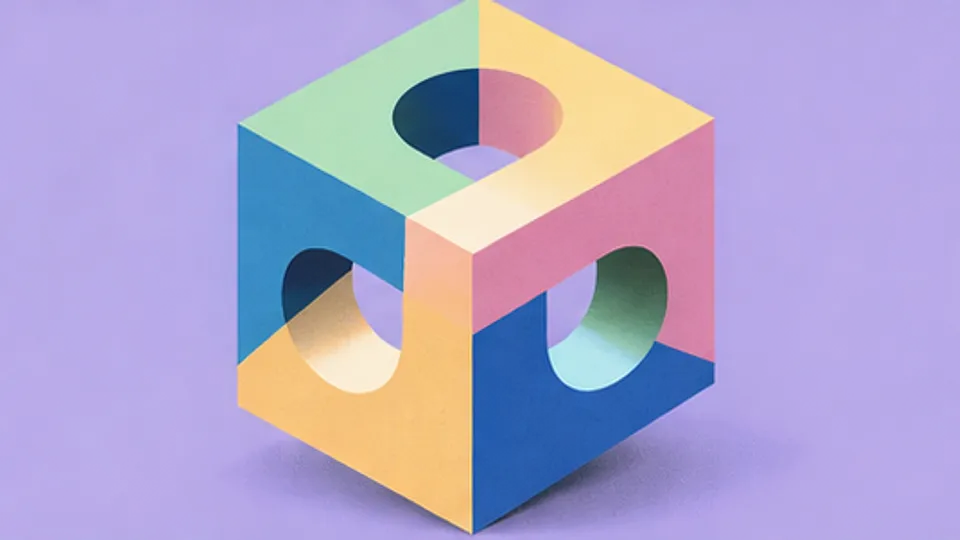
The polyhedron people — and they are a particular breed, hunched over brass polyhedra and Mathematica notebooks since Plato — have a favourite parlour game. Draw a map of faces: this one touches that one, that one touches the next. Then ask the murderous question: can you actually build it? Out in three-dimensional space, where every face must lie flat, every edge must meet its neighbour, and nothing is allowed to pass through anything else? Mostly, the answer is a shrug and a grants proposal.
So now comes Ruslan Mizhaev — not a professor, not a department, an independent researcher and design engineer — with a shape out of the very small club of solids where everybody knows everybody. Eight flat faces. Each of them nine-sided. Each one shares an edge with all seven of the others. Twenty-four vertices, 36 edges, three faces meeting at every vertex, and the whole thing looped into a closed surface with three handles — three holes, like a pretzel that went to finishing school. A genus-3 polyhedron, in the lingo, where ordinary folk say doughnut for genus-1.
There are eight flat, polygonal faces, and each is a neighbour of all seven others along an edge. Together, they form a closed surface with three handles.
The family resemblance runs to the tetrahedron — four faces, all mutual neighbours, schoolchild stuff — and to the celebrated Szilassi polyhedron, the seven-faced curiosity in which every face also touches every other. Mizhaev’s contribution comes with a wrinkle the old guard didn’t have: some of his face-pairs share two edges rather than exactly one, which is where the thing stops being a footnote and starts being a construction problem from the bad end of the dream factory.
Here is the lovely part, and Mizhaev says it himself: he was not hunting this animal. He was mucking about with polyhedral surfaces in computer-aided design software — CAD, the draftsman’s digital workbench, not the geometer’s ivory tower — when the all-neighbours property simply turned up. The underlying structure, he points out, is something he first described back in 2020. What is new now is the certification: all 24 vertices pinned down with integer coordinates, plain whole numbers, along with the equations that let any other mathematician check the work. Are the faces flat? Does the surface actually close? Does anything intersect where it mustn’t — the classic way these constructions fall apart in the night? Now anyone can look.
The Gatekeeper Shrugs — Politely
Lars Schewe at the University of Edinburgh, asked to weigh the find, performs the ancient academic ritual of damning with measured approval. Interesting, yes. A brand-new era, no. “It’s more a small piece that we didn’t have before,” he says — it overturns no conjecture, settles no grand question. But then the actual practitioner in him surfaces: “constructing these has always been a difficult task.”
Difficult how? Schewe lays it out. The brute-force route means writing down an enormous system of equations — where every vertex may sit, how every face must fit — a haystack of algebra that quickly becomes practically impossible to solve. So researchers fall back on computer searches, on geometric intuition, on building physical models and hoping. This, note, is the state of the art at the summit of human mathematics: gaffer tape and divination.
And here the story takes its unmistakably 2026 turn. Mizhaev used ChatGPT — the very chatbot your nephew uses for homework — to help with some of the verification calculations and to write the Python scripts for the new integer-coordinate version of the shape. He is careful to add that the original 2020 construction predates his turning to the machine. The eagle was eagle-eyed first; the software arrived for the paperwork.
Schewe, for his part, closes with the confession that is really the whole story of this corner of mathematics. The rules can be stated in an afternoon. The object is another matter entirely. “I can tell you these are the rules,” he says. “But when I try to build it and I try to draw it, I can’t do it.”
Mizhaev can. Eight faces, nine sides apiece, three holes straight through the middle, every face shaking hands with every other — and the coordinates, gloriously, nothing fancier than whole numbers you could read off a carpenter’s tape.