
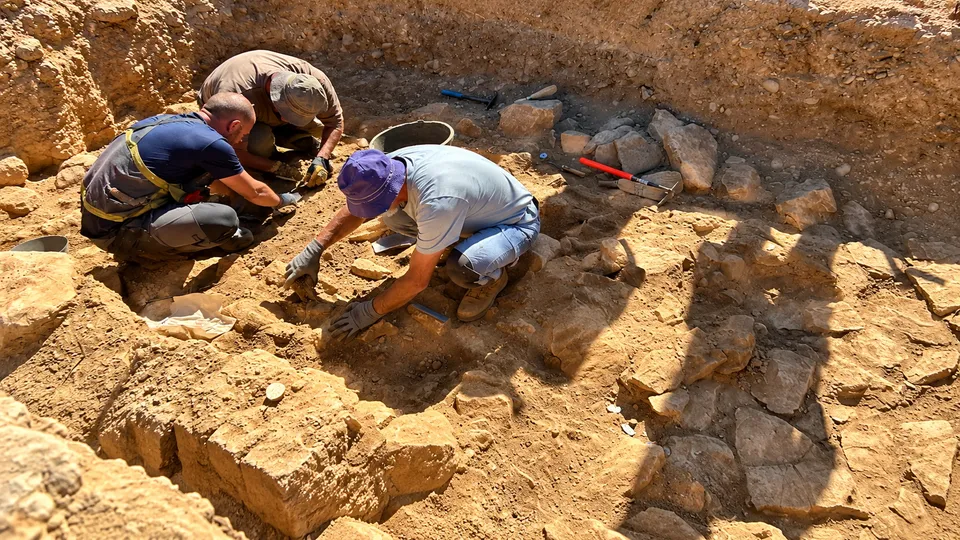
Archaeologists in North Macedonia have dug up a 2,600-year-old grave at the Rasnica necropolis, near the village of Koroshishta outside Struga, close to Lake Ohrid. According to Arkeonews, it held a bronze helmet, a shield, a sword and several spears, plus bronze vessels, a silver pin, amber and glass beads, a gold ring and other things made of valuable materials. It may also have held a thin sheet of gold that once covered the dead person’s face. The National Archaeological Museum announced the find, and the results were [presented at a press conference in Ohrid](<https://albeu.com/english/6th-century-bc-military-tomb-discovered-near-koroshishta-struga/1040545/>) on October 5.
Pero Ardžanliev of the museum, who directs the project, called it an exceptionally rich Archaic grave whose occupant was buried with a complete set of weapons. He also said it appears to be older than the rich tomb found at the same site in 2024. Macedonian outlets [reported](<https://www.vecer.press/arheolozite-otkrija-bog-vojnichki-grob-so-zlato-i-so-oruzhje-od-6-vek-kaj-strushkoto-selo-koroshishta/>) that he based this on the material and on a preliminary dating analysis.
One tomb is an anecdote
The age matters, and here is why. The 2024 discovery was a monumental burial complex roughly seven meters by 4.5 meters, about 31.5 square meters of grave, holding more than 100 Late Archaic artifacts. They included a bronze helmet decorated with gold applications, a bronze shield, gold rings and foils, amber and glass beads, silver pins, a silver kantharos (a drinking cup), bronze vessels and terracotta figurines. That is a spectacular find. But a single spectacular grave is open to a deflating reading: maybe one rich family, one unusual funeral, one outlier on an otherwise quiet hillside. Two rich graves, the second apparently earlier and carrying an almost complete arsenal, are much harder to explain away. Now you have a cemetery with a history.
The museum says so in fairly unambiguous terms. In one English rendering of its announcement, the results [“unequivocally confirm Rasnica’s character as a necropolis from the Archaic period.”](<https://albeu.com/english/6th-century-bc-military-tomb-discovered-near-koroshishta-struga/1040545/>) It now describes Koroshishta as one of North Macedonia’s most significant newly discovered Archaic-period archaeological complexes. And, in the paragraph that I suspect matters most to the people involved, it wants the digging to continue as a long-term systematic project, and heritage authorities have said they will ask the government for sustained funding for excavation, conservation and study.
I don’t say that cynically. Imagine you run a national museum and go to the finance ministry with one extraordinary tomb. The ministry can reasonably say congratulations, here is a grant, please put it in a display case. Go back two years later with a second, older grave a short walk from the first, and you are no longer asking for money to finish a find. You are asking to fund a site. Archaeology works on the same pitch-deck logic as everything else: one data point is a story and two are the start of a trend line.
The gold that nobody will name yet
The most tantalizing object is the one the archaeologists are most careful about. Next to the shield they found a thin gold sheet that, they think, may originally have been laid over the deceased’s face. If that holds up, it would be a gold funerary mask or face covering. But the foil is extremely fragile and has not yet been conserved, so the team is not committing to an identification until specialists can work out its original shape and construction in the lab.
There is a reason for the caution, and a reason for the excitement. Gold placed over the face, eyes or mouth is one of the signature features of elite Archaic burials in parts of the Balkans. Rasnica is only about five kilometers from Trebeništa, the famous necropolis whose wealthy graves produced gold funerary masks along with jewelry, weapons and imported vessels. Ardžanliev noted that preliminary observations may even put the Rasnica foil earlier than comparable material from Trebeništa. That would be a significant claim, which is exactly why nobody is making it yet.
Trebeništa’s graves were first found in 1918 by [soldiers repairing a road](<https://en.wikipedia.org/wiki/Trebeni%C5%A1ta>). That turned up a lot of gold, but it is a long way from modern excavation practice. Rasnica’s value is that it is being dug properly. The position of every object, the way the graves were built and how the different parts of the burial ritual relate to each other can all be recorded. A gold mask in a museum case tells you that someone was rich. A gold sheet found lying beside a shield, in a documented grave, next to another documented grave, can tell you how they wanted to be seen.
Who was this, exactly?
Nobody knows yet, and the team says so. “Warrior burial” is an inference from the equipment. Anthropological analysis has not yet established the person’s biological sex or age. Researchers also want to know whether they suffered from any diseases, and whether they were biologically related to the person in the 2024 tomb. The museum says the full weapon set should let researchers look more precisely at the status, identity and military role of some of the people buried at Rasnica.
The broader picture is a wealthy region. Archaic burials have also been investigated at Radolišta and nearby Delogožda, which suggests that affluent communities lived around the Ohrid-Struga basin well before the better-known kingdoms and cities of the Classical and Hellenistic periods. In the sixth century BCE, goods, technologies and ideas were moving through the Balkans, and elite graves there mixed local burial customs with prestige objects and artistic styles circulating through Macedonia, the Aegean and the wider Mediterranean. Amber, precious metals, fine bronze vessels and elaborate weapons were how a person displayed status and connections.
Arkeonews makes a sensible point about what all this can and cannot prove. The finds are better read as evidence of a powerful local elite than squeezed into ethnic or national categories that may not have existed in the same form 2,600 years ago. In a part of Europe where the question of who the ancients “really” were can still get political, that is a fairly brave thing for an archaeology site to say out loud.
Anyway, the deceased went into the ground with a helmet, a sword, several spears and possibly a gold face. What they may contribute most to the people of Struga 26 centuries later is a line in the budget.