
Of the three great pieces that lifted a space shuttle off the ground, only one was built to die. The orbiter came home. The solid rocket boosters were fished out, refurbished and refilled. But the external tank, 154 feet (47 meters) of it, fed propellant to the orbiter’s three main engines, was cast off, and broke apart as it fell back through the atmosphere. Every flight, a new one. Every flight, a loss.
One flight-worthy tank outlived the program. It is called ET-94, and it now stands upright in Los Angeles with Endeavour fixed to its side, inside the Samuel Oschin Air and Space Center, the California Science Center extension that opened on November 13. The person who made its skin look the way it did on a launch pad was neither an engineer nor a curator. She is a sculptor, as Robert Pearlman reported for collectSPACE, in a story carried by Ars Technica.
The tank that was set aside
ET-94 was a so-called lightweight tank, finished just as NASA was moving to a super-lightweight model, and so it was put to one side. It had been meant for a science mission on Columbia. Then came 2003. The tank’s insulating foam, sprayed on to shield the orbiter from the deep cold of liquid oxygen and liquid hydrogen and to slow the propellants’ boiling away, had a habit of shedding during ascent. Foam that broke loose caused the loss of Columbia and its crew.
After that, the tank built for Columbia’s mission was turned into an instrument for understanding Columbia’s destruction. Its foam was stripped off and tested.
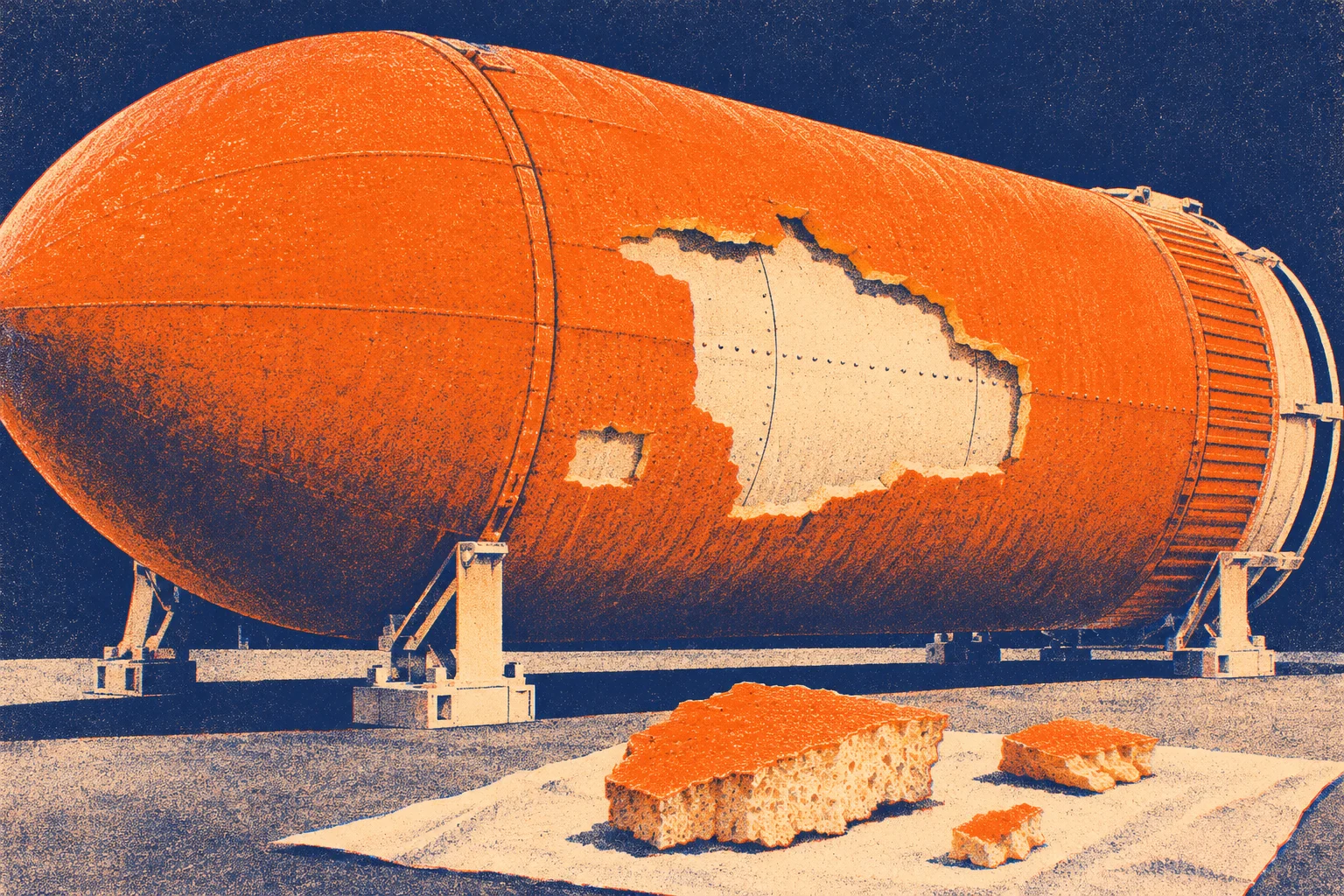
Here is a small reflection, offered as nothing more: great institutions learn by cutting things open, and what they cut open is rarely put back together. When the program ended, NASA donated ET-94 to the California Science Center. It came across the ocean on a barge, then by road, and then it waited at Exposition Park for nearly a decade, wearing its wounds.
“So much of the foam on the ET had been dissected and removed during its time as a test article that they [the California Science Center] were trying to figure out how to put it back on and blend it in to the original foam in a convincing way,” Natalie Rosen said.
A stranger among engineers
Rosen had never worked on an aircraft or a spacecraft. Many of the people around her on the Endeavour project over the past several years were former NASA technicians and engineers. She came from somewhere else entirely.
“My background is in the fine arts. I have my bachelor’s and my master’s in fine arts from Cal State Long Beach,” she told collectSPACE. “When I came in on this project, they were looking for a sculptor, and I had been sculpting.” Her thesis work had been in mixed media, and she knew how to shape foam. The museum, as it turned out, had a great deal of foam to shape.
Orange, cream, burnt sienna
Shuttle enthusiasts and model builders have argued for years over the true color of the external tank. Rosen’s answer is that there is no single one.
“It’s orange. It’s cream. It’s burnt sienna. It just depends on the original foam, when you’re seeing it and how it’s aging. Because it starts as a kind of very ice cream-white almost color, and then depending on how long it sits out in the Sun, it turns orange.”
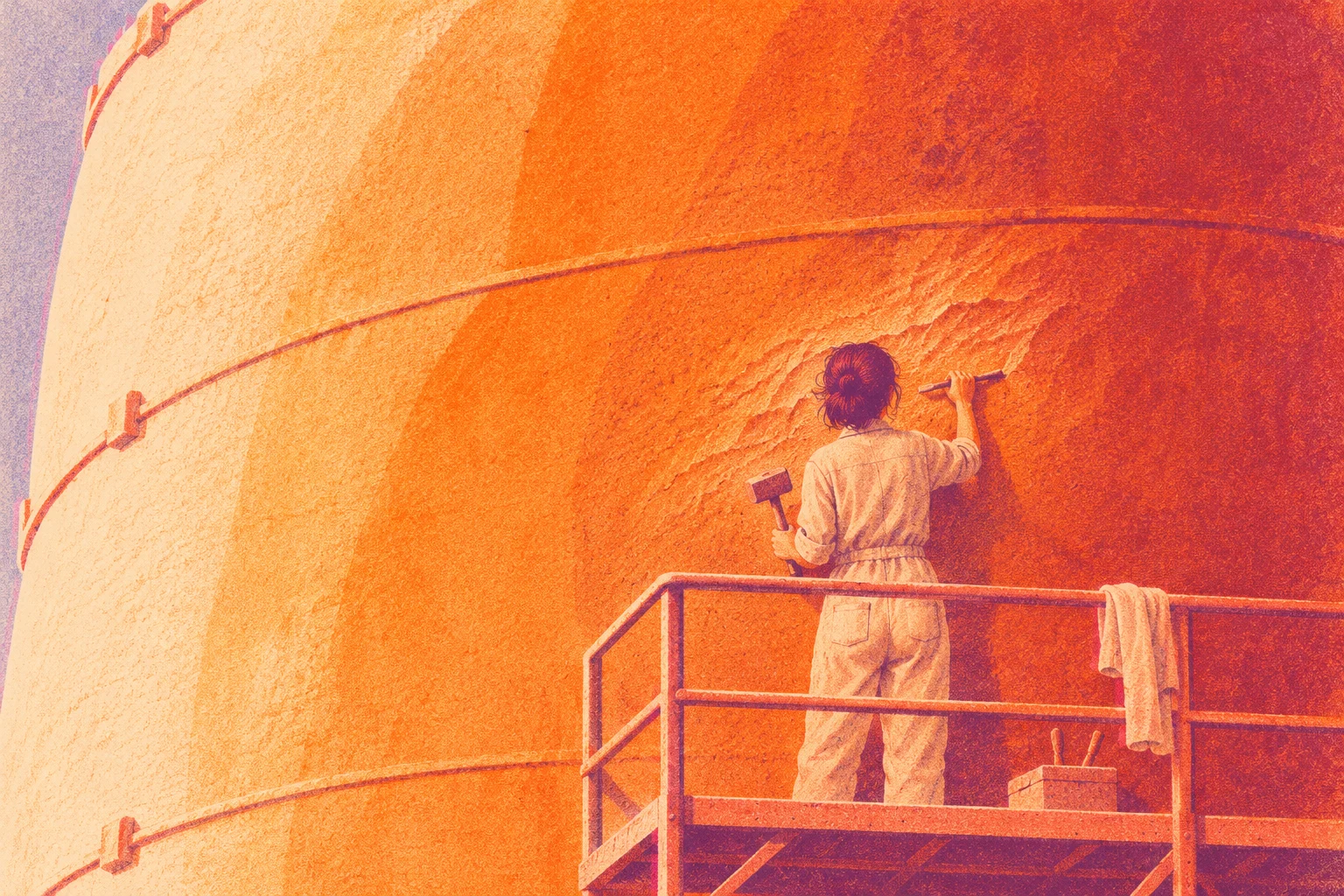
Most of the color decisions were settled before she arrived. Dennis Jenkins, who led the Endeavour project, had mixed a paint called “ET Orange” for the bumpy acreage foam that covers most of the tank, and a mocha-like shade had been chosen for the intertank. The newest foam, on the closeout hardware (feed lines, ice frost ramps, the flanges around the intertank and the intertank rings), got the palest custom mix of all. “That was what we called the ice cream color,” Rosen said.
Color was the easy part. For multiple reasons the original aerospace-grade foam could not be used, so a commercial substitute had to stand in, and it had to carry the surface Rosen calls the “orange peel.” Look closely at the tank, she said, and there is a bumpy texture with a pattern left by the way it was sprayed in manufacture: “There’s this overlapping line, a subtle-like stripe to it.”
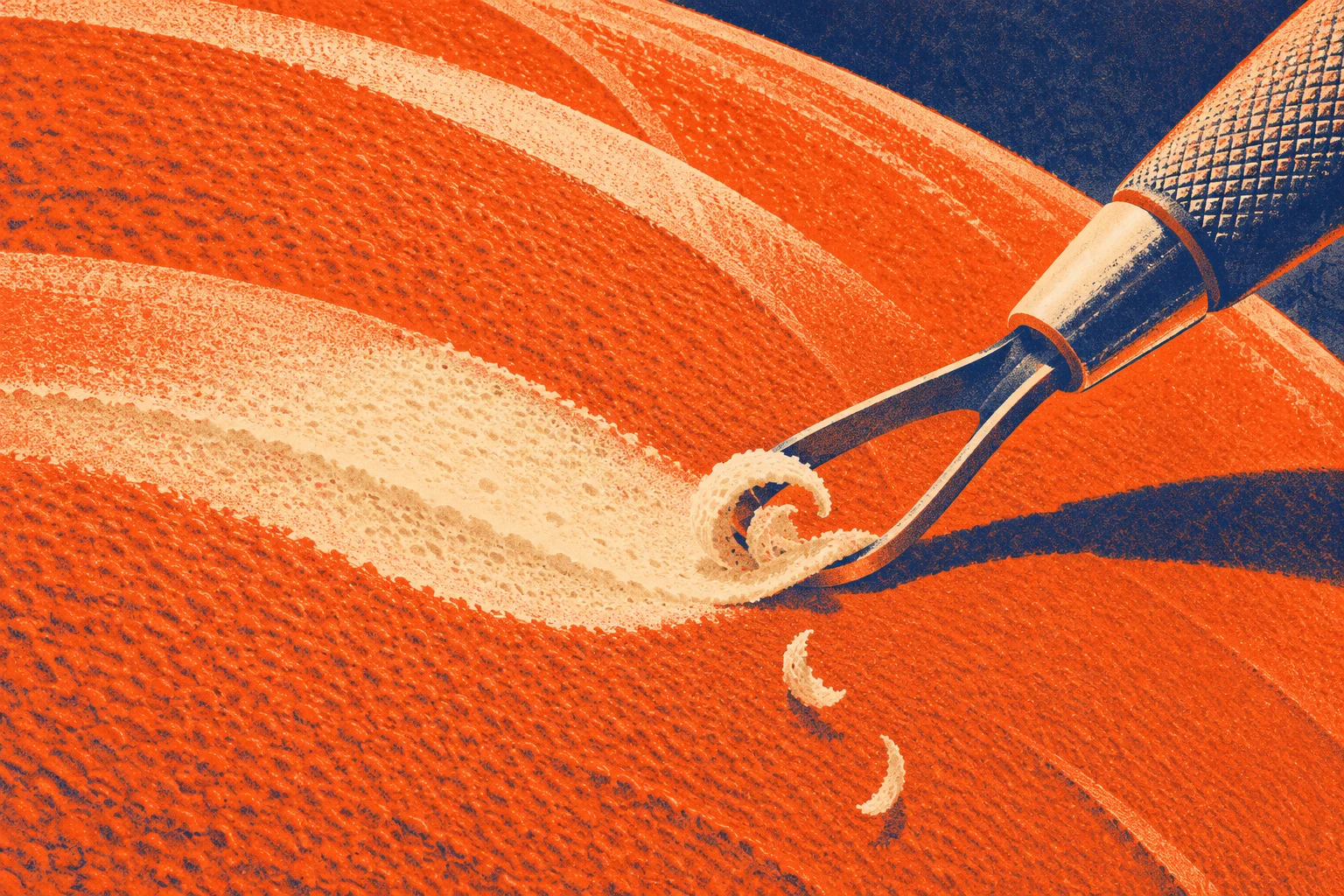
The first attempts failed. “We tried taking impressions off of the real foam and making molds and casting, but that didn’t really work,” she said. Her proposal was simpler and slower: lay in dense plain urethane foam and carve its top by hand to match the original around it. That became the method for repairing the acreage foam.
Jenkins, a former shuttle engineer who led NASA’s delivery of the orbiters to their museum homes, did not stint on praise. “She had to come up with a lot of new processes because we couldn’t apply foam the same way they did at Michoud. It’s not flightworthy by any means, but just coming up with how to make it look real took a lot of imagination on her part, and she was pretty much a one-woman show for most of it,” he said.
Up the ladders
Part of the repair was done before a crane lifted the tank into the building and mated it with the boosters and the orbiter. After that, the work went vertical, and so did she.
“It’s definitely the largest art project I’ve ever worked on, and, I mean, I touched every inch of it,” Rosen said. “Once it went vertical, I was going up and down stairs. Probably the scariest was the point in the scaffolding where it just became ladders. So I had to be very, very careful and calculated in what I was doing.”
The scaffolding came down ahead of the opening. Even then she was not finished: a couple of weeks before, she went up on a scissor lift to install one last piece on the aft dome of the liquid hydrogen tank.
The museum’s own timetable had stretched, too. When stacking began, CBS Los Angeles reported that the new center was not expected to open until 2025 and put its budget at $400 million. It opened in November 2026. Meanwhile the industry that once threw away a tank on every flight is still chasing the fully reusable rocket, as SpaceX’s attempts to catch Starship back from orbit show.
What stays
Rosen is staying. Over the past year she has helped assemble, take apart and reassemble aircraft, made repairs to the museum’s satellites and probes, and brought in outside specialists to clean and mend thermal blankets. “They’ve offered me another position, and I’m happy to stay,” she said.
Admission to the Samuel Oschin Air and Space Center is free, but demand is high enough that visitors need timed entry tickets, booked online or by phone at 213-744-2019.