
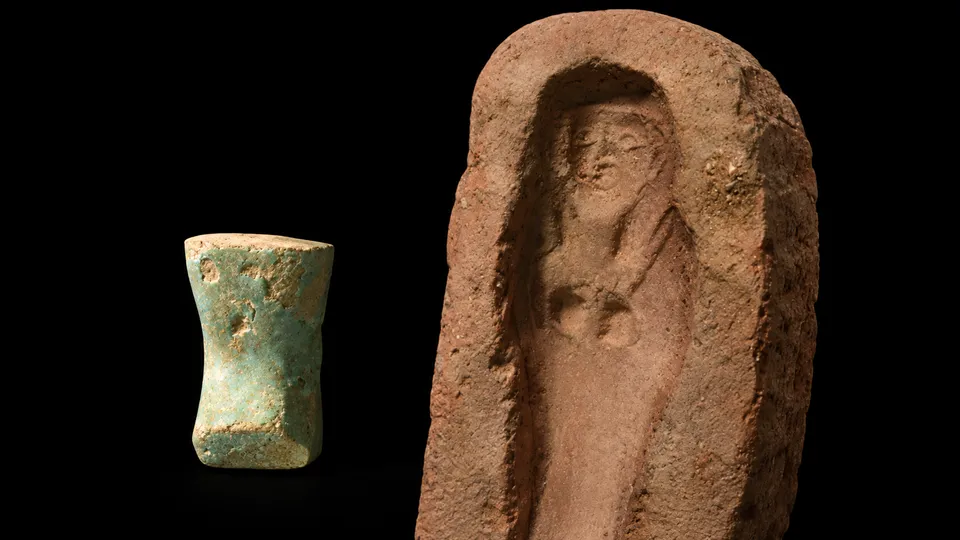
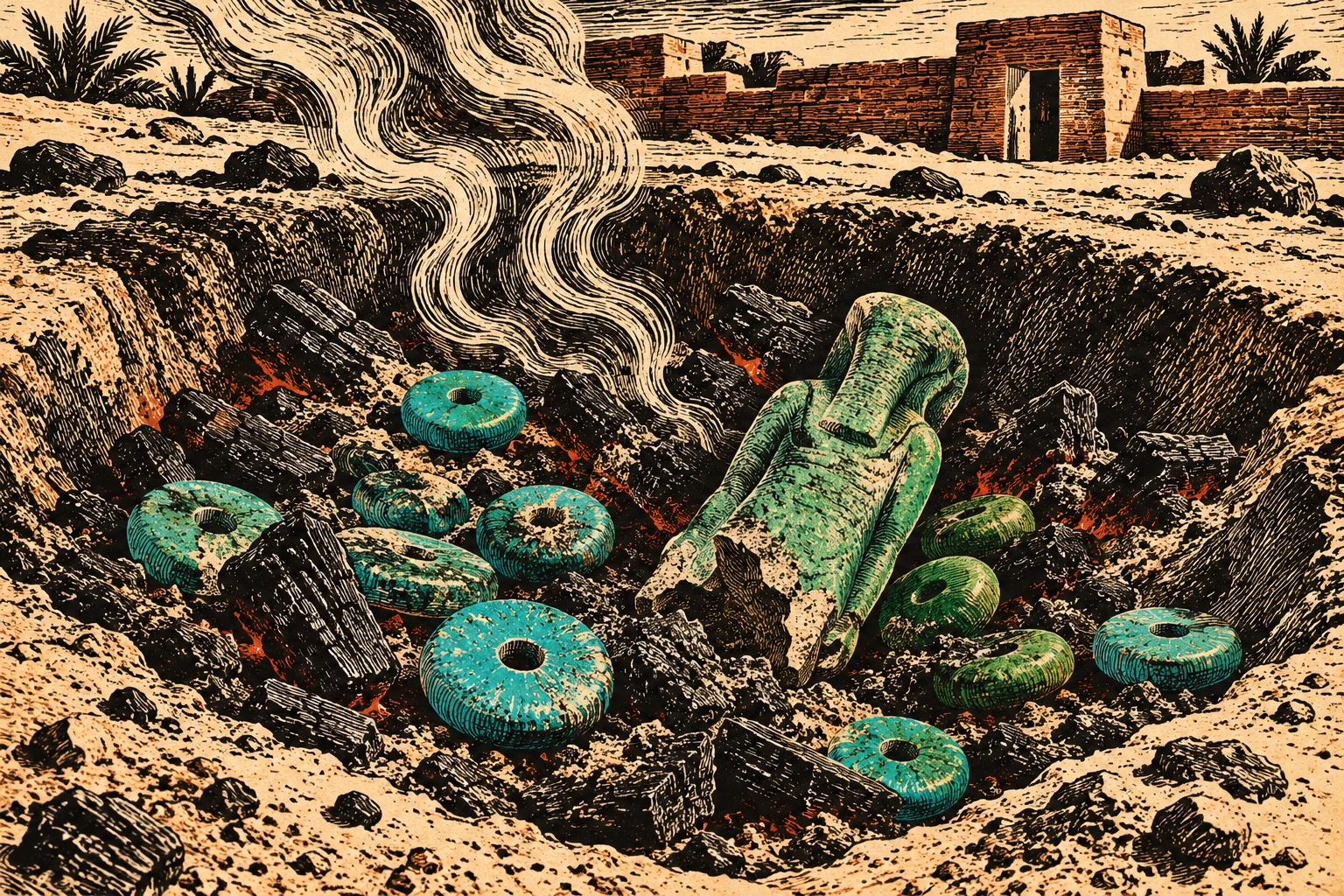
A workshop beside a temple at Napata, in what is now northern Sudan, was firing colored glass-paste objects around 2,700 years ago, in the middle of the seventh century BCE. Archaeologists excavating the site between 2018 and 2020 found three firing pits, two mudbrick basins, hundreds of blue, green and white disk beads, and a fragmentary green funerary figurine, all packed into ash deposits next to Sanam Temple. The team’s findings, led by Rennan Lemos of Durham University and Kathryn Howley of New York University, were published on 19 October 2026 in Antiquity, as Arkeonews reported. It is the first securely identified faience-production site from the Middle Napatan period, a stretch of Kushite history for which almost no manufacturing evidence has survived.
Faience is not pottery and not glass but something in between: silica mixed with alkali and a source of lime, fired at low temperature until the surface turns glassy. Firing high enough — the pits at Sanam could have reached roughly 900°C — produces the glossy blue or green finish ancient Egyptians called “that which is brilliant,” according to the study’s authors, as Phys.org reported. The technology came from Egypt. What the excavators found at Sanam is where, and for whom, Kushite craftspeople adapted it.
A temple built for an Egyptian-ruling king
Sanam Temple was built by Taharqo, who ruled around 690–664 BCE as part of the Kushite dynasty that controlled Egypt during its Twenty-fifth Dynasty, a period in which Nubia governed its larger northern neighbor rather than the reverse. The temple was dedicated to a local form of Amun and sat inside an administrative complex at Napata that included a building identified as a royal treasury, where earlier digs turned up imported storage jars and fine goods, plus cemeteries serving a population wider than the royal court. The 2018–2020 excavation, directed by Howley’s Sanam Temple Project, reopened a site that the British archaeologist Francis Llewellyn Griffith had excavated for a single season in 1912 and left largely unexamined for more than a century.
Matching molds, royal tombs
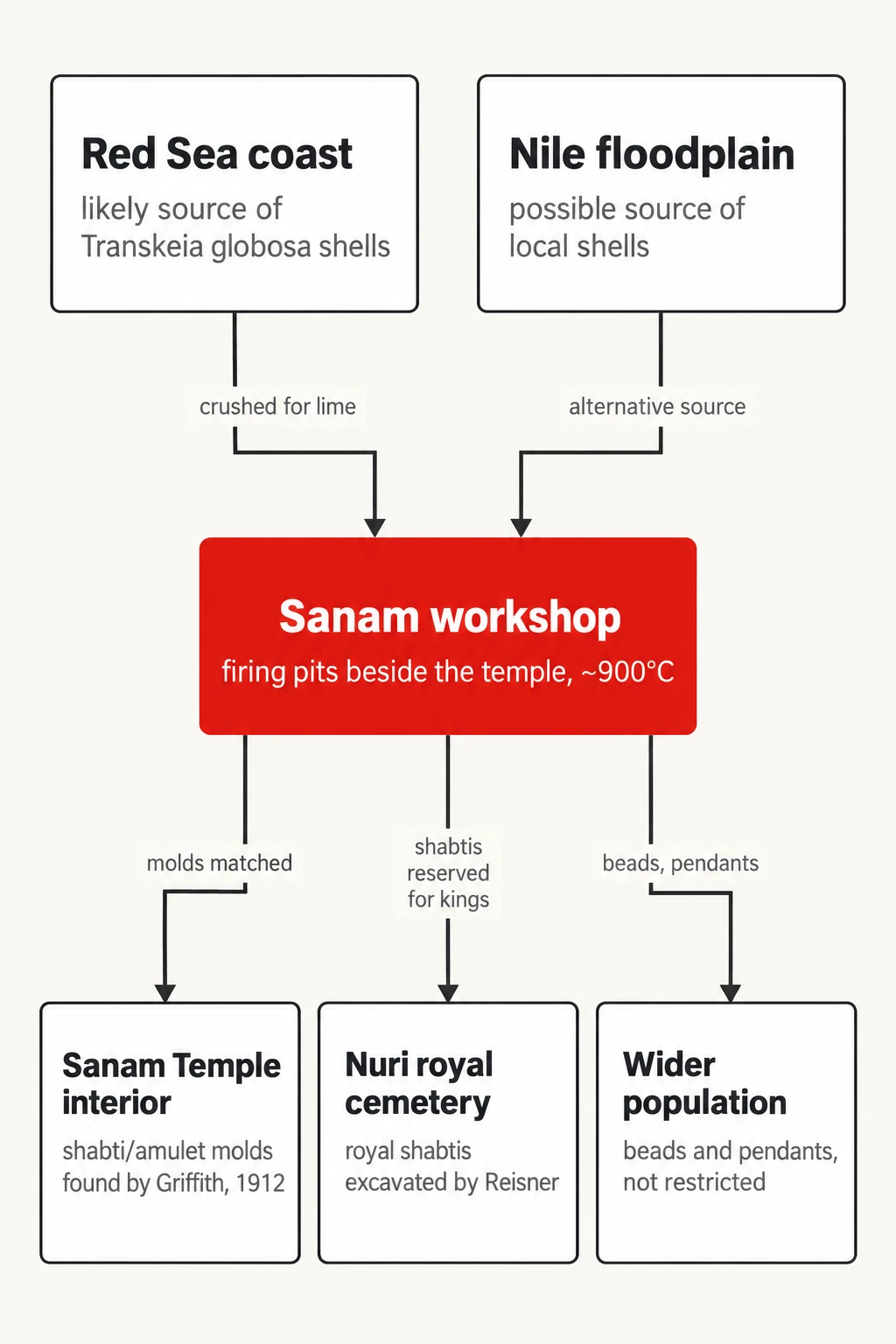
The chain of evidence linking the workshop to Kushite kings runs through a mold. Griffith’s 1912 excavation inside the temple recovered clay molds for shabtis — small servant figurines that ancient Egyptian and Nubian burial customs placed in tombs to work for the dead in the afterlife — and for amulets. The new excavation found a fragmentary shabti outside the temple that matches one of those molds, tying the workshop directly to production inside the sanctuary. The same molds, the authors report, also match faience shabtis that George Reisner excavated decades earlier from the royal cemetery at Nuri, where Kushite kings and their relatives were buried. The researchers argue this chain — workshop mold, temple mold, royal tomb object — shows Sanam supplied funerary goods made specifically for royalty.
| From | To | How |
|---|---|---|
| Red Sea coast (likely source of Transkeia globosa shells) | Sanam workshop (firing pits beside the temple, ~900°C) | crushed for lime |
| Nile floodplain (possible source of local shells) | Sanam workshop (firing pits beside the temple, ~900°C) | alternative source |
| Sanam workshop (firing pits beside the temple, ~900°C) | Sanam Temple interior (shabti/amulet molds found by Griffith, 1912) | molds matched |
| Sanam workshop (firing pits beside the temple, ~900°C) | Nuri royal cemetery (royal shabtis excavated by Reisner) | shabtis reserved for kings |
| Sanam workshop (firing pits beside the temple, ~900°C) | Wider population (beads and pendants, not restricted) | beads, pendants |
Based on Lemos et al., Antiquity (2026)
That restriction is itself a departure from Egyptian practice. In Egypt, shabtis turn up in burials across several social classes. In Napatan Nubia, the study finds, they appear confined to royalty, while other faience products — beads, pendants — circulated more widely. Access to the object tracked status more tightly in Kush than it did in Egypt, on the evidence of one workshop and two cemeteries.
A local substitute for lime
The raw-materials problem is where the adaptation shows most clearly. Egyptian faience recipes used limestone as the lime source. Limestone is scarce across much of Sudanese Nubia. Among the ash layers at Sanam, the team found thousands of small shells alongside grinding stones and production waste — material the researchers interpret as a substitute lime source, ground down to calcium carbonate rather than kept as ornament or food debris. Some of the shells belong to a marine bivalve, Transkeia globosa, characteristic of the Red Sea coast; others may be local Nile shells, and the mix between the two sources is not yet resolved. Getting Red Sea shells to an inland temple means either long-distance trade or a supply network the Napatan state had some hand in organizing. Further laboratory work that could pin down the shells’ origin has been blocked: the ongoing war in Sudan has prevented the team from re-examining the material, the authors told Arkeonews.
| Aspect | Egypt | Kush (Sanam/Nuri) |
|---|---|---|
| Shabti access | Multiple social classes | Royalty only |
| Workshop location | Edge of settlements | Beside a major temple |
| Lime source | Limestone | Crushed shells (Red Sea and/or Nile) |
| Basis of state power | Land and agriculture | Production of prestige goods |
Temples as factories
Firing faience is a smoky, smelly business, which is why Egyptian workshops typically sat on the edges of settlements, away from anything the smoke might bother. Sanam’s workshop sat immediately outside a major sanctuary instead. Lemos argues the choice was deliberate: “This evidence demonstrates that Sanam Temple was not simply a religious monument but also a center of state-controlled production. The workshop produced faience objects associated with royal power, including shabtis destined for the royal cemetery at Nuri.” The temple’s own inscriptions record Taharqo moving people and resources after military campaigns, and the researchers think some of the people attached to the temple may have staffed the workshop, though their identities and working conditions are not recoverable from the archaeological record.
The argument Lemos and Howley build from firing pits and shell fragments is about where Kushite royal authority actually sat. Egyptian kingship is usually described through control of land and grain. The Sanam evidence points to a different lever: controlling the shells that came from a distant coast, the labor that worked them into shabtis, and the rule that decided who got to be buried with one. “Rather than merely adopting Egyptian cultural practices,” Lemos told Phys.org, “the Kushites selectively adapted foreign technologies and ideas, developing their own production methods and creating objects that carried specifically Kushite social and political meanings.” Whether that pattern holds at other Napatan temple sites, and whether the shells really traveled from the Red Sea rather than the nearer Nile, are questions the paper leaves open — and that the war in Sudan has, for now, left unanswerable.