
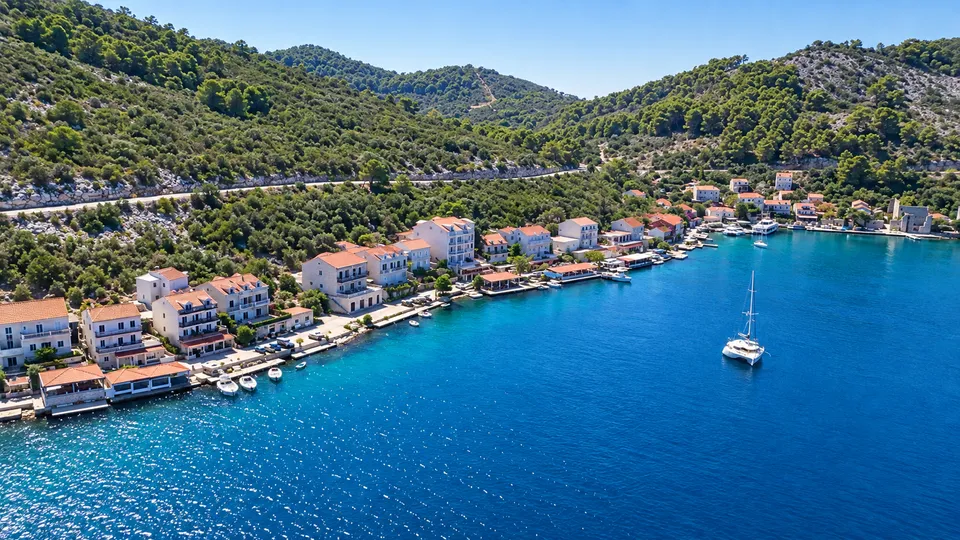
On the Croatian island of Mljet, the ruins of a Late Antique palace stand beside one of the most sheltered bays in the Adriatic, much as they have for roughly 1,500 years. What has changed lately is the emerging understanding that the interesting part of the property was always the waterfront.
Underwater archaeologists working in Polače Bay have been piecing together the infrastructure that tied the palace to the sea: a substantial stone quay with a working waterfront, a large submerged structure identified as a fishpond, and centuries’ worth of pottery and coins scattered across the bay floor. The latest campaign, run from April 6 to 26 this year and led by Igor Miholjek of the Croatian Conservation Institute alongside German and Slovak partners, had a specific target: find the Late Antique shoreline that once ran between the quay and the fishpond and connected the whole complex.
They did not find it. But the absence was informative — the evidence gathered, the researchers say, supports the conclusion that the quay and the fishpond both date to Late Antiquity and formed part of the palace complex. Which rewrites the character of the ruins on land. This was not merely an aristocrat’s villa with a view; it was a working coastal estate whose daily operations ran through the water in front of it.
What the bay was for
The geography explains the logic. Polače sits in a naturally protected bay on Mljet’s northwestern side, off Croatia’s southern Adriatic coast — safe anchorage out of the wind, along an important maritime route. Ships arriving through the southern Adriatic could enter calm water close to the palace; the quay, first investigated in the 1970s and now mapped in much finer detail, is where cargo and people came ashore. Regular stone blocks and abundant Roman and Late Antique material around the structure confirm heavy use where vessels could approach.
The fishpond, documented during surveys in 2022 where a shoal meets the coast, fills in the domestic side of the picture. The quay shows how goods arrived; the pond shows how the estate managed its food supply. In one work area, Sector 4, finds again pointed to intensive activity between the fourth and sixth centuries. The land-based complex — the palace itself, two Early Christian basilicas dating to the fifth and sixth centuries, baths, economic buildings — turns out to be the bit of the settlement that happened to stay dry.
The objects recovered over the years make the harbor legible as commerce rather than plan. The finds include fine and coarse pottery, North African bowls and amphorae, red-slipped vessels, decorated plates, Christian lamps and numerous bronze coins from the Constantinian period, plus an especially striking older piece: a gold solidus of the Byzantine emperor Maurice Tiberius, who ruled from AD 582 to 602. Anica Kisić’s study of material from the 1975 underwater campaign identified lamps imported from across the Mediterranean — two well-preserved examples of African types associated with North African production, others with parallels in Greece and Asia Minor. Somewhere in the fifth and sixth centuries, this sheltered bay was a significant port plugged into trade routes spanning the whole sea.
Two mysteries, 5,000 years apart
Who built such an elaborate residence has long been debated. Archaeologist Igor Fisković has argued that much of the monumental complex developed during the fifth century, with possible links to Ravenna and the politics of fifth-century Dalmatia. Those remain hypotheses, Arkeonews notes, though the scale of Polače among Late Antique complexes on the Croatian coast is exceptional by any account.
And then there is the find that doesn’t fit the palace at all. During earlier work in Sector 5, on a submerged shoal elsewhere in the bay, researchers recovered fragments of Neolithic pottery. The Croatian Conservation Institute says the fragments make it possible to suggest a Neolithic settlement once stood on that shoal — though no such settlement has been confirmed by further excavation, and the sector has for now been excluded from additional investigation. Careful wording, and worth keeping: there is not a discovered Stone Age village under Polače Bay. There is pottery that suggests people occupied this coastline thousands of years before anyone thought to build a palace here.
Which leaves the bay holding two unanswered questions at opposite ends of its timeline. Somewhere beneath the modern waterline is the missing Late Antique shore that connected the quay to the fishpond, the seam of the 1,500-year-old waterfront; the rising sea took it, and the divers will keep looking. And somewhere under a shoal in Sector 5 is whatever left Neolithic pottery behind. The palace, for centuries the obvious monument at Polače, is starting to look like the middle chapter of a much longer lease on the same good harbor. People worked out early that this was the sheltered spot on the route. The palace builder was simply the most recent to have the masonry budget.