
Even in death, the respectable citizens of Roman Egypt hedged their cultural bets. A newly uncovered tomb in the Dakhla Oasis, deep in Egypt’s Western Desert, greets the visitor with hieroglyphic funerary spells in the old pharaonic style—then commemorates one of its occupants in a 19-line poem written in ancient Greek, laid in red ink beneath a carved sun disk. A bronze coin bearing the image of the emperor Constantine completed the ensemble.
The discovery, announced by Egypt’s Supreme Council of Antiquities and reported by outlets including Ahram Online, was made by an Egyptian archaeological mission at Bir Al-Shaghala, part of the ancient necropolis of Mothis. Mothis was the capital of Dakhla Oasis in the Ptolemaic and Roman periods; its settlement corresponds to the modern town of Mout, and the site’s present name comes from a local water well. According to the council, the tomb belonged to a man and his wife and dates to the Roman period.
Whoever built the monument reached for much older Egyptian forms. A staircase of 14 steps descends to a sandstone entrance carved with hieroglyphic texts containing protective funerary spells and recitations. Above the doorway sits an Egyptian-style cornice decorated with a winged sun disk flanked by two cobras, followed by an architectural element resembling a bundle of reeds. The doorway itself was sealed by a stone slab decorated with Osirian imagery and surrounded by further spells.
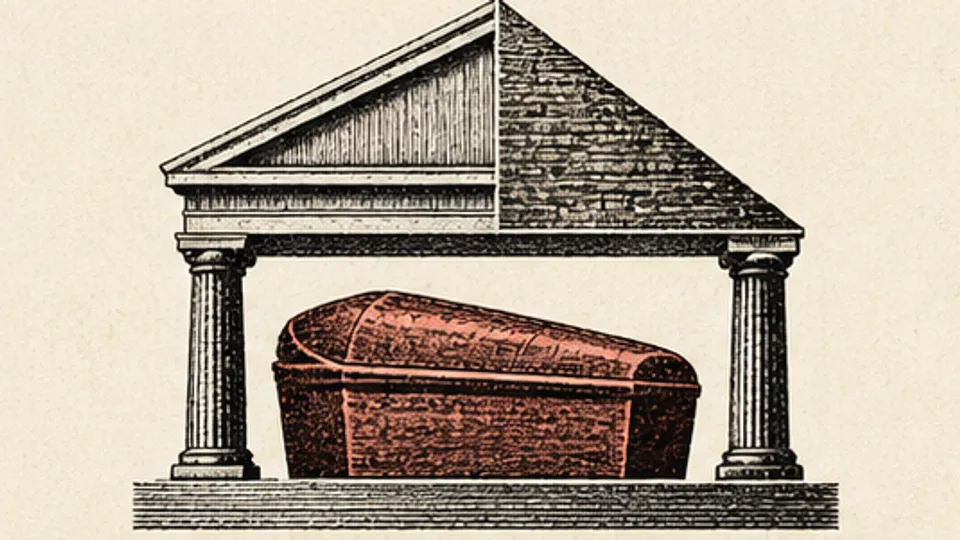
Beyond the slab lies a transverse mud-brick hall with a vaulted ceiling, part of which had collapsed on its western side; two plastered mud-brick burial chambers occupy the hall’s right side. Above them rose the feature that gives the monument its striking silhouette: a pyramid-shaped mud-brick superstructure. Pyramid-topped funerary monuments were already known at Bir Al-Shaghala, so the shape is not unprecedented at the necropolis. The tomb’s value lies in the combination of that architecture with the texts and imagery preserved around it.
Greek verse, Egyptian spells
On the upper lintel of the entrance, the team identified a funerary scene representing the seventh hour of the Amduat, the ancient Egyptian composition describing the sun god’s nocturnal journey through the underworld. The Supreme Council of Antiquities says this particular scene has now been documented at Bir Al-Shaghala for the first time; additional inscriptions and images connected with the tomb’s occupants extend along both sides of the lintel. The Amduat’s origins lie in the New Kingdom, more than a millennium before this burial—evidence of how tenaciously Egyptian ideas about death and rebirth survived centuries of Persian, Greek, Ptolemaic and Roman rule.
Egyptian tradition, though, was only half the story. Set into the southern wall of the pyramid-shaped structure, archaeologists found a rectangular stone funerary stele with a pedimented top, a sun disk carved in relief at its centre. Beneath it, across 19 lines of red ink, runs an ancient Greek funerary poem dedicated to a man named Psychtis. Preliminary study suggests he may have served as a judge, though the researchers have not established that identification conclusively. The team dates the elegy to the late third or early fourth century AD.
The juxtaposition is the point. Egyptian spells and imagery guarded the entrance while a Greek poem mourned one of the dead inside; rather than fitting any single cultural category, the tomb preserves traditions that coexisted under Roman rule. Objects recovered with it tell the same blended story: a sandstone offering table positioned above a purification basin of the same material, several pottery vessels, and the Constantine coin.
The find belongs to a broader local tradition. Excavations at Bir Al-Shaghala began in 2002, and successive campaigns have uncovered tombs with differing plans—some with open courtyards and staircases flanked by altars that may have served outdoor funerary rituals, others with an upper funerary shrine topped by a pyramid. Several burial chambers contain stone or pottery coffins beneath vaulted sandstone or mud-brick ceilings, their walls preserving Egyptian Books of the Netherworld alongside Greek and Roman elements. Archaeologists have suggested that the character of these monuments may indicate the necropolis served members of the elite of the oasis capital.
The tomb may also have had a second life. In its upper part the archaeologists identified a mud-brick chapel above the main entrance and a funerary shrine in front of it, supported by four square mud-brick columns. The team believes these remains may indicate a later phase of reuse, though further study will be needed to establish when and how that occurred.
Nearly 1,700 years on, the monument makes a quiet argument about identity in a remote corner of the empire. A man remembered in Greek could enter the afterlife armoured with Egyptian spells, while a Roman emperor looked on from a coin left among the grave goods. Empires changed the language of mourning; they never managed to change the destination.