
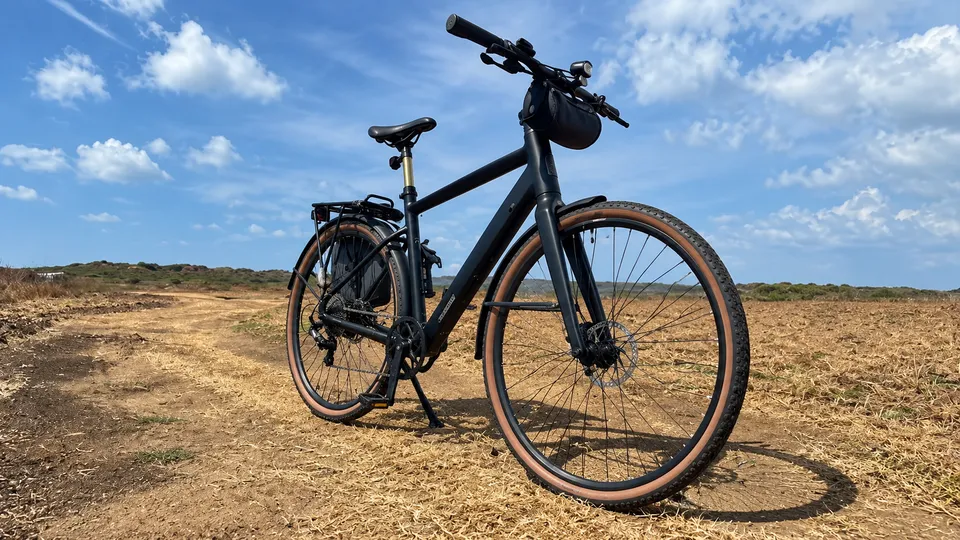
Most product reviews are deterministic: the gravel bike gets reviewed on gravel, the fat-tire bike on snow, and everyone learns what they already knew. The more interesting genre is the misuse review, in which someone takes a product built for one job and makes it do another, because that is where you find out what a thing actually is. Electrek’s Micah Toll has performed a fine specimen. He took the Ride1Up Roadster V3 — a $1,295 e-bike that is, by his own description, a budget-focused urban daily driver — on a 38 km (24 mile) ride in which he spent most of his time off-road: gravel, hard dirt, loose sand, muddy puddles and a few rocky climbs.
The adventure began on a train, which is where the bike’s one unambiguous virtue showed up. The Roadster V3 weighs 40 lb (18 kg) stock, and Toll could carry it through stations, onto the train and up escalators without ceremony. That sounds trivial until you remember that the e-bike market has drifted toward 70- or 80-pound fat-tire machines, which are less bicycles than furniture with motors. Being light enough to combine with a train is, Toll argues, a genuine adventure feature: it multiplies the routes you can reach. The rack, bags and dropper seat post he had fitted added a few pounds on top of the stock weight.
On the trails, he ran the bike in Eco mode nearly the whole time, leaning on the MiVice torque sensor, which meters out motor power in proportion to your own pedaling. His summary of the riding experience: less small motorcycle with pedals attached, more bicycle that happens to have an electric tailwind. That is also the honest caveat. The Roadster V3 is not powerful, and Toll likes it that way — but it means the rider is doing real work, and the motor is there to take the edges off.
The exception is the bike’s hidden throttle, which Toll uses the way it probably should be used on a bike like this: not as propulsion, but as, in his words, “an occasional little electric get-out-of-jail-free card.” His actual example: hitting a climb in too high a gear, blipping the throttle to hold momentum for a few seconds while getting the shifting sorted, rather than grinding to a halt. Same move he uses to dart away from cars in the city. It is a small feature with a disproportionate effect on how rideable the bike is, on pavement or off it.
The physics eventually asserted itself in the sand. The Roadster’s Continental 700x45c tires are decent multi-role rubber, but they are not four-inch fat tires, and on the loose sections Toll could feel the bike start to wander sideways under him — which, he notes, “definitely got my attention.” Momentum, finesse and, he concedes, some optimism kept the rubber side down. The dropper post earned its keep here too, letting him dab a foot on technical bits without ever fully dismounting. On gravel and hard-packed dirt, though, the bike was, he says, right at home; and the pre-ride drizzle left puddles that let him identify an underappreciated advantage the Roadster holds over many dedicated gravel bikes: fenders. Blasting through a puddle without painting a stripe of muddy water up your back is, granted, a low bar for engineering. It is also the kind of bar that matters on the actual ride.
Now the numbers, because they are the interesting part of any e-bike story. Toll rode the 38 km in about 1 hour 50 minutes and got home with roughly a third of the battery left. On city streets he typically gets around 70 km (44 miles) per charge; his extrapolated off-road range worked out to about 57 km (35 miles) from a relatively small 360Wh battery — respectable, he figures, given that sand and climbing eat batteries for breakfast. Part of that economy, he is careful to note, came from the rider: his Garmin watch estimated 696 calories burned. He takes smartwatch calorie counts with a grain of salt, but reports his legs endorsed the general figure.
So what is the verdict? Toll is admirably clear about what he did not prove. Would he recommend the Roadster V3 as a dedicated gravel e-bike? Probably not — there are bikes with wider tires, more aggressive geometry and gravel-specific components for that job, and Ride1Up sells a suspended variant that would at least sand down some of the rough edges. The point is something else: the same relatively cheap bike he commutes on, carries onto trains and rides through the city also survived nearly two hours of dirt, gravel, sand, rocks and puddles, and brought him home with charge to spare.
“For $1,295, I’d call that a pretty successful adventure.” Which is really the whole e-bike value proposition in one sentence: the bike is not the best at anything, it is just surprisingly adequate at everything, and adequacy at $1,295 beats excellence at three times the price for most actual humans.