
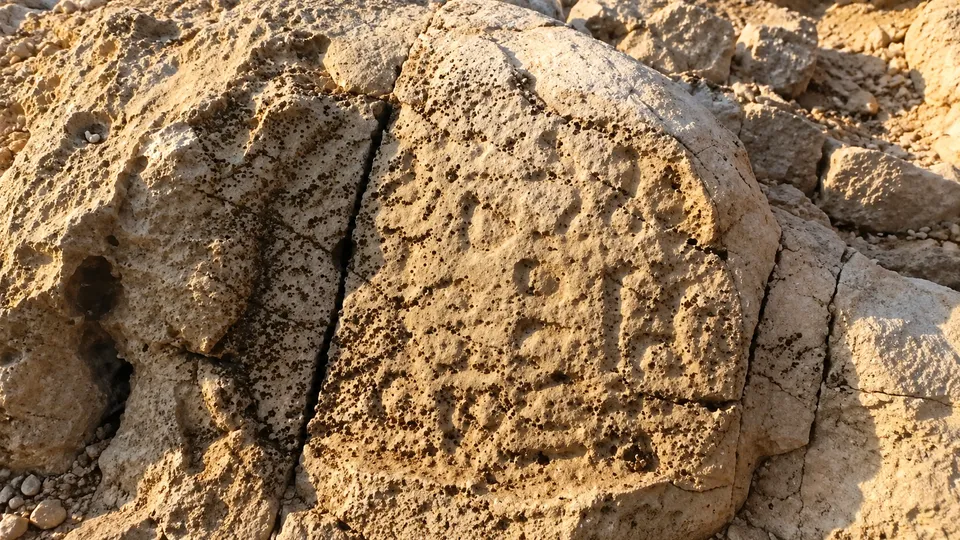
The Marvdasht plain in Iran’s Fars province has produced more than 50 Sasanian-era inscriptions, the densest cluster known from the empire that ruled Iran between 224 and roughly 651 CE, according to the historian Najmeh Ebrahimi. Make that 50-plus-one: researchers have identified a new Pahlavi funerary inscription, carved into a rock frame north of the ruined Sasanian capital Estakhr, which the archaeologist Abolhassan Atabaki has tied to a Zoroastrian burial from the empire’s final century, as arkeonews.net reported.
No full transcription or translation has been published yet. What’s established so far is the script, Pahlavi; the approximate date, late Sasanian, before the empire’s collapse in the seventh century; and the location, on the plain that also holds Iran’s largest known concentration of Sasanian funerary inscriptions specifically, per Tehran Times, which first carried Atabaki’s and Ebrahimi’s comments via the outlet Jamaran.ir. Estakhr was never the empire’s political capital — that was Ctesiphon, near modern Baghdad — but it was the Sasanian dynasty’s ancestral seat, briefly the empire’s first capital from 224 to 226 CE, and a religious center tied closely to Zoroastrian institutions, according to the summary history on Wikipedia.
Why the ground was off-limits
Zoroastrianism, Iran’s pre-Islamic state religion under the Sasanians, ranked earth, water and fire among its sacred elements, ones a corpse was believed to defile. The Vendidad, the legal portion of the Avesta, sets out purification rules built on that premise: a decomposing body contaminates whatever it touches, so ground burial fouls the earth and cremation fouls the fire. Zoroastrian communities ruled out both. Instead they exposed the dead at open-air sites, generally on elevated or rocky terrain away from farmland and water sources, and let birds and scavenging animals strip the flesh.
Underground spaces were viewed by Zoroastrians as dark, stagnant and associated with evil.
That line is Atabaki’s, as relayed by Tehran Times, explaining why Sasanian communities avoided subterranean tombs. He traces a sharpening of the pattern after the Achaemenid period and through the Sasanian era: ground burial gave way increasingly to exposure on high, rocky ground, a shift he connects to the religion’s doctrine of bodily resurrection.
A four-day itinerary
Zoroastrian doctrine held that the soul lingered near the body for three nights after death. A ritual called khorshid-negahreshni, exposure of the corpse to the sun’s gaze, carried the weight of purification during that interval. On the fourth day the soul reached the Chinvat Bridge, where its thoughts, words and deeds decided its fate — a judgment that ran in parallel to, and independent of, however long the physical decomposition took.
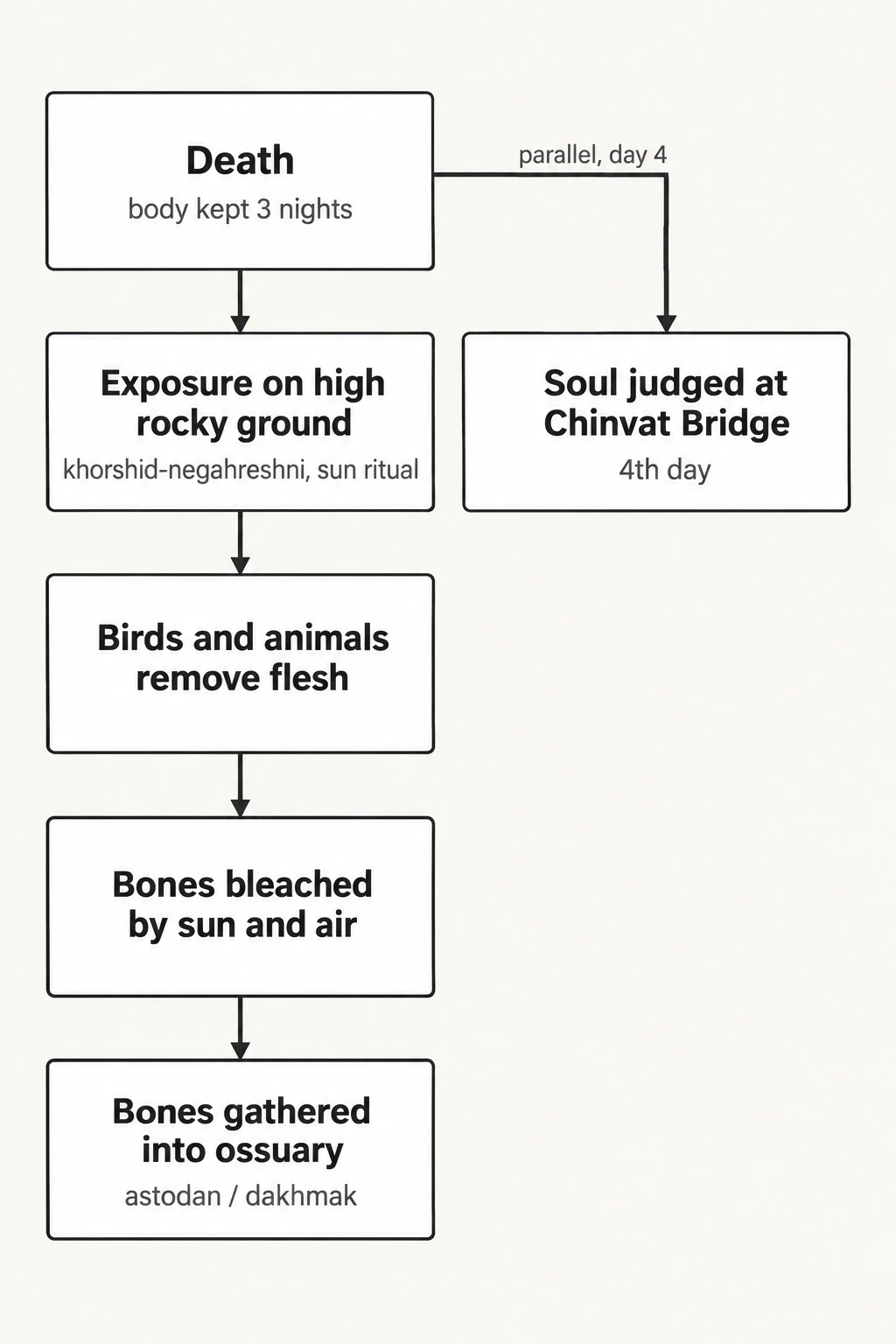
| From | To | How |
|---|---|---|
| Death (body kept 3 nights) | Exposure on high rocky ground (khorshid-negahreshni, sun ritual) | |
| Exposure on high rocky ground (khorshid-negahreshni, sun ritual) | Birds and animals remove flesh | |
| Birds and animals remove flesh | Bones bleached by sun and air | |
| Bones bleached by sun and air | Bones gathered into ossuary (astodan / dakhmak) | |
| Death (body kept 3 nights) | Soul judged at Chinvat Bridge (4th day) | parallel, day 4 |
Based on Tehran Times, reporting comments by Abolhassan Atabaki and Najmeh Ebrahimi
Once scavengers had done their work and the sun had further cleaned the bones, relatives gathered them into ossuaries, known as astodans. Many Sasanian inscriptions use the term dakhmak for these repositories, per Ebrahimi. The fully enclosed Tower of Silence, the structure most associated with Zoroastrian funerary practice today, developed more prominently in later periods; Sasanian-era communities more often relied on open exposure ground paired with separate rock-cut or masonry bone repositories.
Rank decided the architecture
Sasanian funerary structures were not uniform. Ebrahimi catalogues rock-cut chambers, stone cairns, burial towers, trough-shaped graves, jar burials, small dakhmaks and ossuaries, a range she attributes to differences in wealth and social rank rather than religious rule alone.
A comparable find near Naqsh-e Rostam, reported by Tehran Times in 2025, shows what a weathered inscription can eventually yield. That text, seven lines of Pahlavi carved beside an ossuary, was heavily damaged, with many characters illegible — yet Atabaki read enough to identify it as naming the person who had commissioned the ossuary’s construction. Ebrahimi put the number of recorded ossuary niches around the nearby sites of Hajjiabad and Garmabad, both close to Estakhr and Naqsh-e Rostam, at more than 100, twice the count of inscriptions identified across the entire Marvdasht plain.
Estakhr’s own run as a religious capital ended abruptly: the city put up stiff resistance during the Arab conquest of Iran in the mid-seventh century and was largely destroyed as a result, per the Wikipedia summary cited above. That collapse brackets the new inscription’s dating window — it was carved sometime before an empire, and a city, that no longer existed by the century’s end. Whether the text eventually yields a name, as the 2025 Naqsh-e Rostam inscription did, depends on work Atabaki hasn’t finished. Reading seven or more lines of worn Pahlavi takes longer than carving them did.