
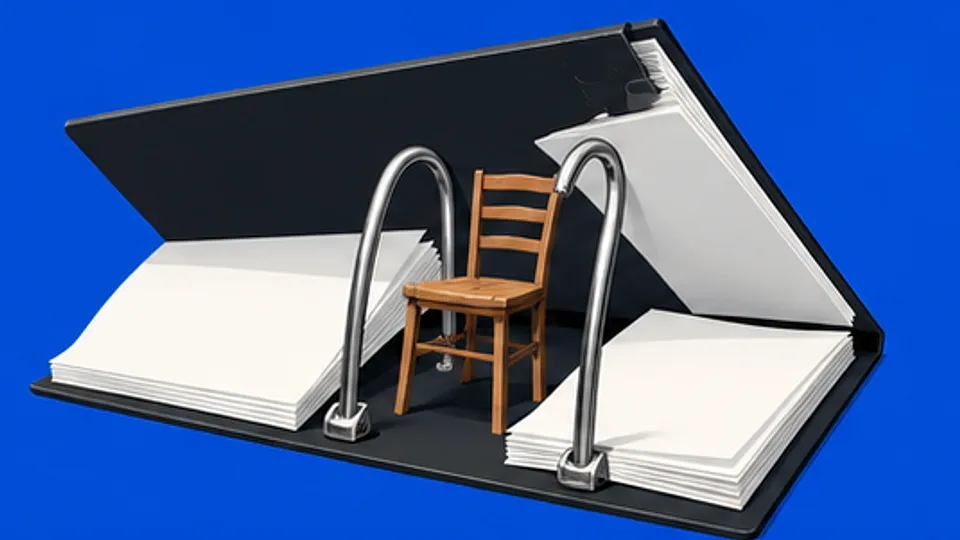
Here is a cartoon model of how organizations work. Imagine you are very good at making chairs. Someone wants a chair. You make the chair. The quality of the chair is determined by your chair-making skill, which everyone already knows about because of your previous chairs. That’s it. That’s the whole institution.
Now imagine, instead, that the customer wants to ensure quality. Notice the verb. She can’t make chairs herself, and she can’t really judge chair quality in advance, so instead of trusting the chair to be good, she asks you to document, in triplicate, that it will be good — that it is being good, hour by hour — and that it was good, per the agreed goodness schedule. The quality of the chair is now determined by a filing cabinet.
That is the running joke, and also the quietly furious thesis, of a new post on the long-running London blog diamond geezer, which has written up the whole thing as a fairy tale about a humble carpenter named William. William carves the finest furniture you ever did see — his tables are a marvel, his cupboards masterpieces, and his chairs, carved from solid oak with curved elegant legs and intricate ornate backs, his signature product. One day the Queen turns up on his doorstep and commissions a chair for the royal bedchamber: the very finest he can create, free from all imperfection. She bestows upon him three days.
Three days, the blogger’s arithmetic implies, is exactly enough time to make a great chair, provided you spend the three days making the chair. Reader: he does not spend the three days making the chair.
The knock at the door of quality assurance
On day one, just as William is about to venture into the forest to find the finest wood, the Queen knocks again. He cannot begin, she says, until he has completed a Project Initiation Document — “imagine what might happen if your goal objective parameters were left undefined.” The form runs to 18 pages. William spends most of the day on it, consulting the village elders over the hard parts, and finally grabs some wood just before sunset. It is a bit scrappy and not up to his usual standards.
On day two, chisel poised, he is interrupted by a Risk Assessment Spreadsheet: “imagine what might happen if some unforeseen disaster were to impact upon the successful delivery of project milestones.” Most of the day goes on the spreadsheet, with all relevant Health and Safety protocols addressed. He starts carving in failing light. The carving is not up to his usual standards.
On day three, with the pieces ready to assemble and tiny royal crests planned for the armrests, the Queen arrives with a Performance Appraisal Overview, because she “must insist on firm documentary evidence that all designated objectives have been achieved.” William spends the day obtaining written feedback from key stakeholders, as appropriate. He assembles the chair at dusk. No crests. The varnish is still damp.
I think the interesting question here is: what is the Queen even for? In a nothing-happens world, the paperwork does nothing. In a something-happens world — the wood splits, the project goes sideways — the paperwork still can’t do anything; it can only have been done. It is not a hedge. It is a receipt. The value of the receipt, to the Queen, is not that it makes chairs better but that it makes an eventual bad chair somebody else’s fault, proved in writing.
Each interruption, note, is justified by the same sentence: “I cannot allow such a threat to quality.” The blog’s choice of corporate-speak is doing a lot of work. The word “quality” has quietly migrated from a property of the chair to a property of the process around the chair, and once it lives in the process, more process is always more quality. There is no amount of paperwork, in this framework, that counts as too much — only amounts of trust that count as too little.
The auditors will be duly satisfied
The payoff comes at the palace, when William presents the chair with some trepidation and hands over the paperwork. “Excellent, you’ve completed all the necessary forms,” says the Queen, locking them away — unread — inside an overflowing filing cabinet. “My auditors will be duly satisfied. But what kind of chair do you call this?” She catalogs the cheap knotted wood, the rudimentary carving, the plain armrests, the damp varnish, and cannot understand what went wrong. William’s reply, in the tale, is that she wasted his time requiring him to prove he was doing a good job instead of trusting him to do one — that her over-bureaucratic quality procedures were the thing that broke the quality.
And here is the verdict, delivered in the queen’s own delighted voice: “Ooh excellent! I think I’ve just invented Business Quality Management. I must initiate rollout to all organisations across the country immediately. We must ensure quality.” And nobody lived happily ever after.
Which is the properly dark note, because it correctly identifies that the document trail is not a bug for the institution but the product. Somewhere there is an auditor whose entire professional existence is downstream of that overflowing filing cabinet, and he is having a great quarter.