
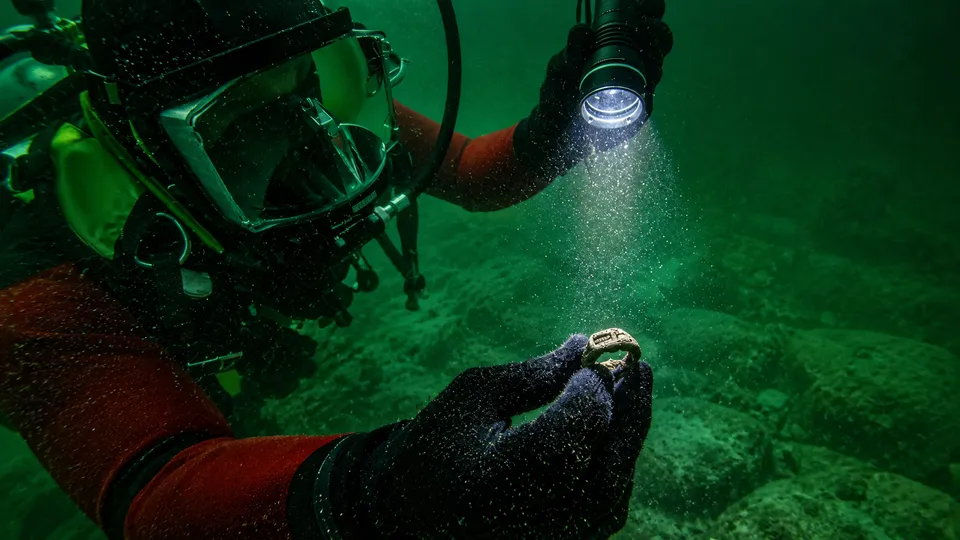
In the green water of Alexandria’s Eastern Harbour, where a royal quarter of the Ptolemaic capital has slept beneath the Mediterranean for centuries, divers have brought up a small bronze ring — and on it, an engraving of the Lighthouse of Alexandria, one of the Seven Wonders of the Ancient World. Egypt’s Ministry of Tourism and Antiquities says it is the first known representation of the Pharos ever found on a seal ring, as Arkeonews reported. The object came from the submerged island of Antirhodos, once part of the monumental harbour district called Portus Magnus.
An image known from coins, now on a hand
The engraving closely resembles depictions of the lighthouse known from coins struck in the second century AD, though the ministry has not assigned the ring itself a definitive date. Hisham El-Leithy, Secretary-General of Egypt’s Supreme Council of Antiquities, called the discovery exceptional, because archaeologists had never before identified the lighthouse on a seal ring. The excavation is being carried out by the European Institute for Underwater Archaeology, IEASM, working with Egypt’s General Department of Underwater Antiquities, under the mission’s director Franck Goddio.
Whose hand wore it
A seal ring is never only jewellery. Such rings could identify a person or an authority, authenticate a dispatch, and leave their mark on the clay or wax that closed a document or a container. The Italian outlet StileArte has raised the possibility that the Pharos image may have stood for an institutional function — an office of the lighthouse itself, of the harbour administration, of maritime communications. The idea remains hypothetical: no sealed document or inscription naming a lighthouse office has been found. Egyptian authorities have offered their own cautious suggestion — that the ring could indicate the palace on Antirhodos kept administrative purposes into the second century AD, perhaps including the management of the lighthouse. It proves nothing; it opens a door.
The quarter beneath the sea
Antirhodos held a prominent place in Portus Magnus, the great harbour of ancient Alexandria, a district of palaces and sanctuaries at the political heart of the Ptolemaic capital before Rome took the city. A palace there was described by the geographer Strabo after his visit to Egypt between 29 and 25 BC. The current excavation season covers four areas of the Eastern Harbour: the Temple of Isis, the palace and western mound of Antirhodos, the remains of an obelisk, and the Timonium, traditionally associated with Mark Antony. Alongside the ring the archaeologists recovered pottery and glass spanning the fourth century BC to the fourth century AD — utensils, tableware, amphoras, vessels, bottles, lamps — the residue of eight centuries of ordinary life in an extraordinary district.
Consider the proportions of the thing. The Pharos was raised in the third century BC, under the Ptolemies, to dominate the coastline and guide ships into one of the Mediterranean’s busiest ports; Roman-minted coins carried its image centuries after it was built, so fused was the tower with the city it served. Now that colossus appears compressed onto a circle of bronze small enough to vanish into a fist. Empires love to carve their monuments large. But a monument’s image on a seal suggests something quieter and perhaps more durable: the clerk, the harbour office, the paperwork of power. Whether the ring advertised its wearer’s city or his office, further study of its context may yet tell archaeologists less about the lighthouse than about the world that administered it — the world that actually worked.