
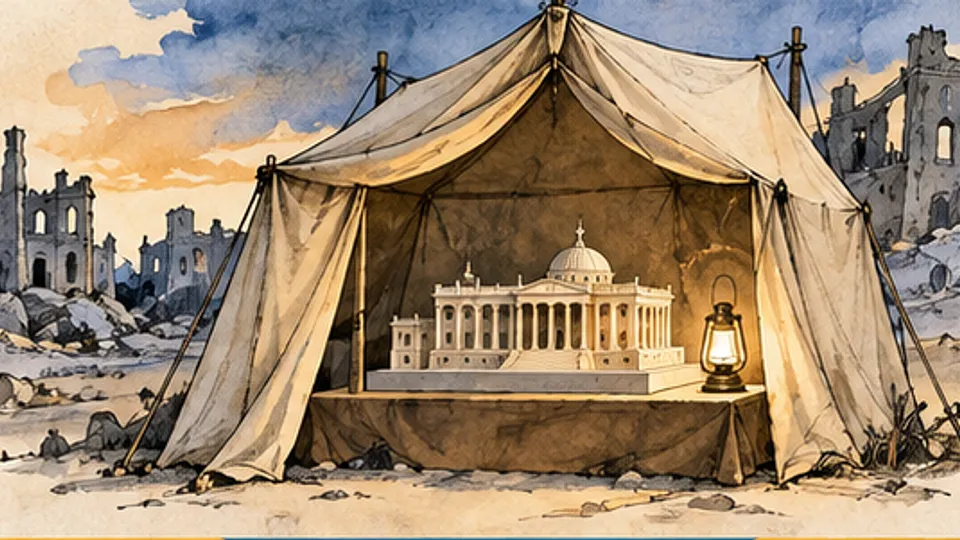
The war is nearing its fourth year, and Mahmoud Seydam is preparing a lecture on museum architecture. He is the head of engineering sciences and applied arts at the University College of Science and Technology in Khan Younis, and a lecturer at al-Aqsa University, and he delivers this lecture squatting in front of a step he calls a table, in a tent, waiting for his students to trickle into an online room that usually empties as fast as it fills. “Is Mohammed the only one here?” He types a message to the group chat. He waits for the others to join.
“Today, we have a simple presentation: an overview of museum design.” He asks his students to imagine the museum as honey in a glass. “The museum is a beautiful interior space. It becomes an element that attracts people.” Then the internet drops, and the lecture stops. He does not seem frustrated; he is used to this. In a calm, professional tone he records a voice note: “Hello everyone … There seems to be an internet problem, so I will record the lecture, upload it to YouTube and send you the link.”
Daybreak
“Sleep itself is a struggle,” he says. “Sleeping isn’t easy while living in tents. Anxiety dominates everything … because there’s no sense of stability.” A tent protects you from nothing and gives you no privacy; there is fear for the children, fear of another strike like the one that fell on the tents around them before. His family has been displaced more than 15 times, each time to somewhere worse, once abandoning everything they had. “We slept for three or four nights on the street, on the pavement.”
He wakes around dawn, prays, and opens his phone. He makes a cup of coffee, sits outside the tent and answers the messages that arrived overnight from students and colleagues. He preserves some of his phone’s battery specifically for this task; voice notes are easier than typing. “This is how I start my day.”
Morning
The morning task is water. He takes a plastic container and walks to where the water truck stops; his children — three sons and a daughter, students of engineering, nursing and computer science — often help. The water goes into a tank of only 200 litres, then into buckets of different sizes and colours set in front of the tent. “We use these buckets to store some of the water for daily use to make it last as long as possible,” he explains. The other tanks were destroyed when the house was bombed. And the water does not arrive every day.
Sometimes there is breakfast and sometimes not. There is flour at the moment; they knead and bake in the tent, but the bread spoils in the heat, and then there is no breakfast. Meals are irregular, though if work absorbs him he forgets about food. The tent itself constantly needs repairs, and then there is the gruelling daily puzzle of charging a phone and a laptop in a place without electricity.
Afternoon
He plugs his laptop into the power strip; the system shuts down at once. He has taught himself basic solar technology to keep up with these breakdowns. He grabs a broom, steps onto a plastic chair and cleans the dust from the panels on the tent’s roof. He records the museum-design lecture. Then he sets out for the offices of Scholars Without Borders, the college’s temporary headquarters, about six kilometres away. The roads are rough, packed with tents and carts, so he usually walks; today he takes a cart pulled by an old car — the sort of cart a horse or a donkey would pull — and then a rundown tuk-tuk. It takes an hour.
“Being in these circumstances and still being able to carry on, to give my all — frankly, I find it incredibly difficult,” he says. “The basic necessities of life must be in place for a person to be able to excel in their work. People don’t even have the bare minimum for life right now.” Most sessions are online; most of the tools and materials teaching requires have become hard to find or simply gone.
He has his own explanation for why the universities went down so fast. “From the early stages of the war, we noticed that the universities were deliberately targeted,” he says. “The university has a certain symbolic significance. It brings together all the future talent and potential, whether among students or the teaching staff.” Once, displaced between Rafah and Khan Younis, he could see his university in the distance and watched the strikes fall on its buildings with his own eyes. When the ceasefire was broken, he says, a video emerged showing the demolition of the whole complex — a complete levelling of the site. “We continue,” he says, “with a certain degree of patience and perseverance.”
Evening
He remembers what evenings were. “Before the war you could take your family out to eat in a restaurant.” An architect by trade, he was drawn to archaeological and heritage sites; he would wander into the antiques shops to look around. “All of this is lost now,” he says. “There is no time for leisure; we can barely secure the bare necessities. Our life runs like a machine. Every day is just like the next.”
His parents and two siblings live in tents a ten-minute walk away, worn down by illness and old age, and he visits almost every day to see if they need anything. In the evenings he sits outside his tent and talks with others to unwind after the long day. Then he returns to the students. “This doesn’t stop until I sleep.” From the moment he wakes, he says, you are barely able to keep up with anything beyond the tasks you have to do. Somewhere inside that machine of a routine, a lecture on the architecture of museums is waiting to be finished — the honey in the glass, in a place where the glass has all been broken.