
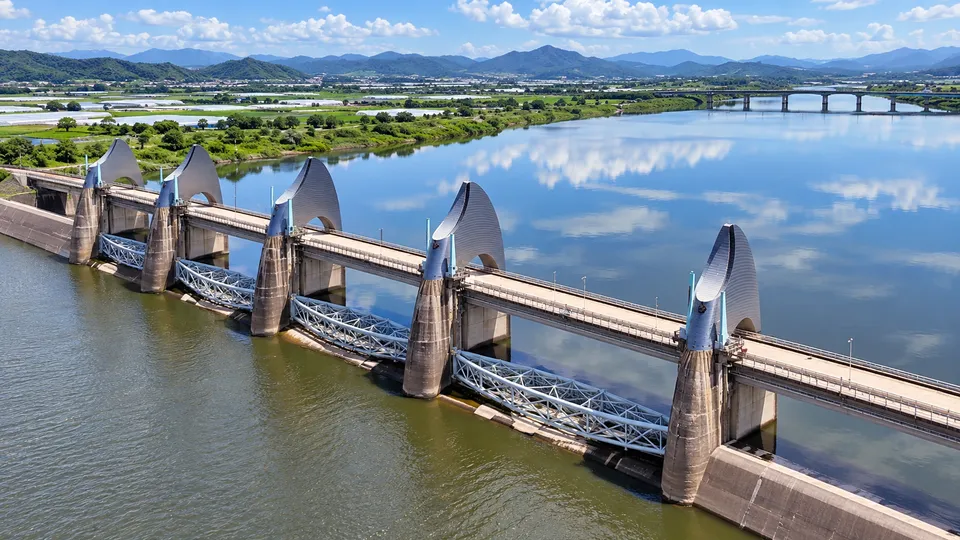
A government-commissioned study of the Four Major Rivers project has all but concluded that the project’s 16 weirs should be torn down or kept permanently open, and it did so before verifying the effects or the economics of each one.
The newspaper Chosun Ilbo obtained the draft report through the office of Kim Wi-sang, a lawmaker of the opposition People Power Party, and described its contents on Friday. The Ministry of Climate, Energy and Environment had commissioned the work from the Korean Society of Water Resources for about 50 million won, and the 126-page draft, completed in February, lay out goals and a schedule for the “restoration” of the rivers along with a budget and an organization to carry it out. The government plans to announce by the end of this year how it will handle all 16 weirs.
The report defines the basic principle of restoration as “keeping the weir gates open at all times or dismantling and removing the structures themselves,” and it sets a timetable: decide this year, then complete the “final handling” of every weir by the first half of 2029. Alternatives get little examination. The draft describes the stilling of the rivers behind the weirs as creating “the optimal environment for algal blooms to rage,” calls the rivers’ transformation a “catastrophe” and uses “green algae latte,” a phrase coined by environmental groups to mock the project, as a section heading.
In its conclusion, the report casts restoration as a way of “restoring democratic procedures and social common sense” and calls opening or dismantling the weirs the “only way” to suppress the blooms. On cost-benefit grounds, it says that even if the analysis were redone the improvements to water quality and the aquatic ecosystem are so clear that the result “would not change from the conclusion that dismantling or opening the weirs is valid.”
The evidence the report leans on runs largely in one direction. It quotes extensively from news articles critical of the project, environmental groups’ websites and their surveys. A 2023 study that found the opposite goes unaddressed: Choi Ji-yong, a professor at Seoul National University, and the National Institute of Environmental Research compared water quality for 10 years before the project and 10 years after and found that BOD, total phosphorus and suspended solids had generally improved at the weirs’ representative points. Mr. Choi attributed the improvement to pollution-reduction measures rolled out alongside the project.
When the previous administration of Moon Jae-in weighed the fate of weirs on the Geum and Yeongsan rivers, it ran a cost-benefit analysis first. The Board of Audit and Inspection said in 2023 that the analysis had used methods and data of questionable validity and reliability. The lead researcher on the new report, Baek Gyeong-o, a professor at Hankyong National University, had publicly argued for removing the weirs well before the ministry hired the society; he also sits on the presidential National Water Management Commission.
Hugh Kim, the ministry official in charge, did not respond to a request for comment that the newspaper described making before publication. The ministry said separately that it was conducting its own cost-benefit analysis of each weir and would announce operating plans and demolition decisions within the year after weighing the results. Mr. Kim, the opposition lawmaker, said water policy “must be based on science, and decisions tilted by ideology can end up harming the national interest,” adding that with extreme rain and drought becoming routine, such a change demanded caution.