
A 15-millimetre knife blade entered a man’s right eyeball, crossed through brain tissue, and stopped with its tip against the inside of his skull. He arrived at a UK hospital conscious, talking and able to move all four limbs. Weeks later he was discharged in what his doctors recorded as “good neurological condition,” according to a case report covered by Ars Technica.
Scoring the damage
The Glasgow Coma Scale that doctors use to triage head trauma runs from 3 to 15, built from three sub-scores: eye opening (maximum 4), verbal response (maximum 5) and motor response (maximum 6). A score of 13 to 15 is classed as mild, 9 to 12 as moderate, 3 to 8 as severe. This patient scored 12, broken down as E3 V4 M5: he opened his left eye only when told to, could talk but was disoriented, and pulled away purposefully when pressure was applied. That put him at the top of the moderate band, one point below the cutoff for “mild” — a number that, on its own, undersold the image of a knife handle sticking out of someone’s face.
Sedating a man who might pull out his own knife
Because he was agitated, the team’s first move was to sedate and intubate him, specifically to stop him trying to remove the blade himself before anyone knew what it was resting against. He was started on prophylactic antibiotics and a tetanus shot. Only then did doctors image his skull, mapping the knife’s path against the brain’s major vessels before touching it.
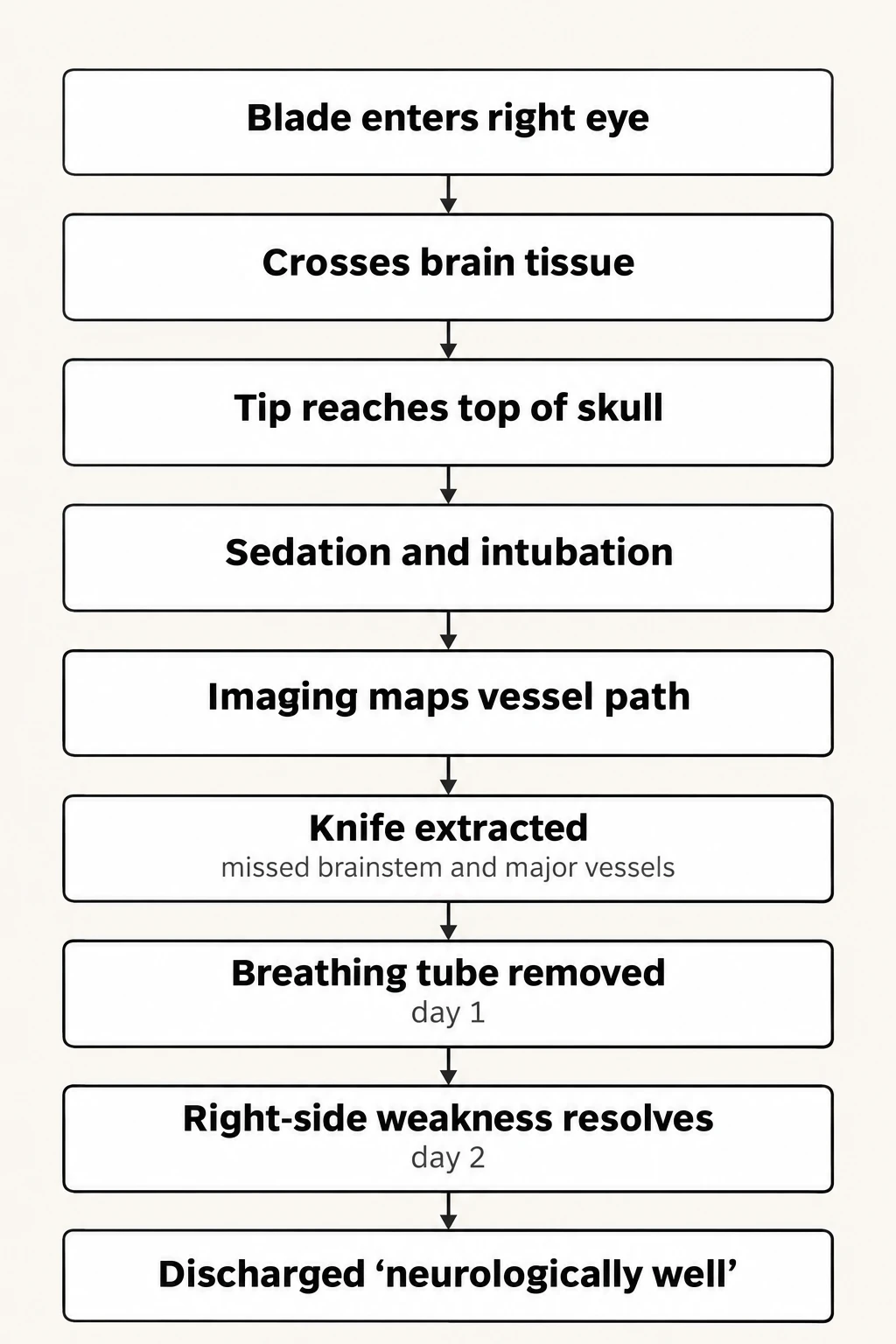
| From | To | How |
|---|---|---|
| Blade enters right eye | Crosses brain tissue | |
| Crosses brain tissue | Tip reaches top of skull | |
| Tip reaches top of skull | Sedation and intubation | |
| Sedation and intubation | Imaging maps vessel path | |
| Imaging maps vessel path | Knife extracted (missed brainstem and major vessels) | |
| Knife extracted (missed brainstem and major vessels) | Breathing tube removed (day 1) | |
| Breathing tube removed (day 1) | Right-side weakness resolves (day 2) | |
| Right-side weakness resolves (day 2) | Discharged ‘neurologically well’ |
Based on Case report detail via Ars Technica
What the postoperative scans showed
The removal itself narrowly missed the brainstem and the brain’s major vessels, which is the detail that decided the outcome more than any other single fact in the case. Postoperative CT showed intracranial air, minor bleeding and swelling tracking toward the inner table of the left temporal bone, with swelling next to the left internal capsule — the bundle of motor fibres that, because the nervous system crosses sides, explained the transient weakness on his right. Surgeons removed his breathing tube one day after the operation. The right-side weakness resolved within two days. He developed no infection and no seizures. His language function was untouched, and he lost no coordination. At follow-up he remained “neurologically well,” with ongoing eye and mental-health care.
Why a stab to the eye isn’t a stab to the head
Clinicians classify penetrating head wounds by the speed of the object, with roughly 100 metres per second as the rough line between “low-velocity” objects — knives, nails, rods — and the “high-velocity” mechanisms of bullets and shrapnel. Low-velocity penetrating head injury is rare on its own terms: it accounts for only 0.2% to 0.4% of all head trauma cases, according to a 2024 case review published in the journal Medicine. But rarity and lethality are different axes, and the gap between them is large.
A review of 26,871 penetrating-brain-injury admissions to US trauma centres between 2010 and 2014, drawn from the Trauma Quality Improvement Program and published in the American Journal of Surgery, found an overall in-hospital mortality of 43.8%. Split by mechanism, gunshot wounds carried 41% mortality; stab wounds carried 6.8%. The overall figure sits close to the gunshot figure because gunshot wounds, many of them self-inflicted, dominate the database. A 15 mm blade travelling at knife speed is a different physical event from a bullet: it does not generate the shock wave and cavitation that tear tissue beyond the direct track, so damage stays confined to whatever the blade’s path actually crosses.
Which is the point the treating doctors made explicitly in their writeup, as the man’s survival with full language and motor function intact depended on what the blade missed, not on how far it travelled:
Outcome may depend less on external severity than on precise trajectory relative to critical vascular, cortical and subcortical structures.

Phineas Gage, revisited
The doctors’ own comparison reached back to 1848, when a 25-year-old railroad foreman named Phineas Gage survived a 43-inch tamping iron blasted through his left cheek, behind his eye and out the top of his skull in Cavendish, Vermont. Gage is the textbook case for frontal-lobe survival, and he is also a cautionary tale about how such cases get retold: contemporary accounts and Gage’s own biographer, Malcolm Macmillan, have argued that the dramatic personality change long attributed to him — friends supposedly saying he was “no longer Gage” — was exaggerated in retellings written decades after his death, and that he in fact held steady jobs for 11 years afterward. The current case report drew the comparison on narrower grounds: no personality change was reported in this patient at all, whatever did or didn’t happen to Gage.
The doctors also pointed to a separate precedent, a previously reported nail-gun injury to the frontal lobe with a similarly preserved outcome — one more entry in a small literature of penetrating head wounds that look catastrophic on arrival and resolve into ordinary neurological function, provided the object’s path threads between the structures that matter.
What the case report does not settle is how the knife got there. “The mechanism is unclear,” the doctors wrote, noting only that the man had a history of depression — a detail offered without further comment on intent, accident, or anything in between. The next number to watch isn’t in this report: it’s whatever his eye and his psychiatric follow-up show over the longer term, data a single case report, by definition, doesn’t yet have.