
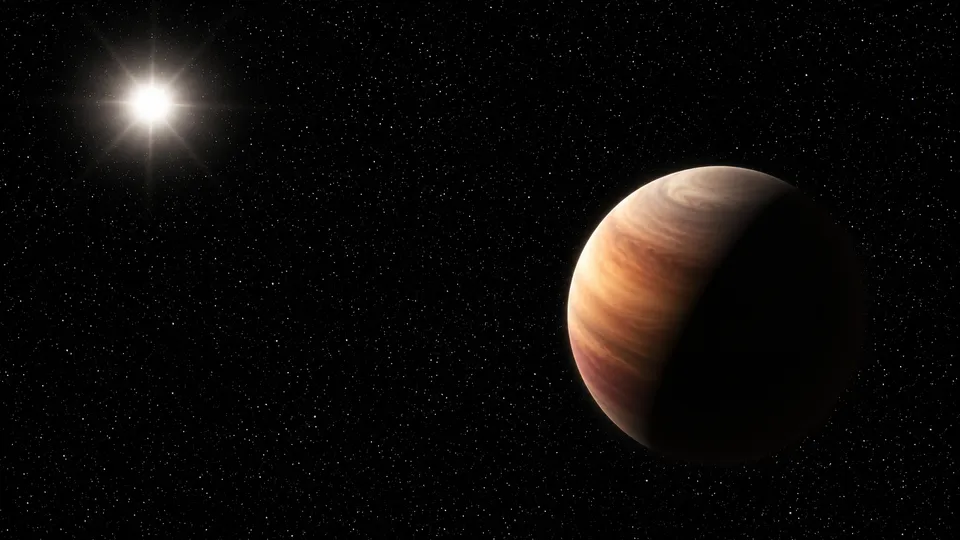
For seven years a planet crossed the face of its star on schedule, more or less, and in the most recent observations it did not cross at all. The planet did not explode and it did not fall into its sun. As far as anyone can tell it is still there, still circling. It has simply turned its path away from us, and the astronomers who watched it go believe something they cannot see turned it.
The star is TOI-2535, an old early K dwarf a little smaller and lighter than the Sun: 0.864 solar masses, 0.877 solar radii, about 9.7 billion years old. The way it moves through the galaxy places it among the stars of the Milky Way’s thick disk. A hot Jupiter goes around it every 8.236 days. The details come from a preprint posted to arXiv this month by Samuel W. Yee of the University of California, Los Angeles, and some thirty co-authors, who describe TOI-2535b as “the first confirmed planet orbiting a single star whose transits have been directly observed to disappear.”
A crossing that kept shrinking
NASA’s TESS satellite looked at the star in five separate stretches between April 2019 and March 2026. Between those stretches, roughly from 2023 to 2025, small telescopes kept watch from Cerro Tololo in Chile, from South Africa, from Teide on Tenerife, from Haleakalā on Maui and from McDonald Observatory in Texas, along with several others. Of fifteen attempts to catch a transit from the ground, six succeeded.

The first oddity was timing. The planet kept arriving early or late, by up to six hours either side of a steady schedule, which the authors say is the largest such swing seen for a hot Jupiter with a period under ten days.
The second oddity was duration. As John Timmer reported for Ars Technica, each transit lasted less time than the one before. The early crossings ran across the star’s equator, the longest path a planet can take over a stellar disk. Later ones drifted toward a pole, a shorter chord, so the planet spent less time between the star and Earth. By the paper’s measure, the planet’s path slid outward across the disk by about 0.16 of a stellar radius each year. The chord shortened until it ran off the edge.
Then there was nothing left to measure.
The hand behind the movement
The obvious suspect is another planet on a tilted orbit, whose gravity could twist TOI-2535b’s path until it no longer crosses between its star and Earth. Astronomers have seen the reverse before, a star with no transits early on that began to show them later. But a planet the size of Jupiter is heavy and hard to shove around. The researchers write: “This is the fastest rate of inclination change observed for an exoplanet orbiting a single star.” Whatever is doing the pushing, they add, “would need to be either extremely massive or on a highly eccentric orbit.”

A reflection, and only that: on a planet or in a palace, the force that moves events is usually the one that keeps out of sight. What shows itself is the thing being moved. All that is known of the second planet is the mark it leaves on the first.
Three hundred thousand pasts
To find out what the hidden planet could be, the team built 300,000 versions of the system, each with different starting conditions, and ran them forward in time. No single arrangement stood out. As long as the two planets were locked in an orbital resonance, with periods in a simple ratio, things held together, at least over short spans.
So they took the 100 best fits and let them run for a million years. About two-thirds fell apart, which ruled out a couple of the candidate resonances. The third that survived had two things in common. The unseen planet has to be massive, roughly Saturn-sized at the very least. And the angle between the two orbits cannot be large. Push it too far and the gap closes over time while both orbits grow more stretched, until the planets swing close to each other and the system breaks up. The preprint puts the mutual tilt at about five degrees or more, which leaves the hidden world inclined enough to steer its neighbour but not so far as to wreck the system.

The modelling drew on fifteen radial-velocity spectra from the NEID instrument on the WIYN telescope, which record the star’s wobble, along with the transit times. In those simulations the planet’s orbit precesses around the system’s common plane over a period of decades, roughly 30 to 50 years.
Waiting for the return
For now the planet has stepped out of view, and with it went the main way of watching it. With no transits left to time, the authors write that further monitoring of that kind “is not possible,” and they recommend a radial-velocity campaign instead, tracking how the star sways rather than waiting for a shadow that has stopped falling. According to BBC Sky at Night Magazine, the team expects TOI-2535b to cross its star again sometime in the next 30 to 50 years, and says the hidden neighbour might show itself first.
It may also have company. Another hot super-Jupiter, TOI-1355b, has been reported precessing out of the transiting geometry of its A-type star, with its transits expected to stop entirely by the middle of 2033. A third, TOI-1518b, is drifting the same way, though more slowly, and its crossings are projected to end in 2194.