
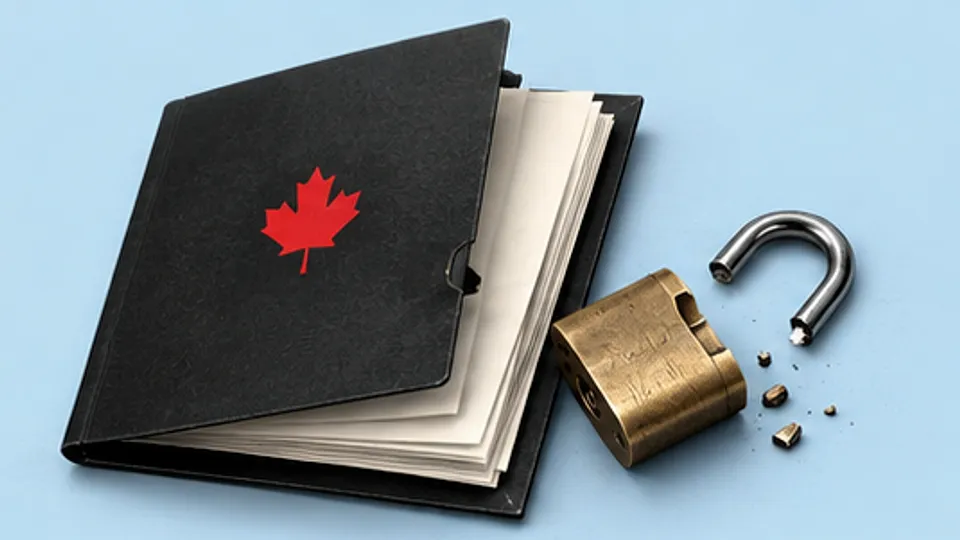
Diplomatic tension is a versatile excuse: it can be invoked against almost any embarrassment, and disproved almost never. On September 1st Canada’s Federal Court declined to indulge it. Justice Simon Fothergill ordered the release of federal records about an American programme to settle Nazi war criminals in Canada after the second world war, ruling that the government’s claim that disclosure would harm relations with the United States was supported by no evidence at all.
The case was brought by B’nai Brith Canada, a Jewish advocacy group, after it received a censored copy of the Rodal Report, a study prepared for the Deschênes Commission, Ottawa’s 1985 inquiry into Nazi war criminals. The report discusses a secret American scheme to resettle Nazis and Nazi collaborators in Canada by evading proper security screening, often with the support of Canadian officials. According to the Ottawa Citizen, the programme was run by the Central Intelligence Agency. After the war, American intelligence agencies recruited Nazis and collaborators, many of them from eastern Europe, for covert operations against the Soviet Union.
Ottawa refused disclosure under the Access to Information law, arguing that the documents would damage Canadian-American relations at a moment of strain between the two countries. Justice Fothergill was unpersuaded. “A bald statement of ongoing ‘tensions’ between Canada and the United States is not a sufficient basis to refuse disclosure of very specific information related to efforts by the United States to resettle suspected Nazis and Nazi collaborators in Canada following World War II,” he wrote. The decision to withhold, he concluded, was unreasonable. It did not help the government’s case that the CIA and the American government had already released similar material years ago.
What the censored study says is no longer much of a mystery. The judge noted that it concluded “inadequate security screening led to many perpetrators of Nazi war crimes entering Canada,” and that Canada was reluctant to prosecute them. The country has long been regarded as a haven for Nazis and their collaborators, including large numbers of Waffen SS soldiers; a number of monuments to the Waffen SS stand on Canadian soil. In 2024 the Ottawa Citizen reported that the Department of Canadian Heritage had been warned that more than half of the 550 names on the Memorial to the Victims of Communism should be removed because of potential Nazi links, fascist affiliations or simple lack of information; 50 to 60 names or organisations were likely directly linked to the Nazis, documents obtained by the newspaper showed.
The subject returned to the front pages in September 2023, when MPs of all parties gave two standing ovations to Yaroslav Hunka, a constituent from North Bay, Ontario, presented by Anthony Rota, then Speaker of the House of Commons, as a hero. It swiftly emerged that Mr Hunka had served in a Ukrainian Waffen SS unit; large numbers of soldiers from that division came to Canada after the war. There are no allegations that Mr Hunka took part in any war crimes.
B’nai Brith greeted the ruling as a beginning, not an end. “For a country that fought against Nazi Germany, to be so hesitant to come with terms and release to the public its Nazi past so we can learn from this dark history, is perplexing to say the least,” said Richard Robertson, the group’s director of advocacy. “This is a victory for all Canadians,” he added. His organisation will press for the release of the full Rodal Report and of the Deschênes Commission’s second part, which remains unavailable to the public.
The deeper puzzle is why the files were guarded at all. The events in question are eighty years old; much of the evidence has already been published by the country that ran the scheme. Governments do not keep secrets of this vintage to protect allies so much as to protect themselves from the record of their own wartime bargains—officials who waved SS veterans through the gates, and successors who preferred amnesia. Justice Fothergill’s ruling suggests that particular convenience has run its course. Whether Ottawa complies gracefully, or reaches for another excuse, will show how much it has learnt from the history it has been so reluctant to release.