
Vidov Vrh sits 781 meters above Montenegro’s Bay of Topla, high enough to watch every road from the Sutorina plain to the Adriatic. That is also the problem. A hillfort built for defense usually sits on ground that is hard to climb and easy to wall off. Vidov Vrh’s terrain is the opposite: open, walkable, better suited to living on than fighting from. Montenegro’s Ministry of Culture and Media classifies the site as a gradina, a hilltop settlement type used from the late Neolithic to the medieval period as a refuge, according to the ministry’s own funding document for the dig. The shape of this one does not fit that definition well, which is the excavators’ starting puzzle.
A new excavation season opened at the site in October 2026 and runs through November, led by the archaeologist Radmila Ćapin with Đorđe Ćapin as deputy and Goran Skrobanović as conservator, under a permit held by Herceg Novi’s city museum, as Arkeonews reported. The Ministry of Culture and Media’s 2026 program for protection and preservation of cultural property lists €8,000 for the project, titled “Sondažno arheološko istraživanje lokaliteta Vidov Vrh,” co-financed by the Herceg Novi municipality, according to the ministry’s own budget document. That is a small grant for fieldwork meant to establish, from scratch, the site’s vertical and horizontal stratigraphy, its chronology, and how long it was occupied. The team is supplementing trench work with LiDAR scanning and geodetic mapping carried out by Uroš Koprivica and the firm Geoerc, work not mentioned in the ministry’s figures but reported by Novski Portal, to produce a terrain model before more ground gets dug up.

The settlement’s occupation window, established by earlier fieldwork, runs from the 4th to the 1st century BCE, roughly 300 years, and the pottery matches the Glasinac culture found across the western Balkans in that period. The 2026 trenches have already turned up a large quantity of Late Iron Age ceramic fragments and what may be architectural remains, per the same reporting. None of this is new: it is the same two questions the Ćapins have been asking since a smaller dig in 2009.
What the 2009 dig actually found
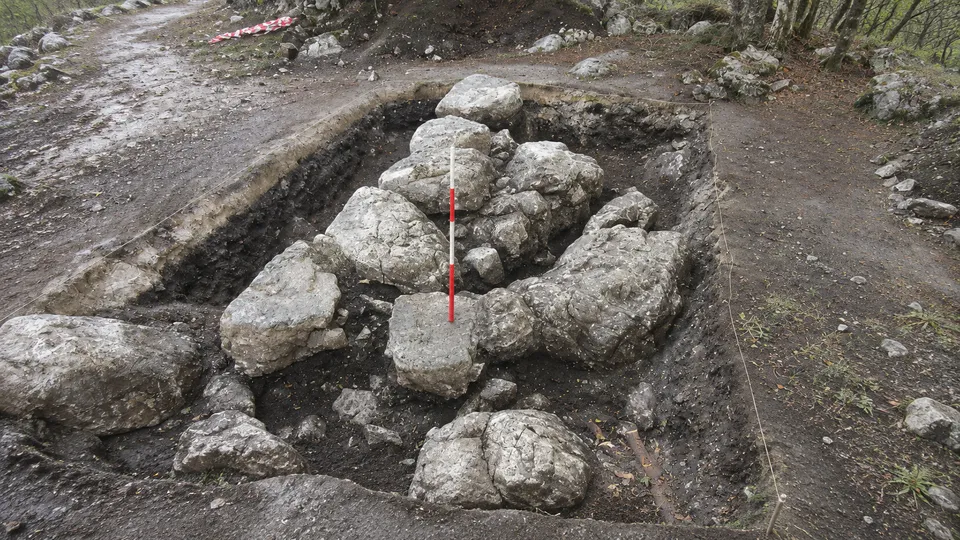
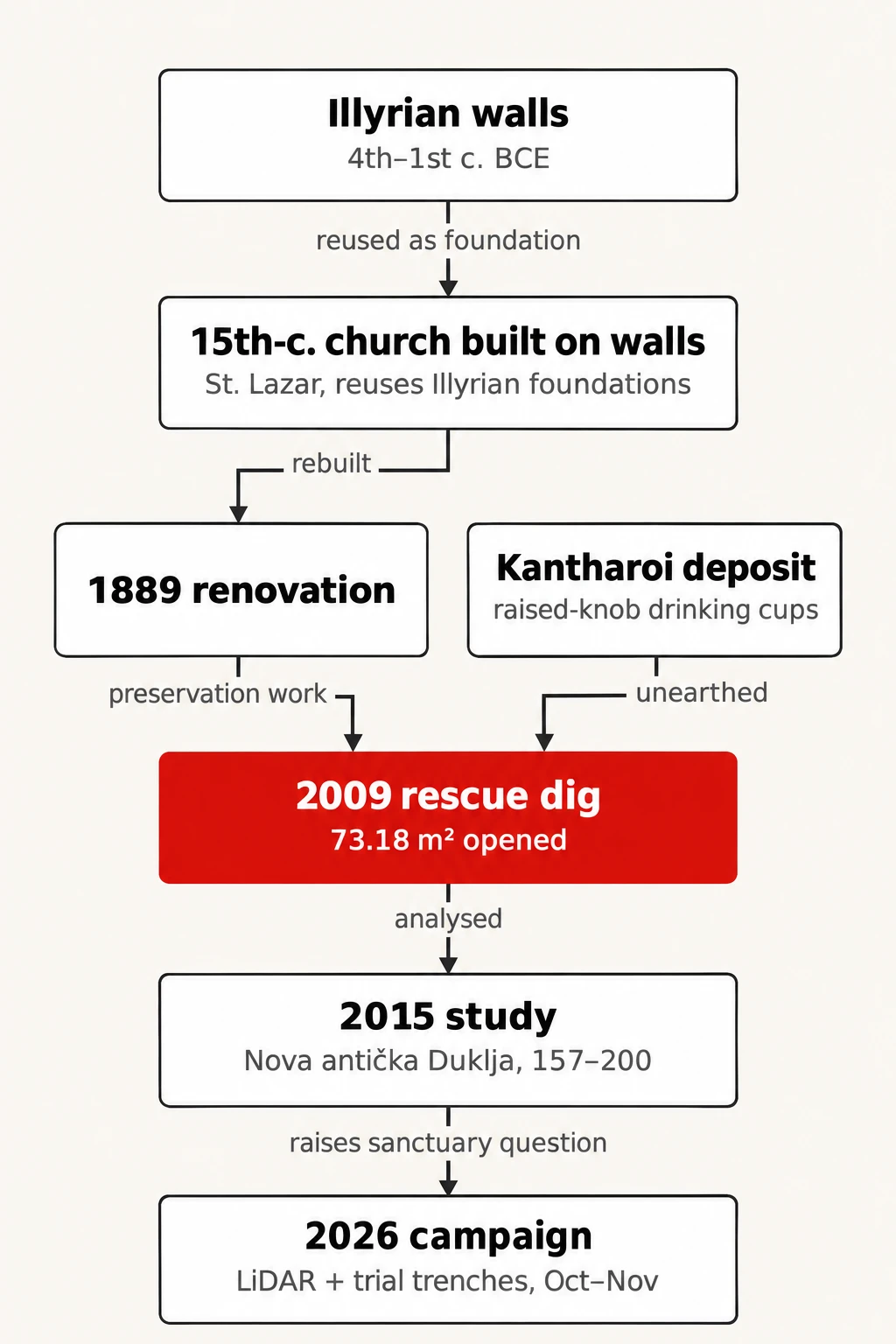
That earlier excavation, a rescue dig around the hilltop’s Lazarica church, opened 73.18 square meters, not a large area, and found four things stacked on top of each other: 15th-century church foundations dedicated to Saint Prince Lazar, wall sections from an 1889 renovation, and, underneath both, sections of Illyrian-era wall that the church builders reused as their own foundations for the north and south walls. A gold earring, a 9th-century bronze belt fragment, and a bronze coin of Alexander the Great turned up in the mixed layers, confirming people kept using the hilltop across roughly 2,400 years without anyone claiming that use was continuous or religious throughout. The results were published by Radmila and Đorđe Ćapin in 2015 in the journal Nova antička Duklja, pp. 157–200, the paper that first raised the sanctuary question.
| From | To | How |
|---|---|---|
| Illyrian walls (4th–1st c. BCE) | 15th-c. church built on walls (St. Lazar, reuses Illyrian foundations) | reused as foundation |
| 15th-c. church built on walls (St. Lazar, reuses Illyrian foundations) | 1889 renovation | rebuilt |
| 1889 renovation | 2009 rescue dig (73.18 m² opened) | preservation work |
| Kantharoi deposit (raised-knob drinking cups) | 2009 rescue dig (73.18 m² opened) | unearthed |
| 2009 rescue dig (73.18 m² opened) | 2015 study (Nova antička Duklja, 157–200) | analysed |
| 2015 study (Nova antička Duklja, 157–200) | 2026 campaign (LiDAR + trial trenches, Oct–Nov) | raises sanctuary question |
Based on Ćapin & Ćapin (2015); Novski Portal
What makes the 2015 paper worth revisiting now is a specific pottery type: kantharoi, two-handled drinking cups, carrying small raised knobs on their surface. The Ćapins compared these fragments to kantharoi found at other confirmed Balkan sanctuaries and argued the resemblance was close enough to suggest ritual use. That is a comparison, not a proof: no altar, no temple foundation, no inscription naming a god has turned up at Vidov Vrh. The claim rests entirely on a pottery typology match, which is the kind of evidence that gets weaker the fewer confirmed sanctuary assemblages exist to compare against.
The god who may not be there
The Ćapins also noticed the hill’s own name. “Vidov Vrh” could preserve the name of a pre-Roman local deity called Vid, according to Herceg Novi Cool’s account of the researchers’ argument, which also states flatly that the finds so far show an unbroken cult use of the site from prehistory to today. That is a stronger claim than the excavation record supports on its own. The comparison the Ćapins draw is to Roman-era votive altars found at Topusko in Croatia, inscribed to local deities Vidasus and Thana, whom scholars of Dalmatian religion equate with Silvanus and Diana. Those altars exist and are dated. Nothing comparable exists at Vidov Vrh: no inscription anywhere on the hill names Vid, Tana, or any other deity. The toponym argument is a plausible etymology, not an epigraphic fact, and the distance between Topusko and Herceg Novi is roughly 400 kilometers, which is a long reach for a direct cult link without an inscription at either end to anchor it.

A better-documented parallel sits 25 kilometers away, on Gradina hill above Risan, ancient Rhizon. There, a Polish excavation team from the University of Warsaw’s Antiquity of Southeastern Europe Research Centre has worked since the mid-2000s and found a relief sherd depicting a man on horseback carrying a lance, matching the known iconography of Rhizon’s protector god Medaurus, as Archaeology Wiki reported on the find. Researchers estimate the god’s statue stood on a base of at least 15 by 20 meters on the acropolis, a built, dateable structure, not a name on a map.
The table is the honest version of the comparison the Ćapins themselves draw: both hills later carried Roman-period religious structures and then medieval churches, and both are read as possible continuity sites. Only Risan has the artifact, the iconography and the architecture to back that reading. Vidov Vrh has a name and a pottery style.
None of that makes the 2026 fieldwork pointless. Stratigraphy and chronology are the groundwork any sanctuary claim would need before it could stand on anything firmer than a kantharos fragment, and that groundwork simply did not exist before this season’s trenches and LiDAR model. The question the €8,000 grant is actually paying to answer is mundane: how big was the settlement, how long did people live there, and does any part of the hill show a floor plan that looks like worship rather than habitation. Until a structure with an altar, a votive deposit, or an inscription turns up in situ, the sanctuary at Vidov Vrh remains what it has been since 2015: a reading of pottery decoration, not a building anyone has found.