
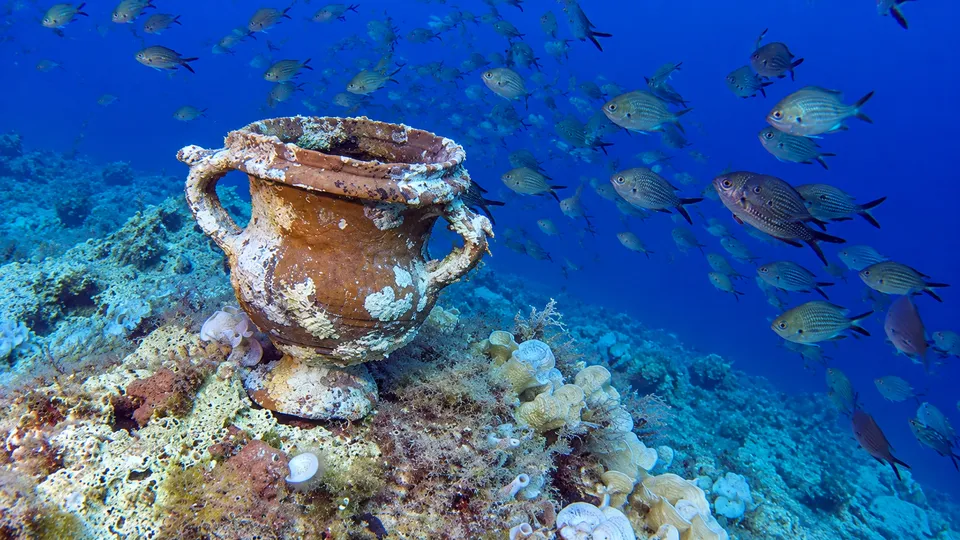
Six metres of a ship’s keel and hull planking have survived two millennia on the seabed of Gnjilna Bay, off Komiža on the Croatian island of Vis, at a site the Croatian Conservation Institute (Hrvatski restauratorski zavod) says is the first shipwreck anywhere to yield fine Greek drinking pottery rather than just the amphorae that normally outlast a hull. The institute announced the finds on October 4, summarizing underwater excavations carried out between 2023 and 2025 and led by Jurica Bezak of its Department of Underwater Archaeology, as arkeonews.net reported.
The site was known before the full excavation only as a scatter of Corinthian type B amphora fragments, the standard large transport jars for wine and oil. What the 2023-2025 dives added was the vessel itself: a lead anchor stock of the Haldane II A type, which together with the amphora typology set a preliminary date in the fourth or third century BCE, and roughly six metres of wooden hull and keel, a structural survival rare enough that most wreck sites preserve only their more durable cargo and lose the ship that carried it.
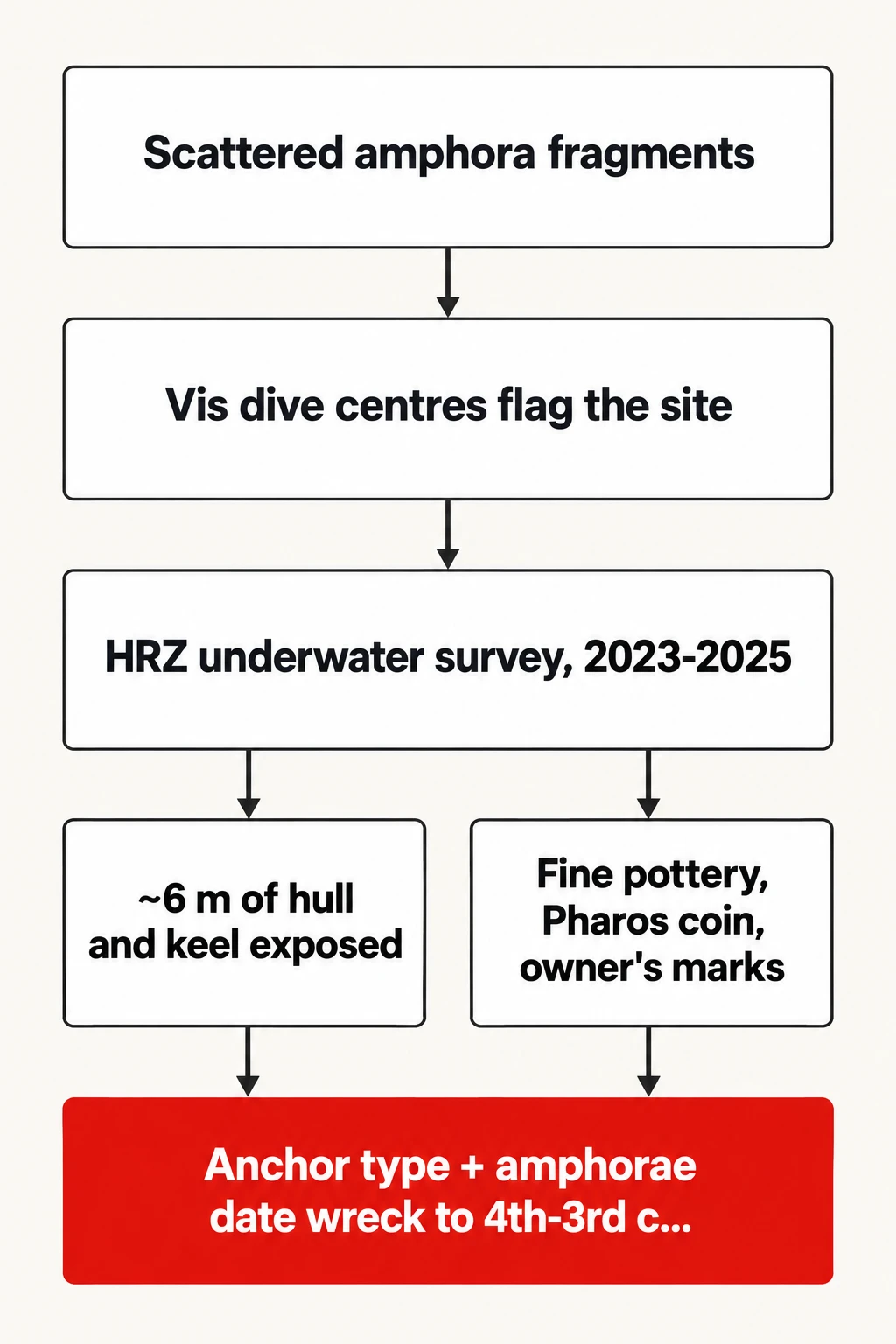
| From | To | How |
|---|---|---|
| Scattered amphora fragments | Vis dive centres flag the site | |
| Vis dive centres flag the site | HRZ underwater survey, 2023-2025 | |
| HRZ underwater survey, 2023-2025 | ~6 m of hull and keel exposed | |
| HRZ underwater survey, 2023-2025 | Fine pottery, Pharos coin, owner's marks | |
| ~6 m of hull and keel exposed | Anchor type + amphorae date wreck to 4th-3rd c… | |
| Fine pottery, Pharos coin, owner's marks | Anchor type + amphorae date wreck to 4th-3rd c… |
Based on Croatian Conservation Institute
Pottery that doesn’t belong on a cargo manifest
A merchant hauling amphorae is expected to carry amphorae, not the tableware of a dinner party. The Gnjilna assemblage includes skyphoi (handled drinking cups), kantharoi (the two-handled cups associated specifically with wine), askoi (small pouring vessels), bowls, plates, salt dishes and aryballoi, small flasks normally holding oil or perfume. The institute says this is the first identified shipwreck anywhere to produce Greek fine pottery of this kind, which is why Gnjilna matters beyond its local geography: it is evidence for what travelled alongside bulk cargo, not just the cargo itself. The drinking vessels tie the wreck to Issa, the Greek settlement on Vis, which Greek colonists from Syracuse founded around 397 BCE under Dionysius the Elder, shortly before founding Pharos on neighbouring Hvar in 384 BCE, according to the Archaeological Museum Split’s account of the Issa collection. Issa later built a reputation for its wine, the same commodity the kantharoi were built to serve.
The luxury ceramics and the well-preserved lead-plated wooden structure are simply astonishing.
Names scratched in after firing
Several black-glazed vessels carry marks scratched into the surface after manufacture, which the institute’s team reads as abbreviated personal names rather than decoration. A mark added post-firing is, by definition, not part of how the pot was made or sold; it is something an owner did to it. That reading supports the idea that some of the tableware belonged to individual crew members rather than forming part of the ship’s commercial inventory, which is the kind of distinction that is usually impossible to draw from pottery alone. Combined with the animal bones recovered from the wreck, the marked vessels are the closest thing archaeologists have to a record of what a Hellenistic crew ate and drank on a working voyage, as opposed to what the ship was paid to transport.
What the amphorae say about the supply chain
The cargo itself carried two different Corinthian amphora forms, designated type A′ and type B. A 2022 compositional study by Maja Miše and Patrick Sean Quinn, published in Archaeological and Anthropological Sciences, analysed 248 amphora fragments from 15 sites across Dalmatia, Gnjilna among them, and found that the Gnjilna examples of both forms came from the same production workshop, despite belonging to different typological categories (see Miše and Quinn, 2022). That is a fact about organization, not geology: a single Corinthian workshop was turning out more than one amphora style for the same distribution network, which is evidence that Adriatic supply chains in the fourth century BCE could draw on standardized production rather than one-off batches. A coin from Pharos, also fourth century BCE, adds a second data point to the same network without pinning down the ship’s actual route.
An earlier, less detailed account of apparently the same stretch of Komiža seabed, reported in July 2025 before the Institute’s formal announcement named the site, put the wreck at a depth of 30 to 50 metres and described additional finds not mentioned in the October statement, including human remains and containers of oil and spices, attributing the discovery’s scale to diver Marko Lete, who said “it is incredible to see how clearly the structure is preserved,” with some surfacing artefacts looking “as though they were made yesterday,” according to Croatia Week. Whether that account and the named Gnjilna excavation are the same investigation at two stages, or two adjacent sites conflated in earlier coverage, the institute’s October release does not say.
The institute has said the finds will eventually go on display at Vis’s own museum. What the six surviving metres of hull do not yet answer is the harder shipbuilding question: what construction method, what wood species, what fastening technique a Hellenistic merchant builder used on a vessel meant to carry both bulk wine jars and a crew’s private tableware across the Adriatic. That is a question the keel itself, still on the seabed, is positioned to answer before the pottery is.