
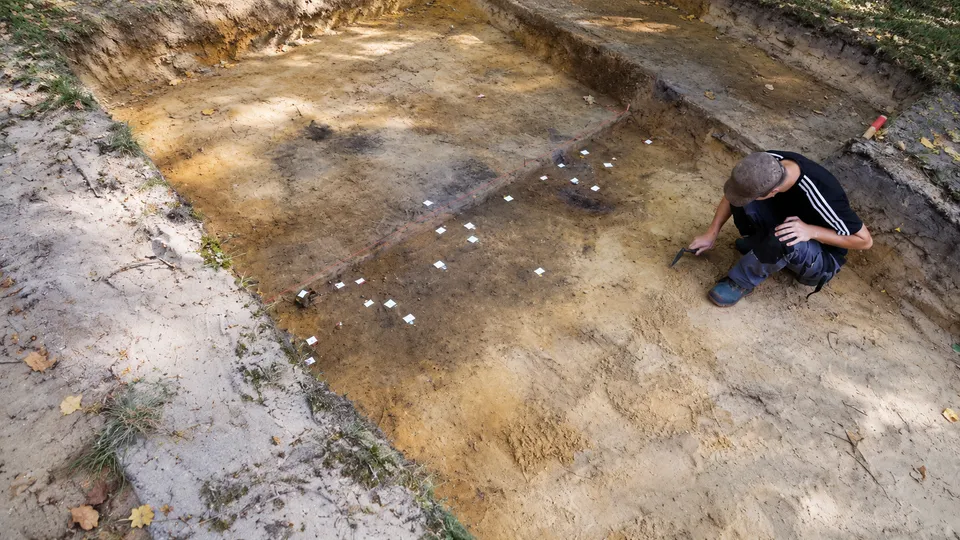
In the Chodel Forest of southeastern Poland, the dead of a thousand years ago keep arriving as riddles. Archaeologists working the early medieval cremation cemetery at Chodlik have uncovered a grave shaped like a boat — approximately 4.5 meters long and between 1 and 1.2 meters wide, its outline close to that of a dugout canoe carved from a single trunk. As Leman Altuntaş reported in Arkeonews, the team from the Institute of Archaeology and Ethnology of the Polish Academy of Sciences, led by Dr. Łukasz Miechowicz, found it wedged between two other burial monuments — one resembling a house, the other a richly furnished burial mound — in a cemetery used when Slavic communities occupied the region between the eighth and tenth centuries. The shape suggests the cremated remains may have been laid inside a wooden vessel, though whether an actual boat formed part of the burial still requires analysis.
Silver above the ashes
The first hint that this was no ordinary grave came near its upper surface: a beautifully preserved silver temple ring, decorated with hollow beads and delicate granulation — the old goldsmith’s trick of fixing tiny spheres of metal into intricate patterns. Digging on, the team recovered more than a dozen small fragments of silver jewelry, some partially melted by fire, along with pieces of ceramic vessels, charcoal, and burned human and animal bones. Whatever happened at this funeral, it was more than the simple deposition of ashes.
Among the animal remains, one item drew particular attention: a horse tooth. Horses are unusual in Slavic burial traditions, though Chodlik has already produced several cremation graves containing horse remains. In a 2021 study, Miechowicz examined an eighth- or ninth-century mound at the site where a person and a horse had been cremated, possibly together on the same pyre. What the tooth in the boat grave meant remains uncertain.
Fragments of human teeth also survived the fire, and the researchers hope they hold enough material for isotope analysis — perhaps a trace of where the dead person came from. The elaborate ornaments speak of valuable possessions, but the individual’s identity, sex and standing are all still unknown.
A settlement at the crossroads
The strange grave makes more sense against the town that stood near it. Between the eighth and tenth centuries, Chodlik grew into an important settlement complex centred on a fortified stronghold of more than eight hectares, ringed by other settlements, defensive sites and burial grounds across the Chodelka Valley. Set near the Vistula River, where crossings and overland routes tied together Central and Eastern Europe, it traded far beyond its forests: archaeologists at the site have found imported objects associated with Rus’ territories, the Rhineland and Great Moravia.
Those far contacts may explain the cemetery’s unusual variety of funeral customs. Alongside burial mounds, the site has yielded structures known as houses of the dead, built in the shapes of early medieval dwellings. The boat-shaped grave adds one more style to the collection — and more cause for argument.
Whose custom was it?
Boat burial is the signature funeral of the Viking Age; across Scandinavia the dead were sometimes laid in vessels with possessions declaring their rank and their beliefs about death. But the custom was never exclusively Scandinavian. Archaeologists have documented rare boat-related graves among West Slavic communities around the Baltic coast — in Pomerania, Mecklenburg and Wolin — and excavations at the early medieval cemetery of Myszęcin in western Poland have shown how Slavic and Scandinavian funeral practices touched and coloured one another.
Chodlik lies considerably farther inland, and Miechowicz calls the grave the first of its kind in the historical region of Lesser Poland. Its shape invites comparison with Viking customs, but a resemblance alone cannot prove Scandinavian influence: the people of Chodlik kept up contacts with several regions, and the burial could as easily be a local adaptation of a practice known from elsewhere. Some researchers have wondered whether boats carried a deeper meaning for the Slavic dead — the vessel as a symbol of the voyage to the afterlife — but what this particular boat meant to those who dug its outline cannot now be known.
Reading a cold pyre
What happened at the funeral must be reconstructed from scraps. Miechowicz notes that traces within the grave may be the ghosts of decayed wooden walls, but centuries of decomposition have left little recognizable wood. The team is gathering all sediment and debris from the burial for flotation and detailed examination — hunting charcoal, botanical remains, human and animal bone — and is building a 3D reconstruction from digital documentation of each layer and every artifact. Radiocarbon dating and specialist analysis should eventually say when the grave was made and how the ceremony ran.
For now the questions stand open. Was the dead person laid in a real wooden boat? Why did the mourners choose so uncommon a form? The answers, if they come, will be coaxed from silver ornaments, cremated bone and the faint outline of what may once have been a vessel — all that is left of a funeral held more than a thousand years ago, in a forest far from any sea.