
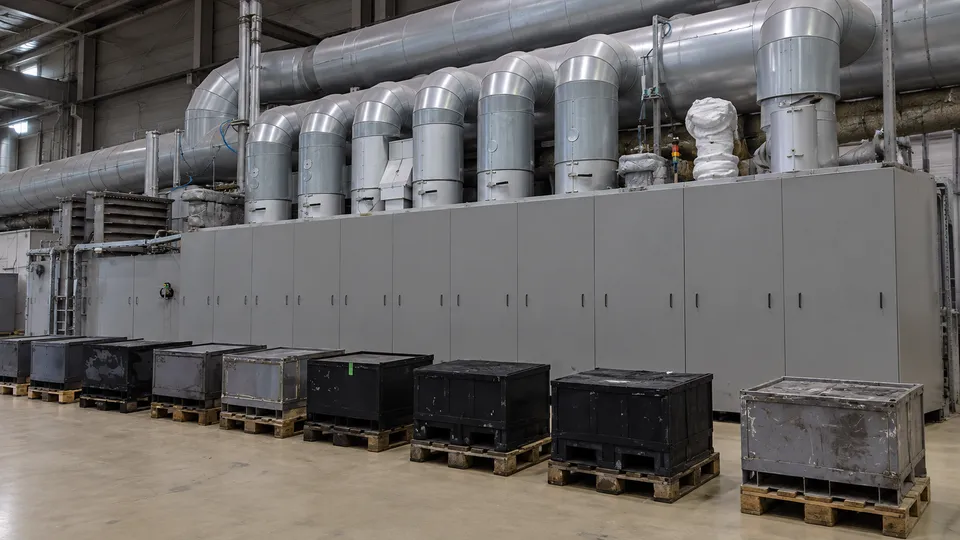
Making lithium, it turns out, is a bit like making filter coffee. Pour water over ground coffee and the flavour washes out, leaving the grounds behind in the filter. That, at any rate, is how Simon Bremer, head of development at Accurec Recycling, describes his firm’s method of extracting lithium from dead batteries: a thermal pre-treatment renders the lithium water-soluble while everything else in the battery is not. “We convert the lithium into a water-soluble form. In other words, the entire rest of the battery is insoluble in water, except for the lithium,” he told Euronews.
The family-owned company, based in Krefeld in Germany’s industrial west, has recycled batteries since its founding in 1995, starting with nickel-cadmium and nickel-metal hydride cells before lithium-ion technology swept all before it. It now employs about 85 people, processes roughly 5,000 tonnes of batteries a year at Krefeld and runs a second plant in Mülheim an der Ruhr. A facility that started operating in December 2025 can initially recover 50% of the lithium in the batteries it handles—already the target that European Union legislation sets for 2027.
Mr Bremer is aiming higher. “We have been working on expanding the plant for about a month now. That means ramping up both capacity and yield so that in the first quarter of 2027 we will be able to recover 80 percent or more,” he said. Accurec is investing €5.5m to double its operating area at Krefeld, lifting annual capacity towards 20,000 tonnes. The process, known internally as CLIMA, uses pyrolysis to break down organic components after sorting and dismantling; heat from that step is recovered to recrystallise the lithium salt, which “allows us to avoid using additional energy and thus reduce overall process costs”, Mr Bremer says. The company claims the technology cuts energy use by almost 50% and CO₂ emissions per tonne of lithium carbonate by more than 59%.
The black-mass drain
The stakes extend well beyond one firm’s balance-sheet. According to Mr Bremer, around 65% to 70% of the battery-grade lithium chemicals used in Europe come from Chinese production. Beijing has already shown a willingness to squeeze exports of strategic materials such as rare earths and germanium. Lithium, indispensable to electric cars and to the storage systems that smooth out wind and solar power, is an obvious candidate for similar treatment.
Yet even the materials Europe does recover tend to leak away. Most European recyclers produce only “black mass”, an intermediate powder of mingled lithium, nickel and cobalt. Few facilities on the continent can separate those metals, so much of the black mass is shipped east. “The actual recovery of raw materials then takes place predominantly in China, and partly in Korea,” Mr Bremer explains. Asian buyers, he argues, pay prices for European black mass that make it hard for local processors to turn a profit—rational for firms that earn their money further down the chain, in finished battery cells, and convenient in that it strangles a competing European industry at birth.
For now, Accurec’s own options close to home are thin. One of the few plausible customers is AMG Lithium in Bitterfeld, which refines lithium for battery production; the two firms have signed a memorandum of understanding, though technical details remain unresolved. “Right now it is still about ironing out the final interface issues in order to enable feed-in to that plant,” Mr Bremer says. Until then, some of Accurec’s lithium goes to other uses, or is marketed in Asia through partners—an ironic detour for a firm whose ambition is a closed European loop, in which lithium from old batteries ends up in new ones made on the continent.
Wanted: a policy, not just a target
Mr Bremer approves of the EU’s decision, effective from December 2025, to classify black mass as hazardous waste, tightening export controls. “That is an important step and, from our point of view, absolutely the right one to say: the material has to stay in Europe,” he says—provided, he adds, that customs and supervisory authorities are given the resources to enforce it.
He is less impressed by the bloc’s recycled-content rules, due from 2031, which mandate minimum shares of recycled material in new batteries but say nothing about where that material comes from. “Alongside the recycled content, we can also talk about a European share,” he suggests, pointing to public-procurement rules in other sectors that require a proportion of production to happen in Europe. His wider complaint is that Europe lacks a strategy for the whole battery value chain: the collapse of Northvolt, the Swedish battery champion, showed the perils of bankrolling flagship projects while neglecting the suppliers and customers around them.
That judgment is hard to fault. Recycling alone will not free Europe from Chinese lithium; 20,000 tonnes of spent batteries a year is a rounding error beside the continent’s appetite. But attaching strings to recycled-content rules, enforcing the black-mass regime and financing mid-stream processing would cost little next to the sums already splashed on gigafactories. Europe has spent years digging lithium out of the ground elsewhere. Digging it out of its own dustbins would be a start.