
Last August, Phil Tippett — the stop-motion legend whose creatures populate Star Wars, Jurassic Park, RoboCop and The Matrix — closed his Berkeley, California studio after a Chapter 11 bankruptcy and liquidated the place, a closure also reported by the Los Angeles Times. A liquidation sale is, at heart, a pricing exercise: decades of accumulated stuff goes out the door for whatever a room full of strangers will pay for it. An original creature maquette has an obvious bidder. A fat binder full of old CDs has, at best, a vague one. The binder is the one that turned out to matter.
Someone at that fire sale bought the binder, took it home, and discovered it held hundreds of high-resolution behind-the-scenes images and videos spanning Tippett’s filmography — material that, as far as the buyer could tell, existed nowhere else. So they digitized the lot and uploaded it to the Internet Archive as roughly 90 .ISO files, one per non-duplicated disc, free for anyone to browse. Word spread this week after Brandon Sheffield flagged the find online, and film people have been picking through it since.
I quickly realized that some of this information wasn’t available online and might not ever be in the future in such high resolution. So I purchased the disc folder and digitized all of its contents. What you have here are .ISO image files of the 90 key, non-duplicated discs from Tippett’s archives.
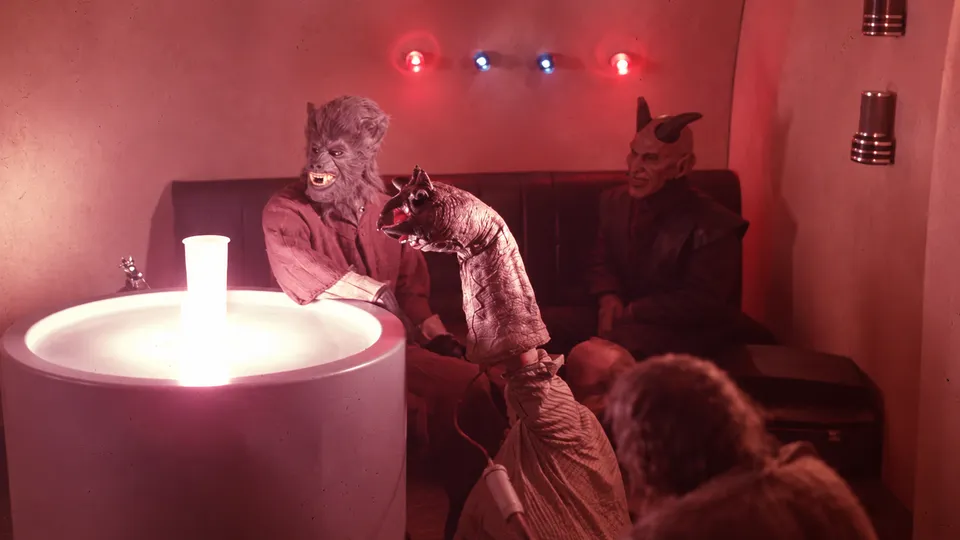
The haul, per Kotaku’s account, includes new angles on the A New Hope cantina scene and stills of the stop-motion and puppet work from the films — the hologram chess pieces, the trash-compactor eyeball — plus construction material on RoboCop’s ED-209, skin textures for Abe Sapien from Hellboy, wireframe files from Jurassic Park, material from Starship Troopers and photos from Ray Harryhausen’s 90th birthday party. It is, in effect, the working papers of practical-effects Hollywood, preserved on burned CD-Rs and then nearly sold for pocket change.
There is an economics-of-preservation point here, if you want one. The studio’s creditors had every incentive to sell everything and no incentive to digitize anything; archiving is a cost, and bankrupt estates are not in the business of incurring costs for posterity. The only reason this material is public is that one attendee performed the arbitrage personally — bought low, scanned at home, donated to the commons. The Internet Archive has absorbed leaked and lost media before, games and films alike, but usually the rescue happens upstream of the liquidation, not in the parking lot after it.
The bittersweet part is the timing. Tippett has said he is not ready to retire, even after his decades-in-the-making passion project Mad God took him, as Kotaku put it, “to hell and back.” The studio is gone; the man is not. And as Hollywood continues its drift away from physical creatures toward digital ones, the physical record of how those creatures were actually built — the wireframes, the textures, the workshop photos — survives by the thinnest of margins: one fan, one binder, one upload.
The market priced the discs as clutter. The internet is treating them as a museum. One of those appraisals was wrong, and it was the one with the auctioneer.