
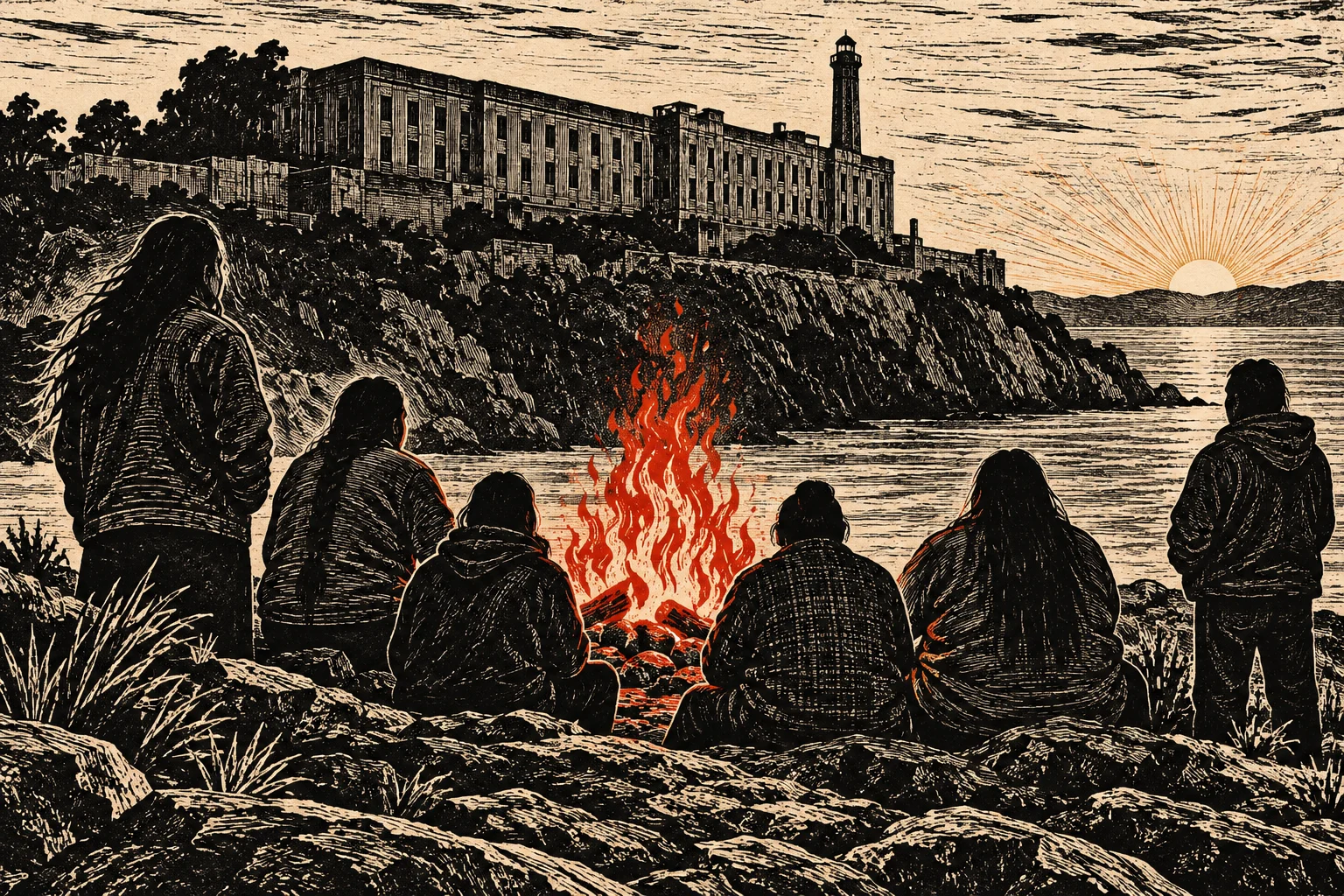
Before dawn on Monday, while San Francisco Bay was still black, the ferries carried thousands of people out to the island the federal government once used as a cage. They gathered around a roaring bonfire as the sun came up, as they do twice a year — on Indigenous Peoples Day and on Thanksgiving — to remember, and to insist on being remembered.
As CalMatters and ICT reported, this year’s ceremony was shadowed by Sacramento. In press materials and in interviews, organizers criticized Gov. Gavin Newsom’s recent vetoes of three bills — on sacred sites, on tribal water, and on missing and murdered Indigenous people — measures California’s tribes had fought for and lost within the past two weeks.
“Our resilience in our continued fight for our religious freedom connects us to being here today,” said Morning Star Gali, executive director of the advocacy group Indigenous Justice, whose organization sponsored Assembly Bill 1881. The bill would have strengthened protections for tribal religious practices and sacred sites. Newsom vetoed it on Sept. 30. His office did not respond to requests for comment on Monday.
The spark that lit the fire
The ceremony, co-hosted by the International Indian Treaty Council, commemorates the 19-month occupation of Alcatraz by the group Indians of All Tribes — the protest that helped ignite the Red Power movement of the 1970s. It began in November 1969, six years after the prison closed, and days after an unexplained fire destroyed the American Indian Cultural Center of San Francisco, the service hub for the city’s Native residents. Led by Richard Oakes and LaNada War Jack, activists went looking for a new home. On Nov. 9, 1969, Oakes swam the bay’s cold waters to the island, declared it “Indian Land,” and offered to buy it for $24 in glass beads and red cloth — an echo of the sham Dutch purchase of Manhattan in 1626. His Alcatraz Proclamation was written in the style of the treaties the United States had offered tribes; the occupiers, many of them students, claimed the island under the 1868 Treaty of Fort Laramie, which promised that surplus federal property would return to Native hands.
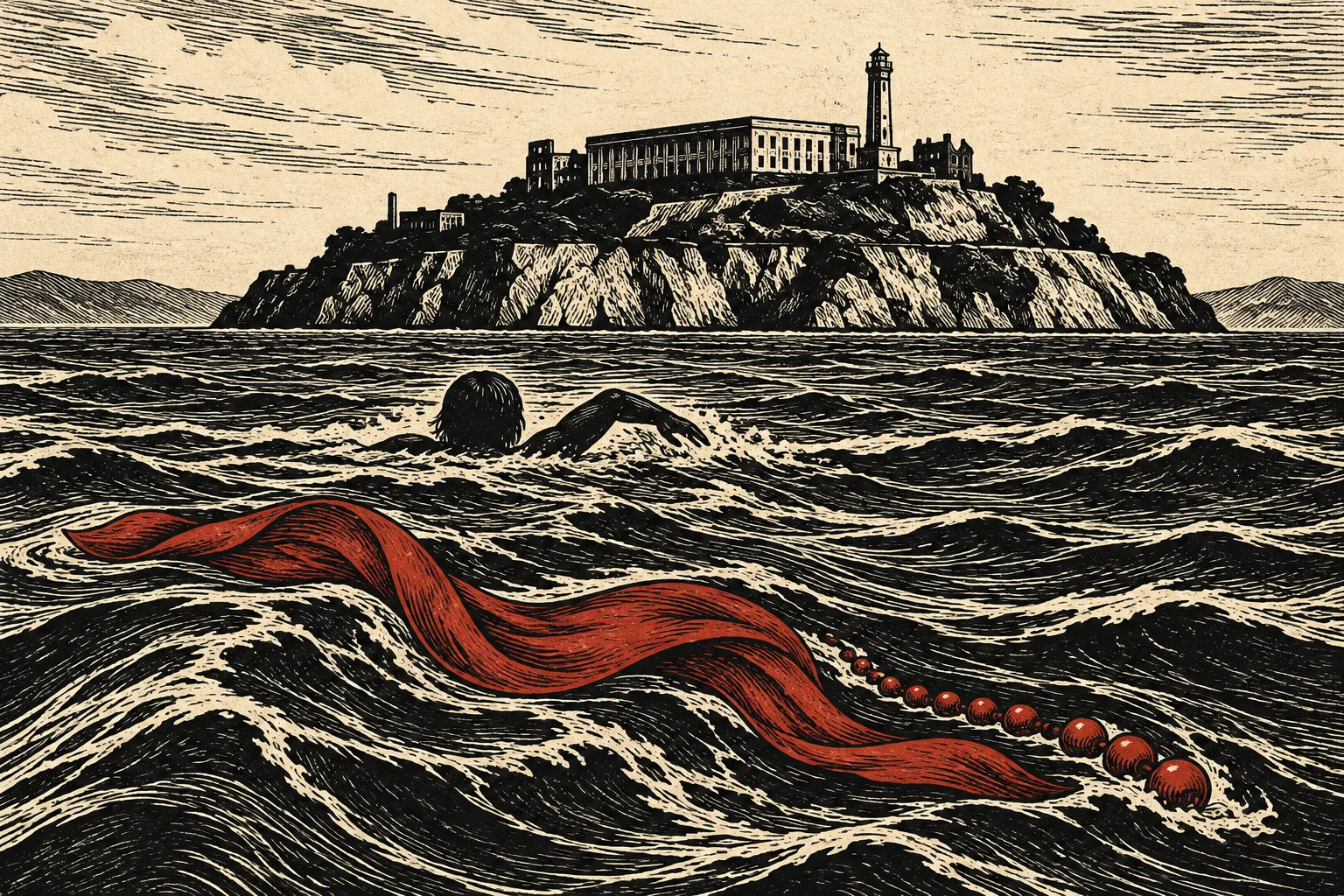
The Coast Guard removed the first landing party within a day. Oakes and about 90 others returned on Nov. 20, and over the following 19 months — at its height some 400 people — the occupiers built a school, a radio station and a health clinic, before federal agents removed the last of them on June 11, 1971. “The spark that lit the fire” is how Gali described it.
There are older memories on the island, too. One speaker, Matonth Brown, an Elem Pomo and San Carlos Apache, counts among her ancestors some of the 19 Hopi men the federal government imprisoned on Alcatraz in 1895, when it was still a military prison. Their crime, in the language of the charge sheet, was seditious conduct: they had resisted the seizure of their children for the government boarding schools — institutions that stripped Native children of identity, belief and language, in a policy experts now call genocide.
A scary world
Irvin Whekins, a Shawnee youth counselor with Elevate Youth California, brought nine Native youth from Chico on the morning ferry, sipping coffee as the boat crossed the dark water. Each year, he said, the gathering is a chance to honor Indigenous diversity and resilience — but the island’s future has its own politics. President Trump has repeatedly vowed to reopen the prison, and in April requested $152 million for it in his fiscal 2027 budget, which Congress has not finalized.
“It’s a scary world we live in — scary president,” Whekins said. “He’s still trying to get rid of us.”
Signed, then vetoed
The anger at Newsom carries a particular sting because of its timing. Less than a week before vetoing the sacred-sites and water bills, the governor signed a law designating Sept. 30 as a Day of Remembrance for Indian Boarding Schools — a law that names 13 California boarding schools where children were held in “harsh conditions” and those who died were buried in unmarked graves. The International Indian Treaty Council called the vetoes a “shocking action.”
AB 1881 would have strengthened protections for sacred Native religious and cultural sites. Gali, a citizen of the Pit River Tribe, said the need is not abstract: “I’ve gone into state parks with all of our relatives to go in to be able to gather medicine and to be able to pray, to be able to pray at the sacred waters — I’ve been kicked out of those spaces.” California State Parks, asked for comment, said it “is not aware of any such incidents in recent years.” Sixty-two California tribes lack federal recognition and its protections; without state-level law, tribal leaders say, they are nearly powerless to prevent serious damage to their sacred places.
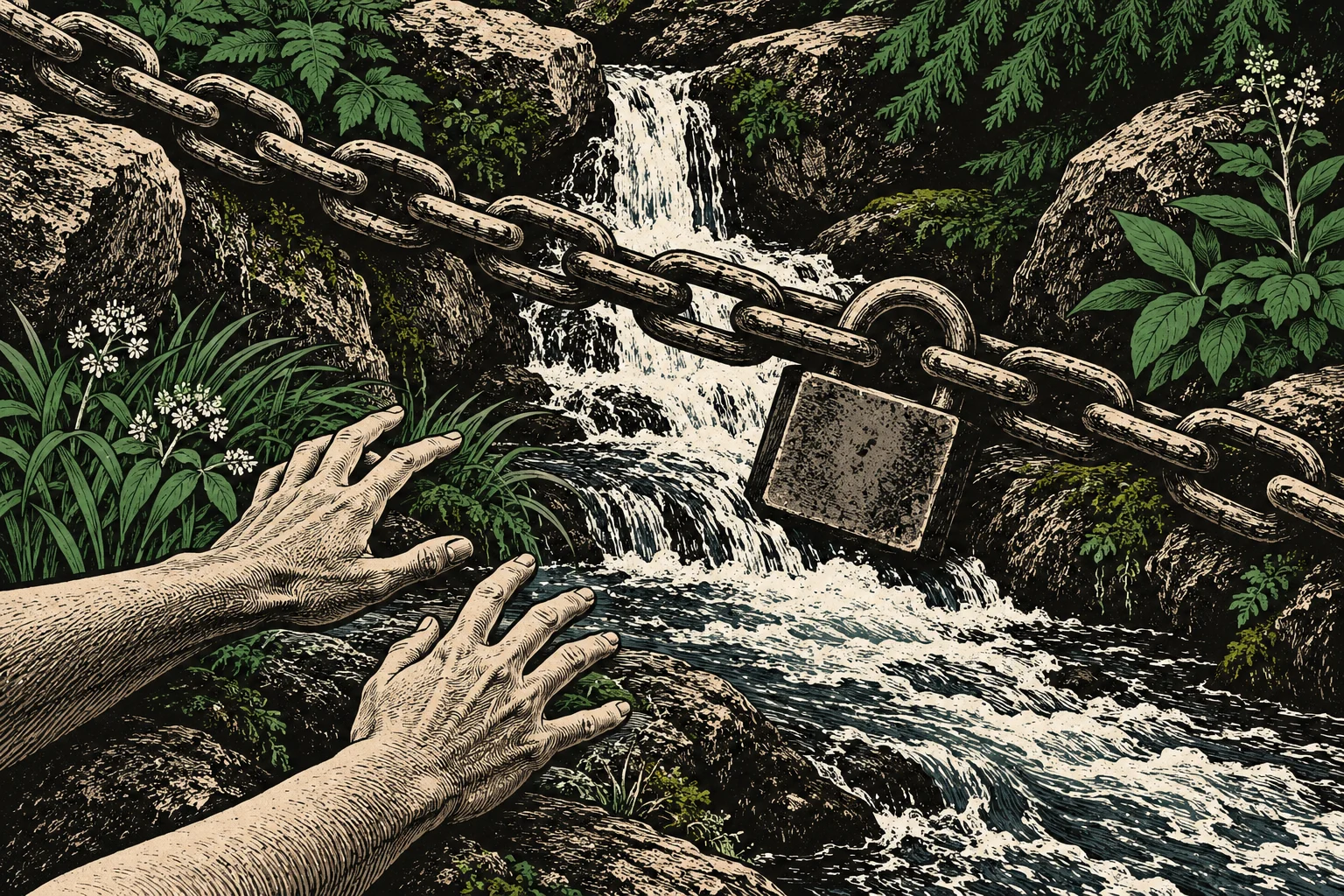
Also vetoed was Assembly Bill 2218, which would have required state agencies to address tribal water shortages and sent disputes over projects in ancestral territories to mediation through the Governor’s Office of Tribal Affairs. Jackie Fielder, a San Francisco supervisor, a citizen of the Three Affiliated Tribes of North Dakota and the first Native American woman on the city’s Board of Supervisors, put the matter plainly: “We know water is life. It must be protected.”
The third veto, of Senate Bill 891, killed a proposed Missing and Murdered Indigenous Persons Justice Program within the state Department of Justice — more funding, better data, advocates for Indigenous families. Newsom’s veto message called the legislation “unnecessary,” saying existing efforts sufficed. Native American women in California face disproportionate rates of criminal violence, including homicide.
“Who else is going to stand up and be visible for our sisters? No one,” said Teyana Viscarra, a Piro-Tewa Pueblo, Apache and Kumiai woman and co-founder of Way Of The Sacred Mountain. “It’s ridiculous, our sisters continue to be ignored even as they go missing and die.” Her group runs the Red Tipi Healing Project, raising bright red tipis marked with white handprints across the country. After the sunrise gathering, she and others reconvened at Yerba Buena Gardens to raise another one — draping the country in red cloth, she said, for as long as the mothers and sisters keep disappearing.
“Every day as a California Indian woman is a fight against erasure and a fight against invisibility,” Gali said on the island. The Muwekma Ohlone, on whose homelands the Bay Area now stands, still wait for the federal government to recognize they exist. Fifty-seven years after Oakes swam the bay, the bonfire is lit again — and the fire keeps asking the same question of the men in the statehouses: whose land, whose water, whose dead.