
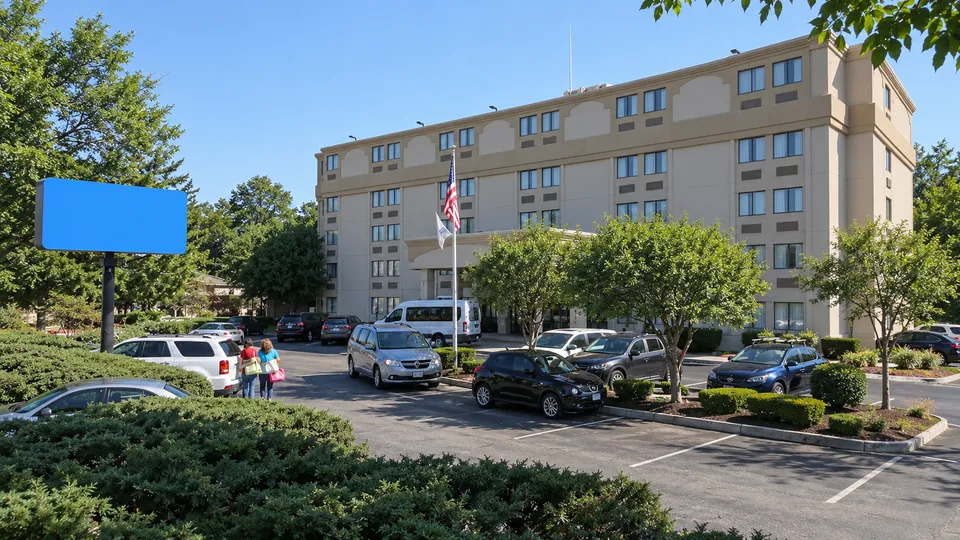
A former Comfort Inn on Morrissey Boulevard in Dorchester reopened on Wednesday as 99 units of permanent housing for formerly homeless older adults, with 96 of the single-occupancy apartments already occupied, The Boston Globe reported.
“The way to solve homelessness is to build homes,” Mayor Michelle Wu said at an event marking the opening. “The numbers show that this works, but we know that actually this isn’t about numbers at all. It’s about people. It’s about neighbors.”
The project is Boston’s latest investment in permanent supportive housing, a model that places formerly homeless people in their own apartments with case workers and counseling under the same roof. It is aimed at the chronically homeless, including people with severe mental or physical health problems, substance use disorders or developmental disabilities — groups for whom the temporary shelter system has often failed.
The building was developed by The Community Builders, with on-site services run by Pine Street Inn. It is one of only a handful of standalone permanent supportive housing projects in New England; most of the roughly 4,000 supportive units in Massachusetts are leased apartments scattered through private buildings.
“All of the tenants here are over 62,” said Lyndia Downie, Pine Street Inn’s executive director. “Six are veterans. More importantly, everyone here is now a tenant with a key. They’re friends. They’re neighbors. They aren’t worried about where they are going to sleep tonight.”
From outside, little has changed. The boxy five-story building still sits on a concrete island between the six-lane boulevard and the Red Line tracks, the hotel canopy still over its entrance. Inside, the old rooms were gutted and rebuilt with modern finishes, new appliances and marble countertops. Residents get free laundry, a small fourth-floor library made by knocking down the wall between two rooms, and movie nights in a first-floor common space.
One resident, Reginald, who asked that his last name not be used, has lived in a fourth-floor studio since December 2025, his first permanent home in years. While struggling with substance abuse, he spent two years living “in a cardboard box” before moving into Pine Street’s temporary shelter. Learning he would have his own apartment, he said, “I felt the direction of my life shift.” With caseworkers’ help he has been sober for a year and is training for a restaurant job. “Just being able to close my door and get away from the cold, the turmoil outside,” he said. “It has changed my life.”
Projects like this one have drawn fights. Neighbors sued over another supportive housing project by the same nonprofits on Washington Street in Jamaica Plain in 2020, arguing the zoning approval was flawed; it opened last year. In Dorchester, neighbors and local officials, including State Senator Nick Collins and former City Councilor Frank Baker, protested that housing nearly 100 formerly homeless people would bring drugs and crime, and opponents at one point demonstrated outside the hotel with signs showing people living on the street nearby. The Boston Planning and Development Agency approved the project in May 2023, after the developers cut 11 units and agreed to accept only residents 62 or older.
The model leans heavily on federal funding, and the Trump administration has moved to curtail permanent supportive housing. Advocates in Massachusetts say proposed cuts could put some chronically homeless people back on the street. “No matter what bad faith arguments people put out there, there is a very deep human truth to the need for a roof over your head and the way in which people are able to flourish when they have it,” said Kenzie Bok, administrator of the Boston Housing Authority. “And it is by people seeing that reality and how it’s changed the lives of other people we will continue to make projects like this happen.”