
Facioscapulohumeral muscular dystrophy (FSHD) has a single well-characterised cause and a severity range nobody could explain. About 95% of cases carry the same lesion: the D4Z4 repeat array on chromosome 4, normally more than ten copies of a 3.3-kilobase repeat unit, is contracted down to one to ten copies. Each repeat carries a copy of the gene DUX4, which is active in the early embryo and is supposed to switch off for good afterward. The contraction stops that switch-off from sticking, so DUX4 flickers back on in adult muscle and triggers a cascade that kills muscle fibres. Worldwide prevalence is estimated at roughly 1 in 15,000 to 1 in 20,000, around 16,000 to 21,000 people in the US by that estimate, according to a clinical review in MedLink. Carry the mutation and you will get the disease. Whether you get it at 13 or at 45, and whether you end up in a wheelchair or barely notice, has had no genetic explanation until now.
A study in Brain from a University of Utah team led by Russell Butterfield and Robert Weiss, covered by the university, supplies one. The answer is DNA methylation, a chemical tag added to cytosine bases (the C in CpG, a cytosine next to a guanine) that dials gene activity down without changing the underlying sequence. More methylation at the D4Z4 repeat means less DUX4 activity means milder disease. That correlation had been proposed before; what the Utah group adds is a measurement precise enough to use, and a second gene that appears to set the dial.
A nine-generation family, measured at single-base resolution
The cohort is K1462, a Utah kindred traced back to a Lancashire ancestor born in 1775 and first described in the medical literature in 1950, according to the paper’s abstract. The family has banked DNA with University of Utah geneticists since the 1980s and has FSHD clinical records going back further still. Butterfield’s team drew on 203 family members born between 1901 and 2022, of whom 139 carry the family’s specific five-repeat-unit contraction and 64 do not. For a 93-person subset with detailed clinical staging, split into mild (27), intermediate (34) and severe (32) groups, the team sequenced the D4Z4 region with a custom nanopore long-read method built to handle what Butterfield called, in the university’s release, “the gnarliest gene out there”: a GC-rich, repetitive stretch that standard short-read sequencing cannot resolve. The method reads methylation at each of roughly 325 CpG sites per repeat, base by base.
The result: the mild group’s repeats carried a median of 30.5 methylated CpGs per read, against 23.7 for intermediate and 21.2 for severe cases, a 12.9-percentage-point gap across 317 of the 325 sites compared. The difference between mild and severe groups held up at a Kruskal-Wallis p-value of 7.2×10⁻⁸, and a methylation threshold of 24.8 marks per repeat separated severe from mild cases with 89% sensitivity and 81% specificity, for a receiver-operating-characteristic area under the curve of 0.92. Those are the numbers that make “methylation predicts severity” a measurement rather than a hunch: a single blood-based assay, with this accuracy, would let a clinician stratify a newly diagnosed carrier’s likely disease course without waiting decades to find out.
Two other effects showed up in the same dataset. Methylation rose with paternal transmission of the mutation by 5.2 marks on average (95% CI 2.4–8.1, p=0.001) relative to maternal transmission, though a separate look at severity by parent of origin (49% more-severe outcomes with maternal transmission versus 30% with paternal) fell short of significance (p=0.08). And severity rose steeply with age, as expected for a progressive disease: the odds of being classed severe rather than mild increased 5.52-fold per decade of age (95% CI 3.53–8.64, p=8.0×10⁻¹⁴), which is itself a reminder that cross-sectional severity comparisons mix disease stage with disease rate and have to be read with the subject’s age attached.
A second gene nobody had connected to this disease
Methylation levels ran in families beyond what simple inheritance of the mutant chromosome would predict, which is the signal that something else in the genome is setting the dial. The team ran a genome-wide association study on 107 subjects across 6.8 million common genetic variants and found one locus that cleared genome-wide significance, on chromosome 15, about 1.5 kilobases upstream of a gene called HDGFL3 (also known as HRP3). Carrying the minor allele of the lead variant, rs12438298, was associated with roughly 10 extra methylated marks per repeat (β=+10.7, p=2.2×10⁻⁹) — a bigger single effect than the paternal-transmission difference. HDGFL3 encodes a chromatin-binding protein built around a PWWP domain, a module known from other proteins to dock onto methylated DNA and histone marks and recruit the machinery (53BP1, NuRD, CAF-1 complex components) that remodels chromatin; nobody had previously linked it to FSHD, and the study does not establish that it causes the methylation difference rather than merely marking it.
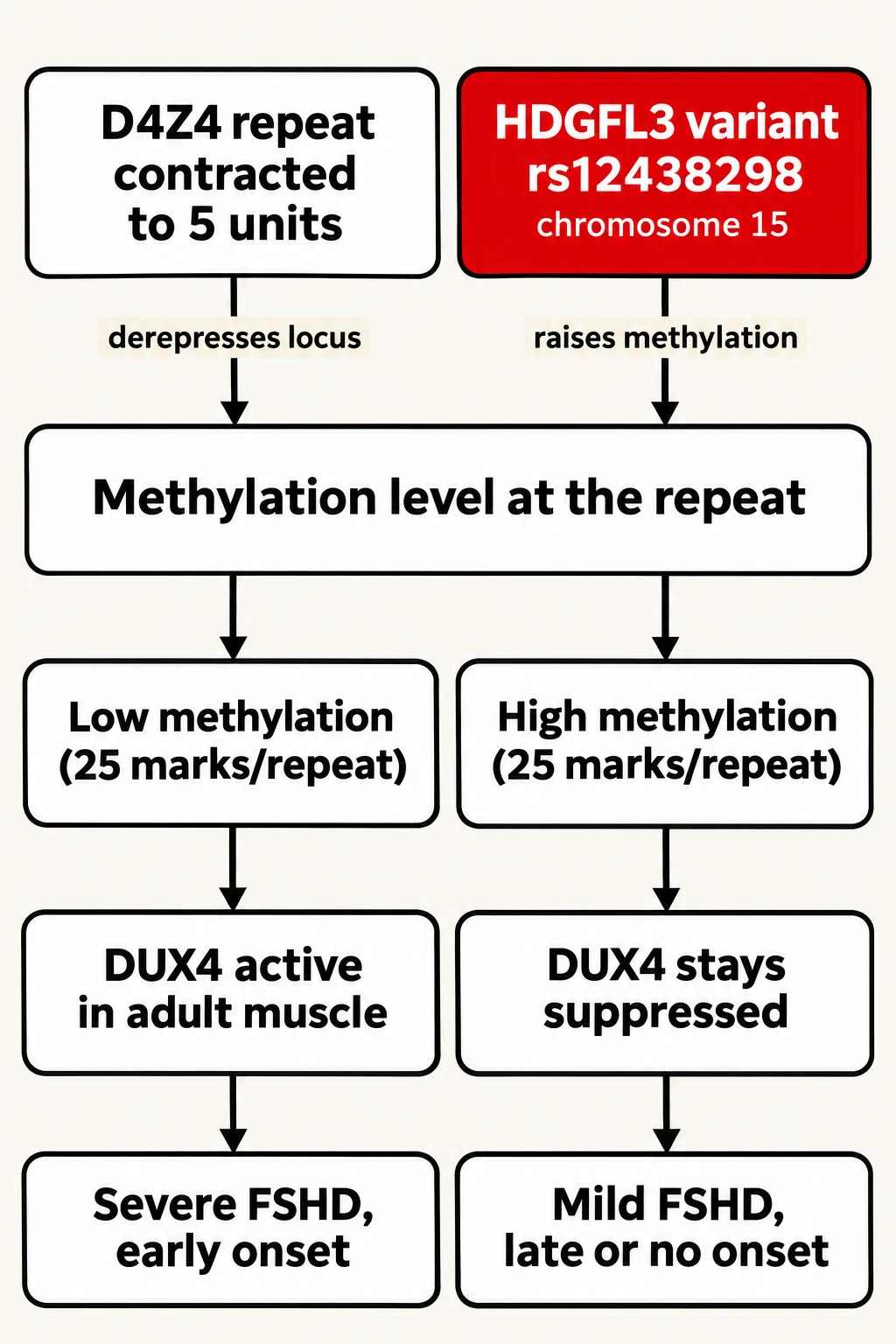
| From | To | How |
|---|---|---|
| D4Z4 repeat contracted to 5 units | Methylation level at the repeat | derepresses locus |
| HDGFL3 variant rs12438298 (chromosome 15) | Methylation level at the repeat | raises methylation |
| Methylation level at the repeat | Low methylation (<25 marks/repeat) | |
| Methylation level at the repeat | High methylation (>25 marks/repeat) | |
| Low methylation (<25 marks/repeat) | DUX4 active in adult muscle | |
| High methylation (>25 marks/repeat) | DUX4 stays suppressed | |
| DUX4 active in adult muscle | Severe FSHD, early onset | |
| DUX4 stays suppressed | Mild FSHD, late or no onset |
Based on Butterfield et al., Brain, 2026
A trial already testing the mechanism
The obvious therapeutic implication, raise methylation at D4Z4 directly rather than waiting for a favourable HDGFL3 variant, is already in a clinic. Butterfield is a principal investigator on EPI-321, a Phase 1/2 trial from Epicrispr Biotechnologies that delivers, via a single intravenous AAV infusion, a catalytically dead Cas protein fused to DNMT3A-family methyltransferase domains that re-methylate the D4Z4 region directly, re-silencing DUX4 without cutting DNA, according to the company’s own technical materials and coverage in Fierce Biotech. Dosing in that trial began in August 2025, and by mid-2026 the company had enrolled two dose cohorts of nine patients and reported, in the FSHD Society’s own release of the data, that three low-dose patients gained an average 0.8 pounds of lean muscle (range 0.5 to 1.3 pounds) six months after infusion, a result the company called the first clinical evidence that any drug can suppress DUX4’s output and grow muscle rather than merely slow its loss. A later update, reported by Inside Precision Medicine, also recorded one case of severe liver enzyme elevation among the treated patients. Epicrispr raised a $90 million Series C in August 2026, according to WowTale, to push toward a pivotal trial.
Butterfield told the University of Utah’s press office, “We just treated our first gene therapy patient a few weeks ago. It’s remarkable to see how quickly these approaches are moving forward.” That reads as the first patient at his own site rather than the first in the programme, since Epicrispr’s own disclosures put the trial’s first dosing more than a year earlier and its patient count at nine by mid-2026; the university’s release does not reconcile the two timelines, and neither Butterfield’s quote nor the press materials specify which.

We just treated our first gene therapy patient a few weeks ago. It’s remarkable to see how quickly these approaches are moving forward.
What the Utah study does not show is also worth stating plainly. It is one family carrying one specific five-repeat contraction on one haplotype background; the paper’s own authors note the kindred design controls out genetic variation around the mutation that exists in the wider FSHD1 and FSHD2 population, so the HDGFL3 association and the 24.8-mark threshold are not yet shown to generalise beyond this pedigree. A GWAS run on 107 related individuals, however carefully modelled for family structure, is a small sample by the standards of genome-wide association studies, which normally need thousands of unrelated subjects to rule out that a hit is really tracking shared ancestry rather than the variant itself. And raising methylation at a locus correlated with mild disease is not the same experiment as showing that raising it in someone who already has severe disease reverses anything: EPI-321’s own efficacy numbers so far come from three patients at six months, with a muscle gain measured in fractions of a pound. The next numbers to watch are the trial’s larger cohort at longer follow-up, and whether an independent FSHD family, with its own founder mutation and its own genetic background, reproduces the HDGFL3 signal at anything near the effect size the Utah data report.