
On the front in Ukraine, the robots that carry the wounded are built faster than the robots that fight. This is not an accident of engineering. It is the point. The last few kilometers to a casualty, one American veteran working in Ukraine told Business Insider, have become “the most dangerous ground on the front” — the stretch where the drones are watching, where medical crews cannot go, where every minute of exposure is another minute in which a vehicle moving a bleeding man can be spotted and struck.
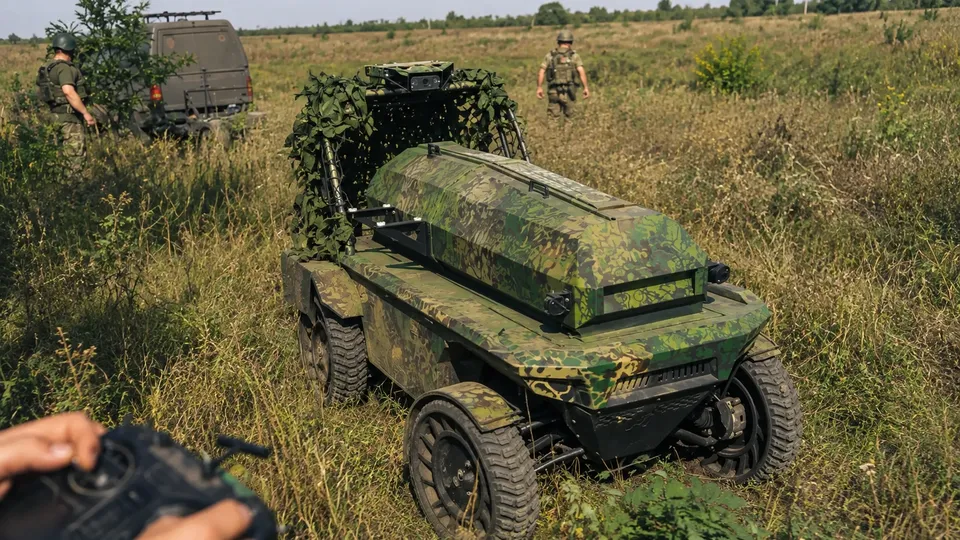
The fastest of the machines is called MAUL. It was built by the Ukrainian robotics company DevDroid, designed alongside specialists from the 1st Separate Medical Battalion, a unit that has repeatedly said speed is the key to successful evacuation. Where the company’s Droid TW-12.7 — a reconnaissance and strike system — tops out at 12 kilometers per hour, MAUL has recorded a mission peak of 72. It runs on an ATV chassis and a combustion engine, where most of the company’s fleet is battery-electric. Oleg Fedoryshyn, DevDroid’s director of R&D, called it a “unique device from all UGVs that we have because it’s very fast.” The speed dodges some drone attacks, he said, and it gets soldiers to treatment sooner.
Speed, in the telling of the people who use these machines, is not a luxury specification. Brave1, the Ukrainian government-backed defense technology incubator, frames it as necessity — “one of the main challenges of the modern battlefield is to save the wounded in time.” Last November the 1st Separate Medical Battalion described an evacuation that succeeded precisely because the robot outran a Russian drone. Nataliia, an engineer at an uncrewed systems company, told Ukraine’s defense ministry in December that the engine came from the battalion commander’s obsession: “he placed emphasis on speed. Existing solutions with electric engines did not allow us to reach the required speed.”
Drones have made the last few kilometers to a casualty the most dangerous ground on the front.
The words belong to Jeffrey Wells, a US Navy veteran of Iraq and Afghanistan now in Ukraine with the nonprofit Task Force Antal, training civilian medics near the front. “Yes, speed matters,” he told Business Insider. “Every minute a UGV spends crossing that ground is a minute it can be spotted and struck. From what I have seen this past year, speed shortens exposure, for the vehicle and for the wounded Ukrainian defender on it.”
And yet the same speed carries its own arithmetic of risk. At 72 kilometers an hour, Fedoryshyn conceded, a small mistake by the operator becomes a large one — a lag in the link, a misjudged turn, and “you will lose your vehicle.” Wells put it more precisely. The fast platforms “leave less room for operator error: a misjudged turn or a lost link at speed is more likely to end in a rollover, and a rollover with a wounded person aboard is a serious problem.” A rollover means other soldiers must go out into the drone-watched ground to help. “The operator is often working remotely, under fire, and exhausted, which compounds the risk.”
MAUL’s design answers some of this — an armored capsule, straps to hold the patient, regular modifications, and plans for more automation of the kind modern cars use to prevent crashes. And the machines are not always driven at their limits. The First Separate Medical Battalion has described an operation in which a robot capable of 38 kilometers an hour averaged 18.
But there is a quieter objection, and it is not about the vehicle at all. “A casualty isn’t cargo,” Wells said. Speed over broken ground means jolting, and jolting worsens bleeding, fractures, spinal injuries — and no medic rides alongside to monitor the patient. Velocity solves the problem of the drone. It does not solve the problem of the body. Wells called speed “one variable among several,” and named the others: “how fast a vehicle can safely move over that terrain, how well it can stay connected with its operator, how protected and stable the patient can stay, as well as how fast it can get to a place where a trained medic can help.” The whole chain, he said, is what matters.
Then there is the question of what soldiers actually have. Ukraine’s growing fleet hauls gear, lays mines, strikes Russian positions — but a unit rarely has a specialized robot for each job. “It’s not like they have 10 different types of UGVs,” Fedoryshyn said, and can choose at leisure. Soldiers strip the turret off a strike robot and use it for logistics. They load a casualty onto a machine never meant to carry one, “because they haven’t any other option.” DevDroid’s answer is to build more MAULs. Soldiers, for their part, often say they prefer generalist robots they can reconfigure on the fly — a preference that, as Business Insider reported, takes its toll when the mission is specialized. The dedicated evacuation robot, with its speed and its armor, usually offers the wounded the best chance of surviving.
A casualty isn’t cargo. The sentence settles over the whole question of how fast the machine should go, and it does not resolve it. Nothing out there resolves it.