
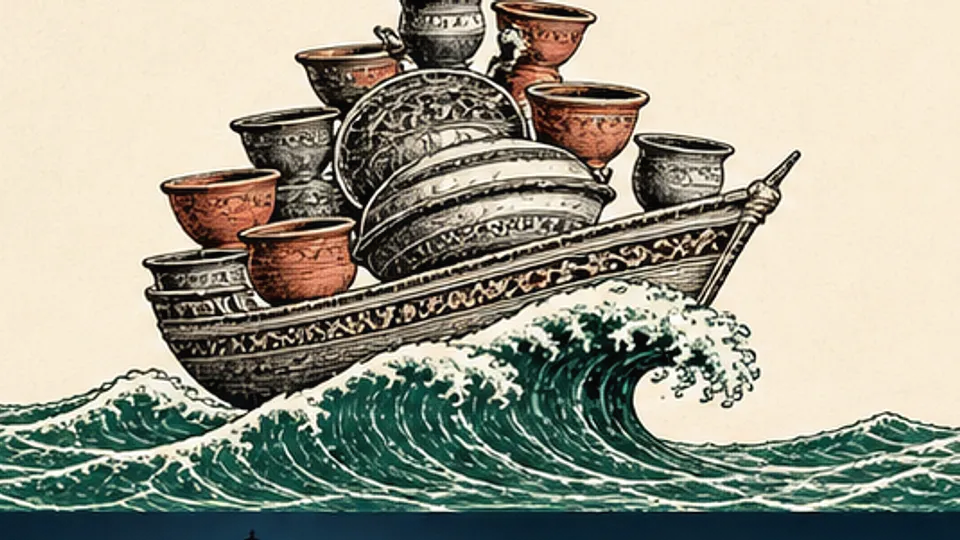
A ship went down off the Mediterranean coast of what is now Türkiye some 2,100 years ago, in the uncertain season between the Late Hellenistic world and the Roman one. It carried no gold, no marble, no weapons. It carried dishes — plates, bowls, serving trays, packed in clay and loaded in numbers that suggest not a pedlar’s venture but an industry’s consignment. The men who filled its hold died or swam for shore; the voyage was never completed. What they left behind is now coming up, piece by piece, from depths of between 42 and 55 meters off Adrasan, near Antalya.
According to Türkiye’s Minister of Culture and Tourism Mehmet Nuri Ersoy, archaeologists working the wreck have so far identified tableware in 122 different forms and sizes among the cargo. Akdeniz University’s Underwater Archaeology Research Center reports that 6,511 intact ceramic pieces were recovered from Adrasan in the first major excavation season of 2025 and transferred to Antalya Museum, while thousands of additional fragments went to the university’s Conservation and Restoration Laboratory in Kemer. And this by all accounts is not the whole of it.
The dishes a statesman wrote home about
The ceramics recovered from the seabed are associated with the region around ancient Rhosus, the port identified with modern Arsuz on the Gulf of İskenderun. It is a name that carries a curious echo. Around 50 BC, while serving as governor of Cilicia, Marcus Tullius Cicero — consul, orator, the man who measured his standing in Rome by the objects he could surround himself with — wrote to his close friend Titus Pomponius Atticus and mentioned that he had ordered Rhosica vasa: vessels, wares, of Rhosus.
One line in a letter, and it has held the attention of scholars for decades. They have proposed that Cicero’s Rhosus wares may correspond to what archaeology calls Eastern Sigillata A, a fine, red-gloss tableware distributed widely across the eastern Mediterranean and produced, archaeological and clay-distribution evidence indicates, somewhere around the Gulf of İskenderun. The precise identification remains debated — the dead, unlike the living, rarely sign their receipts. But the Adrasan wreck now offers something more than conjecture: a physical cargo, sealed in a single ship, from the very world that correspondence describes.
There is a quiet lesson in it. Two thousand years before shipping containers and brand names, a coastal workshop could already make a reputation that reached the desk of a Roman governor. Customers sought ceramics not merely for use but for where they came from. Production, packing, distribution, demand — the whole machinery of commerce was already turning, and this ship was one of its gears.
Packed in clay against the sea
The wreck’s most unusual feature is not the tableware itself but what the merchants did to protect it. According to Ersoy, they packed clay between the vessels inside their crates, so that plates and bowls would not strike one another as the hull rolled on the waves. The precaution served its purpose long past any voyage its makers could have imagined. For archaeologists the result is rare fortune: shipwreck cargoes are usually found shattered and scattered across the seabed. At Adrasan, many vessels survive intact enough for researchers to reconstruct both their shapes and the manner in which they were stowed for transport — a commercial shipment, as Arkeonews puts it, frozen in time.
Clay against clay. The potter’s earth wrapped around the potter’s work, and between the two, the ship sank and the centuries passed.
Work at 55 meters
Nothing down there comes easily. The excavation is being carried out at depths of 42 to 55 meters, with underwater robotic systems supporting the archaeologists on the seabed. The Adrasan project is part of a broader campaign of underwater archaeology along Türkiye’s Mediterranean coast: in 2025 alone, Akdeniz University teams documented ten shipwrecks during surveys in Antalya and Fethiye, while excavation continued at the far older Middle Bronze Age wreck off Kumluca. Even in that company, Adrasan stands apart for the sheer concentration of tableware preserved within a single hull.
What the wreck promises, beyond the vessels themselves, is evidence of a whole economic moment — how wares were produced, packaged and moved when maritime trade bound the ports of the eastern Mediterranean into one system of appetite and supply. A collection of this scale, held together in one cargo, can show what the market wanted, in what shapes and sizes, two millennia before the invoice was invented.
The journey that ended here
Some 2,100 years ago these plates and bowls were merchandise, not archaeology. They were loaded for customers somewhere beyond the horizon, part of the unceasing movement of goods between workshops, harbours and dining tables that made the Mediterranean, long before Rome owned it, a single marketplace. The ship never arrived. Whoever waited for that cargo waited in vain; whoever profited from it took the loss and sent another vessel. That is how commerce absorbs a disaster — quietly, and by sailing again.
Empires fell over this wreck in layers, the Hellenistic kingdoms, the Roman Republic, the Empire, Byzantium, the caliphates, the Ottomans, and the plates lay where clay had guarded them. Now they are rising into the light by the thousands, a dinner service for no one, and a rare physical trace of an ancient trade whose name was once grand enough to be written down by Cicero himself.