
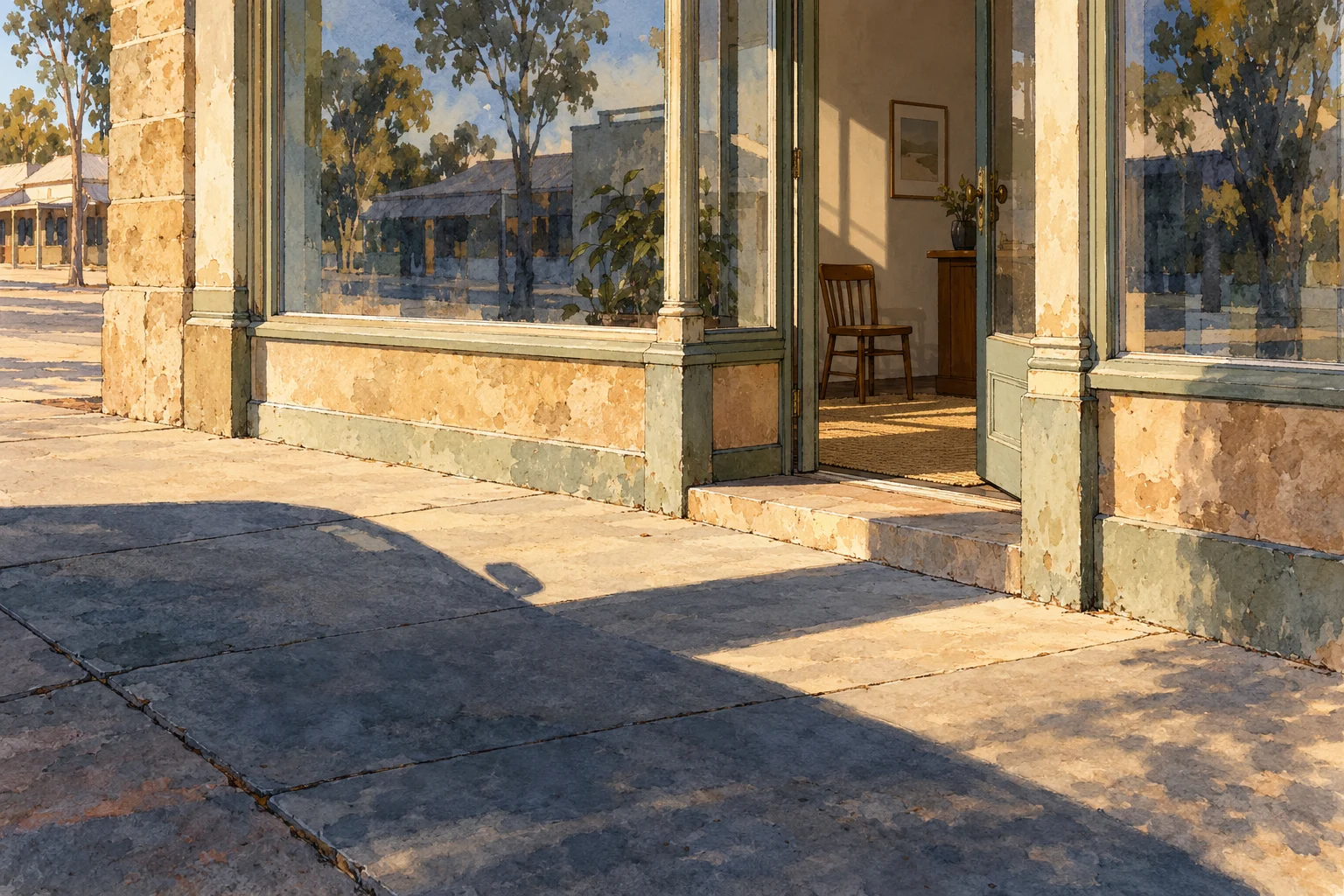
Wangaratta is a small city in the countryside of Victoria, some 200 kilometres north of Melbourne, a town of around 30,000 people where an elected member of parliament can still keep an office on the main road and walk in and out of it without a bodyguard. Australians have long been proud of this. Their politicians go about their business unarmoured, approachable, belonging to the street. Late on Monday afternoon, at about 3:30 p.m. local time, that old arrangement was struck by a Toyota Land Cruiser.
Helen Haines, 65, the independent member for the federal seat of Indi, was outside her electorate office when the vehicle hit her, Al Jazeera reported. She was airlifted to hospital and remains in critical condition. What happened next borrowed nothing from the script of officialdom: ordinary civilians, bystanders on a Monday afternoon, seized the 43-year-old driver and held him until the police arrived. Searching the Toyota, officers found a knife. Acting Superintendent Ashley Mason of Victoria Police, observing the Australian custom of not naming victims, said only that the wounded woman had suffered what had been described as critical injuries, and that there was no further threat to the public. The arrested man, police said, came from Tarrawingee, a hamlet twelve kilometres east of Wangaratta. It is not clear whether he had ever known his victim.
The temperature
The prime minister did not wait for the investigation before naming what he saw. “This wasn’t an accident. There was a deliberate act,” Anthony Albanese told the national broadcaster ABC, conceding that the motive remained unknown. “All of our thoughts are with Helen, her family, her friends, her team and her community at this extremely difficult time. We are praying for her full recovery.” A terrorism taskforce has been activated; CNN described a multi-tiered investigation drawing in the Australian Federal Police, Victoria Police, the Australian Security Intelligence Organisation and the Joint Counter-Terrorism Team.
Albanese reached for a word that rulers use when they sense the air itself turning hostile. “The temperature has increased in recent times,” he said. He addressed himself to the anonymous crowds of the comment threads: “If you look at anyone’s social media feeds and look at the comments, people will say things that they would never say face to face.” And, with the plainness of a man aware how much depends on the sentence: “There’s no place for political violence in a democracy.”
The numbers behind that word, temperature, are no longer impressions. CBC reported that Australian Federal Police Commissioner Krissy Barrett said in 2025 that threats against parliamentarians had doubled over the past three years, and Home Affairs Minister Tony Burke said on Monday that police data counted more than 1,000 such threats against politicians in the 2025–26 financial year. One thousand warnings, filed, logged, filed again — while the country’s representatives continued, as is their custom, to stand alone in their doorways.
A thoroughly decent human being
Those who study power know that the target of a crowd’s rage tells you something about the crowd. Haines came to parliament in 2019 not from a party machine but from three decades in rural health — a nurse, a midwife, an academic with a doctorate earned at Sweden’s Uppsala University with a thesis on childbirth; her own biography notes she built one of Australia’s longest-running rural midwifery services. In Canberra she carried the causes of her distance: stronger climate action, regional housing, gambling reform, mental health, an end to the war in Gaza. She worked with the Labor government to establish the National Anti-Corruption Commission, and made the unglamorous crusade for transparency and integrity in politics her signature — precisely the sort of crusade that earns a politician respect across party lines and, perhaps, a certain kind of enemy.
She is fiercely intelligent but, most importantly, she’s just a thoroughly decent human being.

So said the prime minister, who also called her “incredibly hardworking”. Her family, in a statement posted to her Facebook page and later asking that their privacy be respected, offered the spare vocabulary of the waiting room: “This afternoon, our beloved Helen was involved in an incident outside her Wangaratta Electorate Office, and is receiving medical care. We thank the swift assistance of bystanders and the dedicated health workers who assisted her, and police for their response.”
The shutters come down
By evening the shock had travelled the length of the political spectrum. Opposition leader Angus Taylor called it a “shocking day”. “Our nation cannot become a place where violent attacks are normalized,” he said. Pauline Hanson, leader of the right-wing One Nation party, declared there was no place for violence against any elected representative: “Members of parliament and their staff must be able to serve their communities without fearing for their safety.”
As the politicians spoke, officers worked inside a cordon on the main road of Wangaratta, beside the small office whose door had always stood open. Whether that door, and a thousand others like it across the country, will stand open in quite the same way now is a question the police tape asks better than it answers. For one night, the country waits on a hospital room, and on whatever can be learned from a man from Tarrawingee and a knife in a Toyota.