
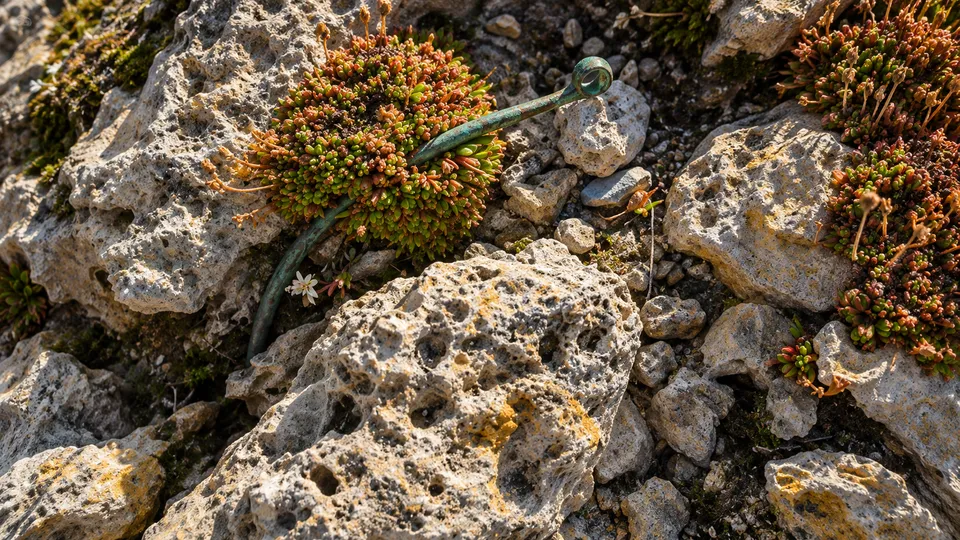
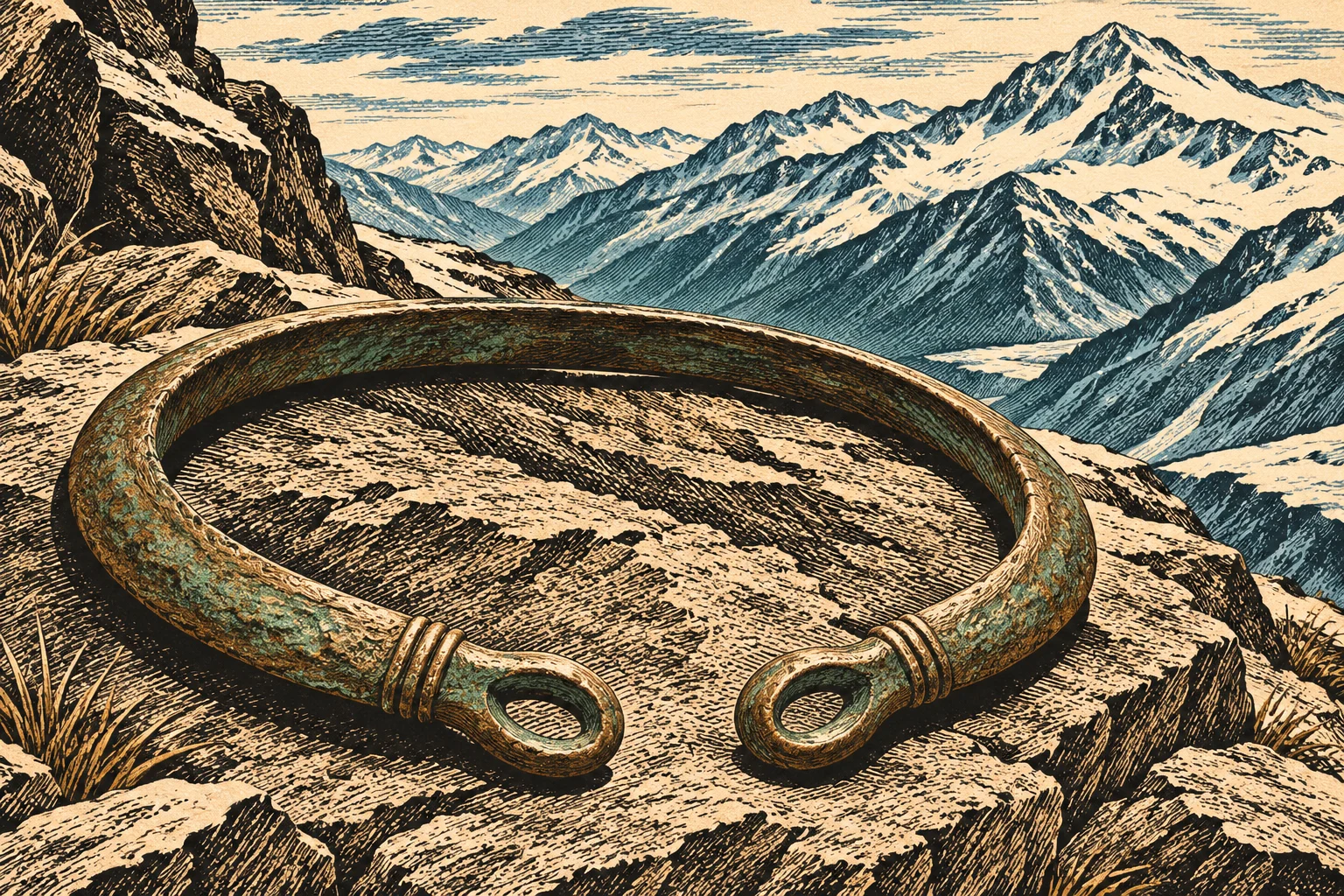
A bronze ring 13 centimeters across, with two loop-shaped ends, turned up above 2,600 meters on the Lötschen Pass in the Swiss Alps sometime before archaeologists documented it in mid-October 2026. The Archaeological Service of the Canton of Bern found it during what its announcement calls a routine survey; the canton’s education and culture directorate announced the find on November 18. The object is dated to the Early Bronze Age, 2000 to 1700 BC — a 300-year bracket, not a point in time, because bronze doesn’t carry a carbon clock.
Radiocarbon dating works on organic material: it measures the decay of carbon-14 in something that was once alive. An alloy of copper and tin has no such isotope to measure. So the date on this ring comes from typology — comparing its shape, in particular the two looped ends, to similar neck rings recovered from graves at Gwatt, Einigen and Hilterfingen, three sites in the Bern region where the burial context pins down the period. Those graves held such rings on both men and women, which means the typology can bracket an era but can’t assign a sex, let alone a name, to whoever carried this one up the pass.
Lötschen Pass already had an archaeological record before this find, documented in a two-volume monograph published in 2015 by Albert Hafner and colleagues: bows carved from elm and yew wood, arrow fragments, scraps of leather, a wooden container that still held coarsely ground cereal flour, plus Roman coins and medieval arrowheads from later crossings. None of it was bronze, and none of it was jewelry. This ring is both — the first metal object and the first ornament ever recovered from this specific pass — and it surfaced away from the spots where the earlier finds came up.
The pass holds patches of permanent snow and firn that accumulate over centuries, burying whatever sits on the ground beneath them. Objects don’t need the ice to survive: bronze will sit in exposed soil for four millennia without much trouble, which is why Bronze Age axes turn up in farmers’ fields across Europe with no help from a glacier. What the ice does is hide things, then, as it melts, un-hide them on a schedule set by the climate rather than by an archaeologist’s trowel. Swiss outlets reporting the canton’s statement say objects have been surfacing at Lötschen Pass by this route since 2011, the year local ice cover apparently thinned enough to start giving things up.
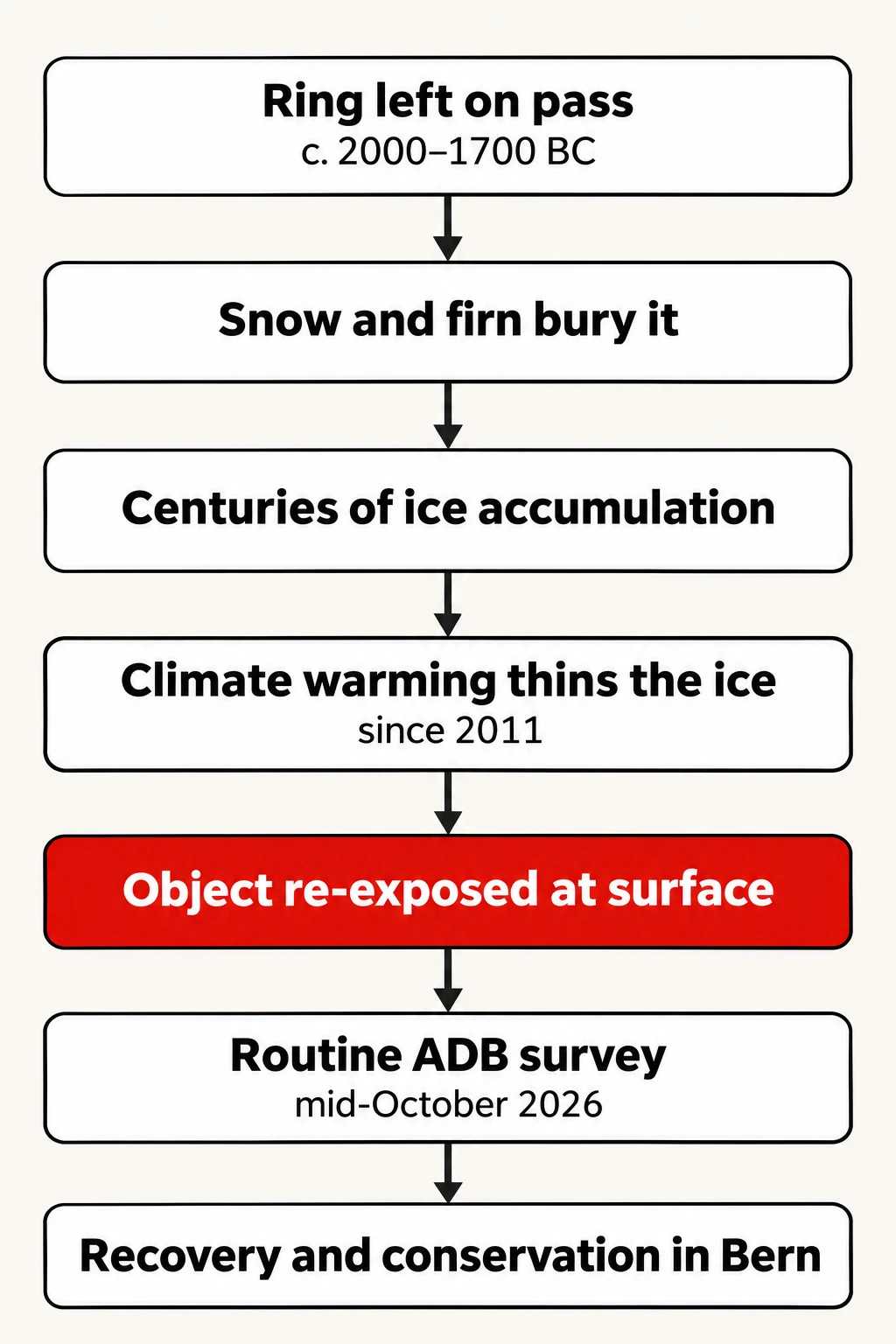
| From | To | How |
|---|---|---|
| Ring left on pass (c. 2000–1700 BC) | Snow and firn bury it | |
| Snow and firn bury it | Centuries of ice accumulation | |
| Centuries of ice accumulation | Climate warming thins the ice (since 2011) | |
| Climate warming thins the ice (since 2011) | Object re-exposed at surface | |
| Object re-exposed at surface | Routine ADB survey (mid-October 2026) | |
| Routine ADB survey (mid-October 2026) | Recovery and conservation in Bern |
Based on Archaeological Service of the Canton of Bern, as reported
Measured against the Alps’ other well-documented ice site, Lötschen Pass’s tally is thin. At Schnidejoch, a pass roughly 13 kilometers away at 2,756 meters, a melting ice patch has produced more than 900 objects since exposure began in 2003, spanning the Neolithic through the early medieval period — roughly the 5th millennium BC to around AD 1000, according to the published record of that site’s excavation. Lötschen Pass, over a comparable stretch of attention, has given up a double handful of weapon fragments, some coins, some arrowheads, and now one ring. A site that has produced a single bronze object in its entire excavated history can’t tell you whether that object is typical of anything; it can only tell you that one ring was there.
The canton’s archaeologists read the ring as a deliberate deposit rather than an accidental loss — an offering to a deity, made either to ask for safe passage or to thank one for it. Archaeologist Regula Gubler put the reasoning to Radio BeO in three words: “Das ist etwas Wertvolles” — “This is something valuable.”
Das ist etwas Wertvolles.
That’s the whole argument: the object was worth enough that losing it by accident seems unlikely, so it was probably left on purpose. Nothing in the reporting describes a cairn, a deposit pit, or any accompanying object that would support the offering reading on its own; it rests on the value of the ring and on the general pattern, known from burials elsewhere, that such rings accompanied people — and, in a grave, their bodies — rather than getting mislaid on a trail.
The canton has built infrastructure for exactly this kind of discovery. Since 2024, an app called IceWatcher, launched by the Valais cantonal archaeology office, lets hikers photograph a find next to an object of known size, geotags it, and routes the report to the relevant canton’s archaeological service — coverage spans Bern, Valais, Graubünden, Uri, Vaud, and border areas of France, Italy and Austria. The app exists because melt-driven exposure isn’t going to stop on its own. Whether Lötschen Pass’s find count ever approaches Schnidejoch’s 900-plus is the number worth watching as the ice there keeps thinning.