
Chronic traumatic encephalopathy has only ever been diagnosed one way: cut open a dead brain, stain it for a misfolded protein called tau, and look for the pattern around blood vessels that distinguishes CTE from Alzheimer’s and everything else. That meant no living person could be told they had it, no drug trial could enroll a patient by diagnosis, and no doctor could track whether a treatment was working. On November 19, a team led by Boston University and Banner Health reported in JAMA that a blood test may change that — tested so far on 21 people.
The 21 were former football players: 12 had played professionally, seven in college, two only in high school. Each had blood drawn while alive, through long-running Boston University studies, and donated a brain after death to the university’s brain bank. On autopsy, 18 of the 21 had CTE and three did not. Of the 18, 16 were high-stage disease — stage 3 or 4 on the four-point scale devised by BU neuropathologist Ann McKee — and two were low-stage. A blood protein called eMTBR-tau, a fragment of the same tau that clumps in CTE brain tissue, was elevated only in the 16 high-stage cases. It was flat in the low-stage brains and flat in the three brains with no CTE at all. A second marker, p-tau217, already used to flag Alzheimer’s, lit up only in the five subjects who had Alzheimer’s alongside their CTE — letting the researchers tell the two diseases apart from a vial of blood rather than a slide.
| Players (players) | |
|---|---|
| No CTE | 3 |
| Low stage (1–2) | 2 |
| High stage (3–4) | 16 |
Source: Boston University
Michael Alosco, the BU CTE Center’s co-director of clinical research and the study’s corresponding author, called the result “a game changer” in Boston University’s own account of the findings, while cautioning that the team is “still in the discovery phase and it’s a small sample size.” The study had no age-matched control group, only two low-stage cases to establish where the biomarker’s floor sits, and no FDA clearance pending — Alosco put a validated, approvable test perhaps five years out, contingent on larger studies confirming the pattern. A second, independently run paper in the same week’s JAMA, using a related marker called eMTBR-tau243 in a separate cohort, found the same elevation in confirmed CTE cases. Two small studies converging on the same signal is better evidence than one, but it is still evidence from fewer than 50 postmortem brains combined, not a diagnostic test anyone can order.
A diagnosis rate depends on who got counted
The new finding sits on top of a research infrastructure built from decades of brain donations. BU’s CTE Center brain bank holds more than 1,800 donated brains. In 2023 the center reported finding CTE in 345 of 376 former NFL players it had examined — 91.7 percent — in a press release that McKee herself flagged as misleading if read as a population rate: brains get donated disproportionately by families who already suspect something went wrong, so the sample is not the league. A different, population-based estimate came in August 2026, when BU researchers published in the BMJ that 215 of 878 NFL players who died between 2016 and 2021 and whose brains were examined — 24.5 percent — had CTE, a figure lead author Daniel Daneshvar called the floor, with a possible ceiling as high as 97.7 percent depending on how undiagnosed cases are modeled. Co-author Jesse Mez called it “a call to action.” Those two numbers, 91.7 percent and 24.5 percent, measure different things — a self-selected donor sample versus a mortality-based estimate for an entire cohort — and neither is the kind of figure a 21-person biomarker study can yet be checked against.
From a bar stool to a brain-donation pledge
How researchers find subjects for a disease that cannot yet be diagnosed in life is its own mechanism, and it ran, in one case, through a bar in Cambridge. Charles “Chip” Collins played quarterback at St. Mark’s School in Southborough and nowhere after that — seven years of football, all of it before college. He went on to run the National Fish and Wildlife Foundation as its first executive director starting in 1986. In his mid-50s he began skipping flights and missing meetings; over several years, doctors ruled out Alzheimer’s, Lewy body dementia and Lyme disease, settling on a vague diagnosis of vascular dementia, as the Boston Globe reported in the story this account draws on. He moved into a Lexington memory-care facility in early 2023.
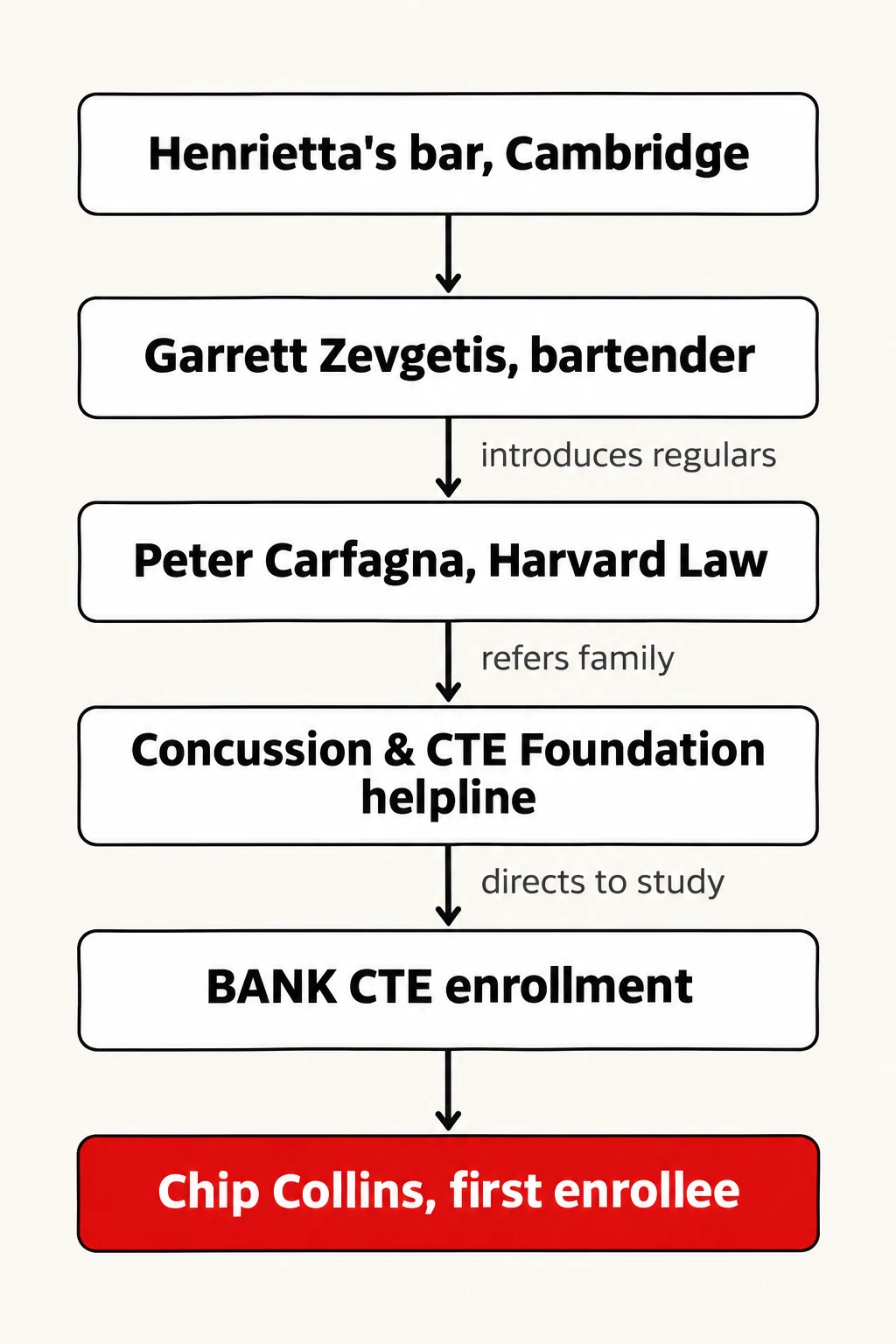
| From | To | How |
|---|---|---|
| Henrietta's bar, Cambridge | Garrett Zevgetis, bartender | |
| Garrett Zevgetis, bartender | Peter Carfagna, Harvard Law | introduces regulars |
| Peter Carfagna, Harvard Law | Concussion & CTE Foundation helpline | refers family |
| Concussion & CTE Foundation helpline | BANK CTE enrollment | directs to study |
| BANK CTE enrollment | Chip Collins, first enrollee |
Based on Boston Globe reporting
The bartender, Garrett Zevgetis, had sat in on a sports-law class at Harvard taught by Peter Carfagna, a board member of the Concussion and CTE Foundation, while researching a documentary. In October 2024, Zevgetis introduced Carfagna to Collins’s wife and daughter, regulars at the same bar. Carfagna pointed them to the foundation’s helpline, which led them to BANK CTE, a Boston University and UCSF-run study funded by the National Institute of Neurological Disorders and Stroke. Enrollment there, according to the study’s own site, requires only a one-time blood draw at a Quest lab and a pledge to donate one’s brain — a lower bar than the NIH-funded DIAGNOSE CTE Research Project, which recruits only men over 50 who played college or professional tackle football. Collins, with no college or pro career, would not have qualified for that program. He qualified for BANK CTE, and became its first enrollee.
He died a month later, at 70. Autopsy, after a year of analysis, found stage 4 CTE — the most advanced stage on McKee’s scale — in a brain whose owner had stopped playing football at 18. His case does not appear among the 21 in the new JAMA paper; Boston University’s broader biomarker research draws on donors enrolled through programs including BANK CTE more generally, which is the connection the Globe’s reporting draws between Collins and last week’s finding.

The next test of the biomarker is scale, not concept: whether eMTBR-tau tracks with stage and symptoms in a cohort large enough to include people who are not already dead. Alosco’s team and the $15 million NIH-funded DIAGNOSE CTE-II project, awarded in 2025, are built to run that test. Whether a signal found in 16 high-stage brains out of a convenience sample of 21 holds up in the much larger, much less selected population of people who are worried about their football years and still alive to ask — that’s the number nobody has yet.