

Nearly 200 Afghans were on a removal list for a flight the Trump administration planned to run through Pakistan on Nov. 3, with Pakistani authorities then expected to push them over the border into Taliban-controlled Afghanistan. A federal judge blocked that flight before it left the ground. As of Nov. 28, no new date has been announced, but Shawn VanDiver, president of the resettlement advocacy group #AfghanEvac, said on social media that new flights are scheduled for next week; he did not say which court order, if any, they would operate under, and did not respond to a request from CBS News for detail.
The mechanism that put those roughly 200 people on a removal list runs through an administrative decision made 18 months earlier. On May 12, 2025, then-Homeland Security Secretary Kristi Noem terminated Temporary Protected Status (TPS) for Afghanistan, the designation that had let Afghans already in the U.S. live and work here without fear of deportation because conditions at home were deemed too dangerous for return. Noem’s determination, published in the Federal Register and summarized in a DHS announcement, found the opposite: that “Afghanistan has had an improved security situation, and its stabilizing economy no longer prevents them from returning to their home country.” The designation had covered roughly 9,000 to 11,000 people and had been granted by the Biden administration in 2022. Work permits and deportation protection lapsed on July 14, 2025, after a 60-day transition window and despite a Maryland federal lawsuit from the advocacy group CASA that won only a brief administrative stay from the Fourth Circuit.

Losing TPS does not by itself get someone deported; it removes the legal shield that had kept Immigration and Customs Enforcement from prioritizing their case. What changed in October 2026 was ICE acting on that opening: at least 76 Afghans have been detained since Oct. 14, VanDiver said, and the agency assembled the Nov. 3 Pakistan-transit flight list. Reports reaching #AfghanEvac put at least three women on that flight. Two of the people facing removal are listed only as Jane Doe in the court filing that stopped it, part of an emergency complaint filed Nov. 2 in the U.S. District Court for the Southern District of New York by the nonprofit Project Rousseau, as CBS News reported.
How the injunction held
The case moved fast and narrowed as it went. District Judge Valerie Caproni issued a temporary restraining order the same day the suit was filed, holding the government to its own representation that it had no confirmed charter or commercial flights booked, according to Jurist. That order was set to lapse Nov. 7. The court also raised doubts about whether Project Rousseau itself, rather than its individual clients, had standing to sue, and ordered an amended complaint by Nov. 9. On that date, District Judge Victor Marrero issued a narrower order barring removal of five named Afghan nationals specifically, while declining to certify a class covering the full group and leaving the broader legal question undecided, as Davis Vanguard reported. On Nov. 17, the court converted its stopgap orders into a preliminary injunction, which remains the operative block as of this writing.
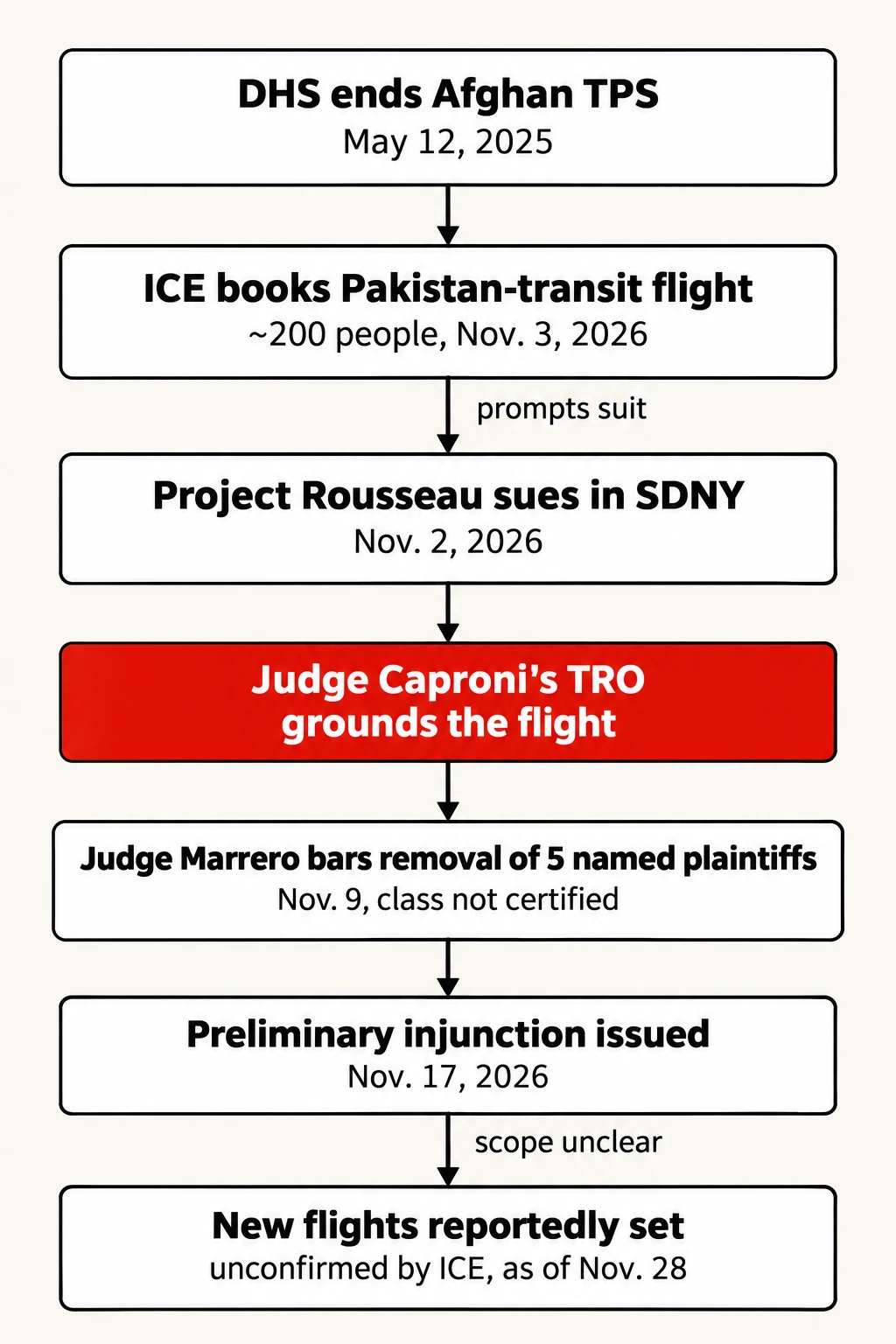
| From | To | How |
|---|---|---|
| DHS ends Afghan TPS (May 12, 2025) | ICE books Pakistan-transit flight (~200 people, Nov. 3, 2026) | |
| ICE books Pakistan-transit flight (~200 people, Nov. 3, 2026) | Project Rousseau sues in SDNY (Nov. 2, 2026) | prompts suit |
| Project Rousseau sues in SDNY (Nov. 2, 2026) | Judge Caproni's TRO (grounds the flight) | |
| Judge Caproni's TRO (grounds the flight) | Judge Marrero bars removal of 5 named plaintiffs (Nov. 9, class not certified) | |
| Judge Marrero bars removal of 5 named plaintiffs (Nov. 9, class not certified) | Preliminary injunction issued (Nov. 17, 2026) | |
| Preliminary injunction issued (Nov. 17, 2026) | New flights reportedly set (unconfirmed by ICE, as of Nov. 28) | scope unclear |
Based on Court filings, as reported by Jurist and Davis Vanguard
That last link in the chain matters more than the headlines about it suggest. Marrero’s Nov. 9 order protected five named plaintiffs, not the roughly 200 people on ICE’s original list; no outlet covering the case has reported that the class was ever certified. Whether the Nov. 17 preliminary injunction extends protection to everyone who was on that removal list, or only to the handful who are named parties, is the open question that determines what “new flights scheduled for next week” would actually mean for the other roughly 195 people.
Who the removal list actually contains
The population at risk is recent and, on the Migration Policy Institute’s accounting, poor. The U.S. Afghan immigrant population roughly quadrupled between 2010 and 2024, and the bulk of that growth, about 180,000 people, arrived after August 2021, when the U.S. withdrawal ended and the Taliban retook Kabul, per MPI data cited by CBS News. That cohort arrived with little capital and even less time to build any: MPI’s analysis of 2022 American Community Survey data found that 39% of Afghan immigrants lived in poverty that year, against 14% for immigrants overall and 12% for the U.S.-born, with a median Afghan immigrant household income of $48,000 versus $75,000 for both the native- and foreign-born populations generally, according to MPI’s profile.
That three-fold poverty gap is the backdrop for why many of these households, including the one at the center of CBS News’s reporting, never finished the green-card process: it stalled after an initial application roughly nine months into their time in the U.S., according to Shaima, a 56-year-old mother of four and former doctor who asked to be identified by first name only, whose husband worked alongside the U.S. government in Afghanistan for more than five years. “Now all the time we are afraid,” she told CBS News. “My husband wants to go to buy some grocery but we are afraid because we don’t have green card.”

For women specifically, the stakes of removal are categorically different, which is why the court filing centers two Jane Does and why advocates flagged the three women reportedly on the canceled flight. Since the Taliban retook power in 2021, Afghan women have been barred from secondary school, university, most paid work and political office. Afghan girls are formally barred from school past sixth grade. UN Women’s current accounting finds that nearly 30% of Afghan girls under 18 are married, including 10% married before age 15, and that the agency has documented rising rates of gender-based violence alongside the education and work bans. “If returned to Afghanistan, women will face the consequences more than anyone in the family,” said Naheed Samadi Bahram, U.S. country director for Women for Afghan Women.
The slower track: a discharge petition
Parallel to the litigation, a legislative fix is moving at the pace discharge petitions move at, which is slowly. On Nov. 9, Reps. Sam Liccardo and Jason Crow filed a discharge petition to force a House floor vote on the bipartisan Afghanistan TPS Act of 2026, which would restore TPS through 2029 for Afghans already in the U.S. by that date who pass biometric and security screening, according to Liccardo’s office. The bill is co-sponsored by Republicans Don Bacon and Maria Elvira Salazar, and a Senate companion, S. 5308, was introduced Aug. 6. The petition needs 218 signatures to force a vote over leadership’s objection; it opened with 21 on its first day (20 Democrats and Bacon) and had reached 109, roughly half the threshold, by Nov. 12. House Republican leadership has not scheduled the bill for a vote. The precedent lawmakers point to is a similar discharge petition this year that forced a vote extending TPS for Haitian immigrants, reaching 218 after four Republicans joined every Democrat.
The numbers to watch now are procedural rather than humanitarian: how many more signatures the TPS Act petition picks up before the House’s remaining floor days run out, and whether the flights VanDiver says are scheduled for next week test the five-plaintiff scope of Marrero’s order or the broader one Caproni’s TRO implied. ICE has not confirmed any new flight date, and did not respond to CBS News’s request for comment on the record.