
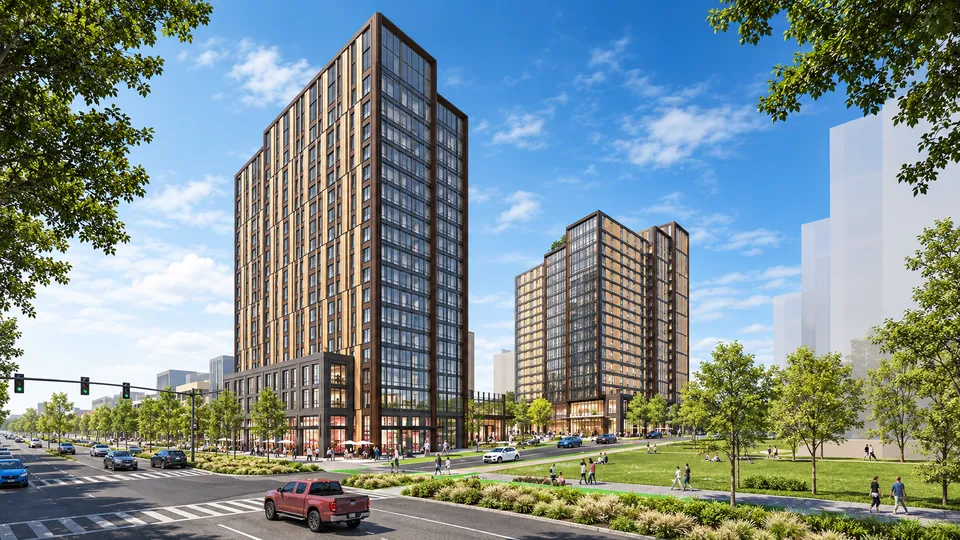
The mechanism in dispute is a June 2026 deadline. Copper Mill, the developer behind a planned 750-unit, two-tower project at 75 Morrissey Boulevard in Dorchester, alleges in a new lawsuit that its joint-venture partners deliberately blew that deadline — because letting it pass would void Copper Mill’s $67.5 million purchase of the site and hand it back to them, free to sell to someone else at a higher price. The Boston Globe lays out the complaint.
How the deal was structured
The 2.24-acre parcel was bought in 2017 for $56 million by two investment firms, Virginia-based Pactolus and Chicago-based POB. Copper Mill alleges they did little with it for years, then agreed in December 2024 to sell it to Copper Mill for $67.5 million — an $11.5 million markup over seven years — with the sale to close after Copper Mill obtained city permits. The contract put a hard date on that: June 2026. Miss it, and the purchase-and-sale is void, the investors keep the land, and Copper Mill is out.
Copper Mill moved fast. In August 2025, the Boston Planning and Development Agency approved two 18-story residential towers on the site — 750-plus permitted units in a city with a documented housing shortage, secured roughly nine months after signing.

That approval, the complaint alleges, is exactly what changed the sellers’ behavior. In a conversation the complaint recounts, POB managing principal Richard Holly told Copper Mill CEO Andrew Flynn that ‘if you guys actually secure permits for 754 residential units at the property, [Pactolus CEO Alan Harter] and I are going to look like morons’ for agreeing to the $67.5 million price. The permits had repriced the land, and the sellers, per the complaint, decided they had sold too low.
The alleged scheme
Holly then pitched Flynn on a joint venture instead of an outright sale: the investors would raise the capital, Copper Mill would keep doing the development work. Flynn agreed. Copper Mill now alleges the venture was a mechanism for running out the clock — the investors’ promised meetings with funders fell through, they made clear they would not raise capital by June 2026, and the complaint calls the failure purposeful. At one point, it alleges, Harter told Flynn: ‘There is no way that I am buying my own [expletive] dirt.’

Earlier this year, the complaint says, Pactolus and POB shopped the project to a different, unnamed Boston developer at a $82.5 million valuation — $15 million above the Copper Mill price — describing it as ‘shovel ready’ on the strength of permits Copper Mill had obtained. The original purchase-and-sale agreement, the complaint notes, barred the investors from marketing the site or entertaining other offers at all. Pactolus declined to comment to the Globe; POB did not respond to requests for comment.
Copper Mill is asking the court to enforce the original sale and is also seeking damages. ‘Copper Mill hoped this step would not be necessary,’ its attorney, Aaron D. Rosenberg of Sheehan Phinney Bass & Green PA, said in a statement. Flynn, in his own statement, emphasized the project’s approvals from the city and neighborhood: ‘housing that is needed now, without further delay.’
Josh Zakim, a former city councilor who runs the housing advocacy group Housing Forward MA, called the dispute ill-timed. ‘It’s a significant project, especially these days when there’s not a lot of developers even trying to do something of this size,’ he said. The number that decides the case is likely the one embedded in Holly’s alleged remark: whether a signed $67.5 million sale can be escaped by letting your own joint venture starve, now that the permits make the dirt worth $82.5 million.