
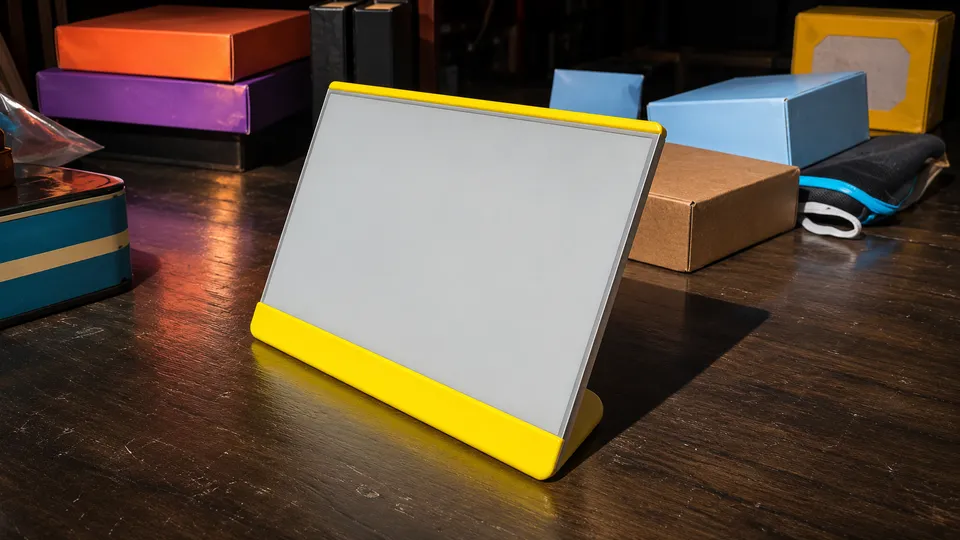
Most screens in a modern kitchen want something from the person standing in front of them: a tap, a spoken command, a monthly payment. At the start of November, writing in Ars Technica, Nick Indge described one that wants nothing. It is a 7.5-inch black-and-white e-paper panel, 800 by 480 pixels, built from a $48 kit that Seeed Studio developed with the software company TRMNL. It stays on. It cycles through whatever its owner has chosen: calendars, weather, news, and the inventions of a community of tinkerers.
Indge had tried this before. He once converted a Lenovo ThinkSmart View, a business video device selling for around $30 on eBay during a liquidation, to run a fork of LineageOS. Its limited memory made it sluggish. The e-paper kit promised the opposite: no interface to fight with, because the screen fills itself, and no subscription required.
It is a small object. Small objects sometimes carry large questions, and this one carries the central question of the connected household. To whom does the screen answer?
A question on social media
The history is short. Ryan Kulp, an independent hardware enthusiast, founded TRMNL in 2023, and its first e-paper device was crowdfunded in 2024. In March 2025 Seeed, an established open-hardware maker in Shenzhen best known for its XIAO microcontroller boards, teased an XIAO e-paper panel on social media. Someone in the community asked whether it could run TRMNL’s firmware. That single question brought the two teams together. In July 2025 they announced a formal partnership, and Seeed’s launch post introduced the kit that month. Hackster.io reported a launch price of $44.90 without an enclosure, with a limited pre-order discount to $35.92.

The two companies split the work cleanly. Seeed designs and manufactures the hardware. TRMNL maintains the firmware, the plugins and the hosted service. The box holds an XIAO ePaper Display Dev Board with an XIAO ESP32-S3 Plus soldered on, the panel, a 10 cm FPC extension cable and connector, a 2,000 mAh rechargeable lithium-ion battery and a Wi-Fi antenna. Seeed’s own documentation says the battery can last up to three months in deep sleep if the screen refreshes every six hours.
Indge set it against the recently announced Apple HomeView, a $299 hub meant to get the whole family interacting with it. The TRMNL kit, in his reading, is its antithesis: an entirely passive thing.
Three roads, three sovereigns
The device itself does almost nothing. It pings an API and displays the picture it is handed. Whoever sits at the other end of that API is the real ruler of the screen, and the owner may choose among three.
The first is TRMNL’s own cloud, which the company calls its BYOD ecosystem, for bring your own device. After a 14-day trial the owner pays a one-time $50 licence to stay connected; TRMNL’s shop page describes it as a perpetual licence for one device, refundable within 14 days. Indge found the “free” trial a misnomer: before registering the device he had to enter a credit card and pay $1. The device’s MAC address is then swapped for a shorter “friendly code,” and a marketplace opens, running from Google Calendar, weather and stock quotes to rotating factoids about the Ferengi Rules of Acquisition from Star Trek. He judged $50 a fair price for the people who do all the rendering, and said he prefers a one-time fee to “yet another forever subscription.”

The second road is Seeed’s SenseCraft, a similar marketplace with no licence fee, alongside Home Assistant compatibility, a plugin repository and a design workspace. Its browser tool promises to “flash official firmware from the browser. No coding. No terminal. Just clicks.” Indge found the promise held once he had a USB-C to USB-C cable and a Chromium-based browser. Firefox users are left out. Setup then mirrored TRMNL’s, minus the credit card. The cost of free is jurisdiction: Seeed is based in China and works under its own privacy policy. “Your call,” Indge wrote.
The third road leads home. Terminus is TRMNL’s open-source container for people who run their own server, and its GitHub page promises “privacy first functionality by empowering you to run your own private server, network, and devices. You own the stack and the data.” The repository shows an MIT-licensed application written in Ruby, and TRMNL’s developer page confirms that self-hosters need no licence. Plugins can be written in HTML, which the screen renders as a bitmap. In exchange, the server has to stay online, and someone has to keep it running.
Here is a reflection, not a finding: every road out of dependence charges a toll, and what changes is the currency. One road takes cash. The second takes trust in a foreign company’s privacy policy. The third takes your evenings.

The ribbon cable
The kit came with no case. Print files for the recommended stands are freely available, and Indge had one made on his local library’s Bambu printer for $8. He left the PLA colour as “dealer’s choice” and got canary yellow. There are two official designs, a triangular prism and an L-shape. He chose the L and advises others against it: he had to cut a channel for the ribbon cable, and needed needle-nose pliers to pull support trees out of a narrow gap.
The cable was the hard part. The FPC is extremely fragile and can break if it is forced around a sharp bend, which is exactly what the L-shaped case demands. Tweezers failed. What worked, on a tip from a commenter on MakerWorld, was a strip of paper tape stuck to the end of the ribbon connector, used to pull it through the passage.
When the kit first powers on, the display shows the TRMNL logo and a QR code. The code leads to a setup guide written by Kulp himself. When Indge opened it, it had been updated 15 minutes earlier. Even a screen that asks for nothing has someone at the other end, still editing.