
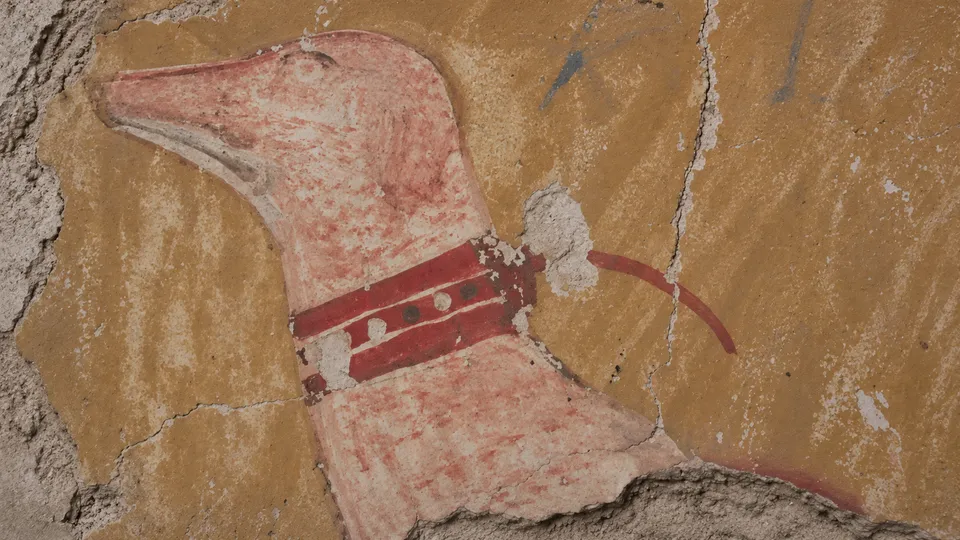
Around 3,500 years ago, an Egyptian official named User had his dogs painted beneath his chair inside his tomb at Thebes, the way you or I might keep a holiday snap on the mantelpiece. Three collared dogs sit upright under him in the surviving offering scenes — slim, athletic animals of the type usually described as sloughi-like, with drooping ears and curved tails. Two of them had their names read long ago: qn[j]j, “Strong one,” and mAaty, “Trusty.” The third dog’s name was written above and behind its head in paint that had faded almost to the colour of the wall behind it, so for as long as anyone has been cataloguing these things, dog number three went anonymous.
No longer. Egyptologist Chelsea Kaufman — of Johns Hopkins University, according to La Brújula Verde — re-examined the scene using DStretch, a plug-in for the ImageJ software that amplifies tiny differences in surviving pigment. Once the image was processed, the hieroglyphs came back into focus, and the name could be read: dwA.ty, roughly “He-of-the-Underworld.” Kaufman’s study, published in The Journal of Egyptian Archaeology, adds it as the 97th known dog name from ancient Egypt.
That is a striking thing to call a dog, and Kaufman thinks the dog’s owner knew it. She reads dwA.ty as a derived adjective of origin — essentially, the dog who belongs to the land of the dead — and notes that the same word appears as an epithet of Anubis, the jackal-headed god of cemeteries, embalming and the protection of the dead. Naming your dog something like “He-of-the-Underworld,” inside the tomb where you intend to spend eternity, looks a lot like a wink at the canine god in charge of the neighbourhood.
Kaufman is careful, though, and the care is the interesting part. One of the signs can carry a second phonetic value, which would produce the alternative reading sbA.ty — “pupil,” as in a student. She considers that less convincing in a funerary setting, but she does not pretend the inscription proves User named his pet directly after Anubis. What the evidence gives you is a name whose strongest linguistic and contextual reading points toward the realm of the dead and a god whose imagery was thoroughly canine. In Egyptology, as in finance, the disciplined statement of what you actually know is worth more than the exciting version.
Zoom out and the whole corpus is oddly revealing. Fewer than 100 dog names survive from all of ancient Egypt, from the Old Kingdom to the Ptolemaic Period. Many describe looks or personality — hence Strong one and Trusty — a smaller number carry religious associations, and some turn up as human names too, suggesting Egyptians did not treat dog-naming as a separate category from people-naming. Dogs, in fact, dominate the evidence for named animals of any kind. Horses occasionally got names, a handful of other cases are disputed, and that is about it. Egyptians drew and carved animals constantly; dogs are the ones they bothered to name.
Where those names survive matters as well. More than half of the recorded examples come from private tombs — and an Egyptian tomb was not just a storage facility for a body. It was a machine for preserving an identity. Tomb imagery had an active funerary function: a depiction could help sustain the existence of whoever or whatever was depicted, and a written name kept that identity available to be spoken and remembered. Paint your dog under your chair, write his name over his head, and he comes with you. Kaufman argues that User was not merely decorating; he appears to have been making arrangements for his dogs to remain part of the world he hoped to inhabit after death.
The third dog was, on top of everything, painted to be unmistakably himself. His coat is white with red, rippling bands — a pattern that resembles brindling while also echoing the rippled fabric of the clothing User wears in the same scene. Kaufman says she knows of no comparable coat on any other dog in Egyptian art. Even the spelling of his name got bespoke treatment. Egyptian dog names that take a determinative — a classifying sign at the end of a word — almost always use a standing dog. Here the determinative is a seated dog, in the same posture as the animal painted below it. Only one other seated-dog determinative is currently known among Egyptian dog names, on a Middle Kingdom dog coffin.
So the same animal carries an unprecedented name, an unmatched coat and one of the rarest hieroglyphic flourishes in the catalogue. Kaufman declines to say precisely what the artist meant by it all, which is fair enough after 3,500 years. What survived, barely, was a handful of faded signs — and what they preserved was not just a picture of a man with his dogs, but the name people once called him by.