

A 22 kg (48.5 lb) adult primate is the subject of the new predation paper, while remains reported from Chad came from olive baboons weighing up to 57 lb (26 kg). That upper figure is 2.0 times the previous 28 lb (12.7 kg) on-record weight limit for raptor predation on primates. The mechanism matters more than the ratio: an eagle need not lift its victim to kill it.
In 2025, researchers led by Catherine Hobaiter of the University of St Andrews found baboon remains among the sandstone cliffs of Chad’s Ennedi Plateau. As Becky Ferreira reports for 404 Media, the team attributes the likely kills to Verreaux’s eagles, among the world’s largest eagle species. The skulls bore talon punctures and the shoulder bones had scrapes consistent with eagle predation.
The carcasses establish feasibility, not an witnessed kill. “We cannot definitively rule out scavenging activity, but the severity of punctures is suggestive of lethal interactions through a killing grip,” the researchers wrote. Separately, baboons rapidly retreated when eagles approached, behavioural evidence that the primates treated the birds as an aerial threat.
Raptors have hunted primates for at least 20 million years. The roughly 2.5-million-year-old Taung child, a hominin toddler, bears marks interpreted as evidence of a raptor attack. Adults have generally been considered too large for such predation; the Chad remains push the plausible prey range well beyond that assumption.
A killing grip instead of an airlift
One objection to raptor-mediated predation of Taung is that the hominin would have been too heavy to carry. The paper quotes Monty Python and the Holy Grail on coconut-carrying weight ratios, but its substantive answer is that carrying is unnecessary. Eagles attacking ungulates such as antelopes or cattle use what the authors call a “low flight with sustained grip attack”.
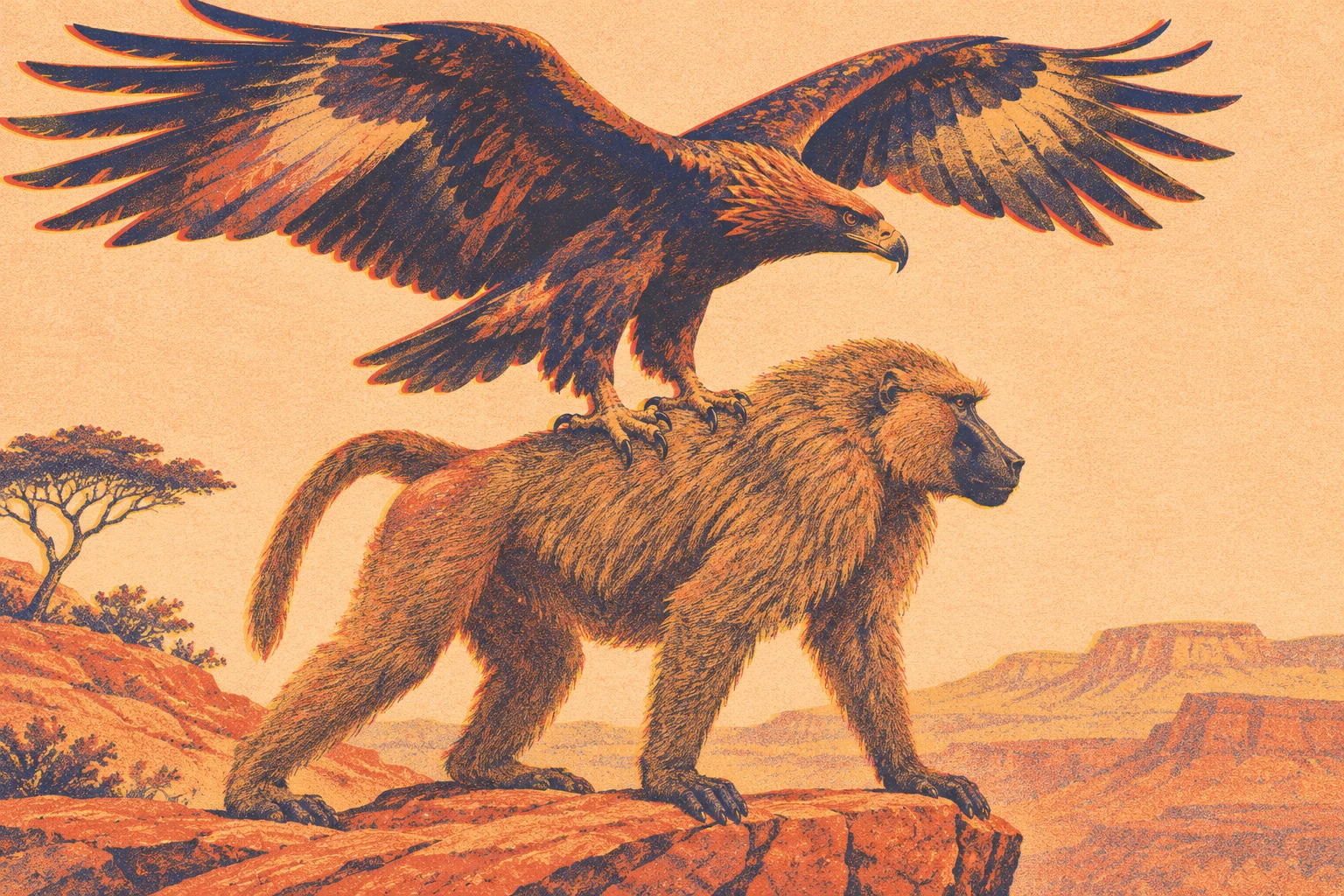
The sequence is: land on the back or neck → lock talons into the prey → if it stays upright, ride with wings extended and flapping for balance → continue until exhaustion, shock or internal injury causes collapse. This lets a raptor kill an animal several times its own weight without performing the impossible cargo flight imagined by the weight objection.
The authors also cite a report of a harpy eagle attacking a 52 kg adult woman. That report and the baboon remains do not document an eagle killing a hominin. They weaken the argument that body mass alone rules one out, extending the credible threat from small juveniles to substantially larger primates.
Watching two stars enter a common envelope
AT 2025abao, nicknamed Bao, is a transient on the outskirts of the Andromeda galaxy. Its expanding primary, Big Bao, drew the companion Little Bao into an inspiral before the system brightened rapidly in 2025. The Nature paper, led by Viraj Karambelkar of Columbia University, identifies the primary as an approximately 7-solar-mass asymptotic giant branch star.
Common-envelope evolution is the proposed shortcut from a wide binary to a compact one: giant-star expansion → two stars orbiting inside a shared convective envelope → frictional drag removes orbital energy → the companion spirals inward. Compact stellar binaries require rapid orbital tightening, but this inspiral had not previously been observed directly in such a system.
In October 2025, AT 2025abao erupted and its photospheric temperature jumped to about 8,000 K. Karambelkar’s team classifies it as a luminous red nova: a transient powered by impulsive energy injection during a stellar merger. That links the brightening to the merger mechanism rather than treating it as an isolated flare.

NASA reports that a three-hour Webb mid-infrared observation on 24 December 2025 let the researchers trace dust ejected over centuries, including material from almost two months after the merger. Matching those measurements to simulations supported the conclusion that the stars merged. The centuries of dust history and the October eruption are complementary clocks, not two estimates of the same interval.
The result supplies an observed sequence for a process usually reconstructed from its before-and-after states. The important measurement is the inspiral itself; the roughly 7-solar-mass primary identifies the system in which that sequence was seen.
Shared songs produce shared kinds of memory
A separate experiment tested how individual music-evoked autobiographical memories really are. Cara Turnbull of Texas Tech University and colleagues surveyed 233 undergraduates aged 18–23, playing clips from 32 popular songs. The 2014–2019 selections dated from the students’ adolescence; the 1985–1995 selections were released before they were born.
Students with similar backgrounds gave strikingly aligned answers. Country songs were associated with very recent periods, especially college, and with family, driving, summertime, romantic partners and listening to music, particularly music chosen by someone else. Those are recurring themes across respondents, not a single shared event.
Hip-hop more often evoked friends and acquaintances—classmates, coworkers and teammates—along with dancing and school. Pop was associated with middle school, listening at home or alone, and singing along. Genre therefore predicted the social setting and period of the recollection as well as its personal content.

The finding is not that songs fail to retrieve autobiographical memories. It is that, within this narrow undergraduate sample, their contents cluster by genre and sociocultural background. Applying the same pattern to other ages or populations requires another sample.
A genome collected without a biopsy
Whale genetics normally relies on invasive skin-and-flesh sampling with darts or scrapers. Éadin O’Mahony’s University of St Andrews team lists the costs: animal-welfare effects, behavioural responses to human activity, and national or international rules that can make biopsy collection impractical or impossible. Genetic monitoring still requires DNA.
Their substitute collection surface was a petri dish mounted on a drone. The team flew through 58 blows—the mucus-bearing respiratory vapour exhaled through the blowhole—from 26 Northeast Pacific humpback whales in Gitga’at First Nation territory in northern British Columbia. The count is 2.2 sampled blows per whale on average, though the distribution among whales is not given.
The researchers recovered a complete humpback whale genome from blow, demonstrating non-invasive whole-genome sequencing rather than merely detecting whale DNA. The 58 blows describe sampling effort; they are not a claim of 58 genomes. The paper’s result is methodological feasibility for monitoring wild cetaceans without a biopsy.
For the baboon claim, the next decisive datum is a directly observed predation event rather than another set of remains. For blow sequencing, it is usable genomes per blow, with sequencing quality and cost, across more populations; one recovered genome does not establish routine monitoring yield.