
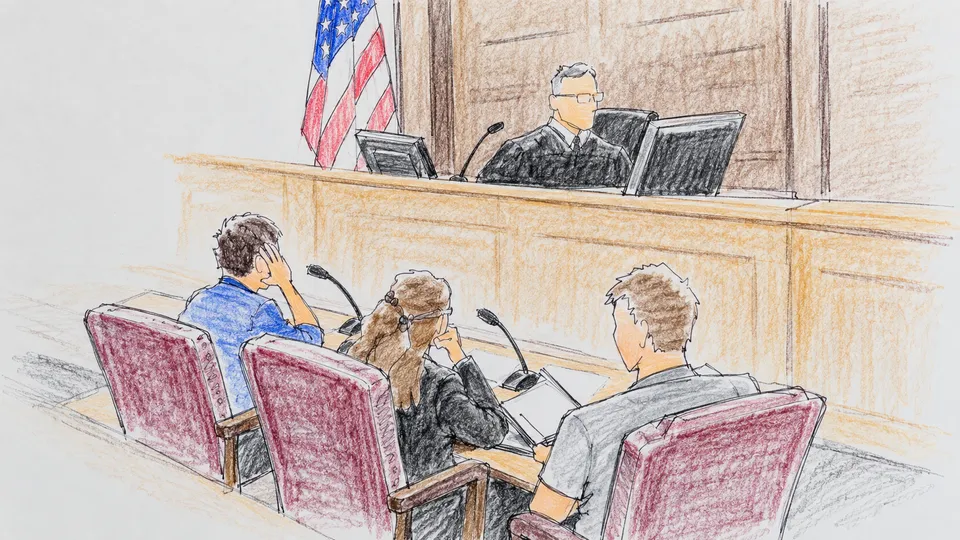
Monday morning in the immigration court in Harlingen, Texas: twenty-five migrant children lined the pews, formally dressed, hair neatly styled. A 6-year-old pretended to fly an airplane. The 3-year-old in the blue jacket was Mateo, in for an initial appearance, and he passed the time testing the microphone while his lawyer spoke to the judge over a remote link — which made him one of the luckier kids in the room. A teenage girl smiled at a friend across the pews and got a reminder from the bench about what the hearing was for. “I see you’re smiling and think these proceedings are funny, but I need you to pay attention,” the judge told her. “They could determine whether you remain in the country or are removed.”
CNN’s reporters were in that courtroom, and what they describe — migrant children as young as 2 appearing in immigration courts around the country, many without attorneys — is not a quirk of one Texas docket. Hundreds of unaccompanied minors, detained crossing the southern border or picked up when Immigration and Customs Enforcement arrested their families, are being held in shelters run by the Department of Health and Human Services’ Office of Refugee Resettlement. Under the Trump administration their cases are moving through the system faster than they used to, with less legal help attached, and interviews with more than a dozen lawyers, advocates and current and former officials, plus court documents and internal memos, describe a system whose procedures keep changing with little notice.
Among the first called on Monday was Angel, a 13-year-old from Honduras with no attorney. Asked whether there was a reason he couldn’t go back, he told the judge: “My mom and almost my entire family are here. It’s too dangerous to go back.” The judge said that under his answers, he didn’t qualify for asylum, and offered the menu: “Would you like to request voluntary departure, or should I issue a removal order?” “I don’t know,” Angel answered, and then he cried, staring straight ahead. “I have no one. I have nothing.” “I understand, but based on your answers, US immigration laws are very strict,” the judge said, and gave the boy until the end of the month to appeal his deportation order.
Immigration court is a civil system, so nobody in it — adult, teenager or toddler — has a right to a court-appointed lawyer; you bring one or you go without, and children must assemble evidence for an asylum claim the same way adults do. A law that has been on the books for nearly two decades, the Trafficking Victims Protection Reauthorization Act of 2008, is supposed to guarantee unaccompanied children protections, including screenings for trafficking and for a credible fear of persecution back home. Attorneys and advocates told CNN those protections are being undermined, and the concrete mechanism for that is a contract.
The $200 million contract, and the $20 million version
For years the government held a contract, valued at $200 million a year, with the Acacia Center for Justice, which subcontracted to 100 legal-service providers and, by Acacia’s count, supplied counsel to more than 20,000 unaccompanied children — know-your-rights presentations, legal screenings, referrals and actual representation. “Before, under our contract, it was mandatory to enter into representation if a child was moving forward to the pleading stage while in detention,” said Shaina Aber, Acacia’s executive director. “You’d never have a child in detention being ordered removed without representation.”
The Trump administration first tried to terminate that contract outright; an ongoing lawsuit challenges that initial attempt. Then, in July, it simply let the yearslong deal lapse. In early August the refugee office awarded up to $20 million to the US Committee for Refugees and Immigrants, a nonprofit, to provide legal services through December 31. The arithmetic is worth a second: $200 million a year is about $16.7 million a month; the replacement caps out at $20 million spread over roughly five months, call it $4 million a month. The plan, in other words, is a temporary program running at about a quarter of the old rate.
And even that smaller plan is underperforming its paperwork. In declarations filed in the ongoing lawsuit, attorneys and advocates said that in the weeks after the award, USCRI’s lawyers either weren’t present at children’s hearings or sat through them without speaking up. On Monday, according to Lauren Fisher Flores, legal director at ProBar, which provides legal services to unaccompanied children across South Texas, a USCRI attorney watched silently as a virtual “friend of the court” while Angel and other children went through their hearings. USCRI did not answer CNN’s questions about any of this.
HHS points to the USCRI deal as proof of commitment. “Under the Trump Administration, ORR remains committed to ensuring that every unaccompanied alien child has legal representation in immigration court,” spokesperson Emily Hilliard told CNN, adding that the office will keep “facilitating the ability of [unaccompanied alien children] in its custody to fully participate in immigration legal proceedings with representation by counsel.” On the evidence of Monday, “facilitating the ability” meant a lawyer on a video link who said nothing, which facilitates representation roughly the way a closed library facilitates reading.
Faster
The other half of the change is speed. Hearings that used to be spread across months are now happening within days or weeks, asylum interviews are being abruptly rescheduled, sometimes on 24 hours’ notice, and internal procedures shift frequently. “We have seen that increase over the last couple months and supercharged over the last few weeks,” said Daniel Gestal, deputy director of the children’s program at the Amica Center for Immigrant Rights. Relatives and guardians trying to get children released to them face new hurdles, which the administration describes as additional vetting; officials argue the whole approach benefits the children by keeping them out of harm’s way. Advocates and attorneys say it appears designed to remove children quickly.
The Executive Office for Immigration Review, which runs the immigration courts, denies that cases are being fast-tracked. A spokesperson said the agency “prioritizes the timely completion of all cases and makes scheduling adjustments as needed to ensure cases do not languish.”
“The 4-year-olds don’t know where they are and what’s going on,” one advocate who works with unaccompanied children told CNN. “They may understand that they’re talking to a judge, and the judge asked them their name, but that’s the extent of their understanding.” The advocate added: “I’ve never witnessed so many removals and to see it happen with children who are standing there completely alone.” At one point on Monday the judge turned to a group of fifteen minors without attorneys: “Is this your first time in immigration court?” All answered yes. “Do any of you want voluntary departure?” Nobody raised a hand. One child stretched her arms playfully toward the ceiling.
Cases that do not languish is a scheduling standard, and by that standard the system is performing: a 13-year-old goes in alone, answers the questions he can, cries at the ones he can’t, and leaves with a removal order and an end-of-the-month deadline to appeal it. Timely completion, as specified.