
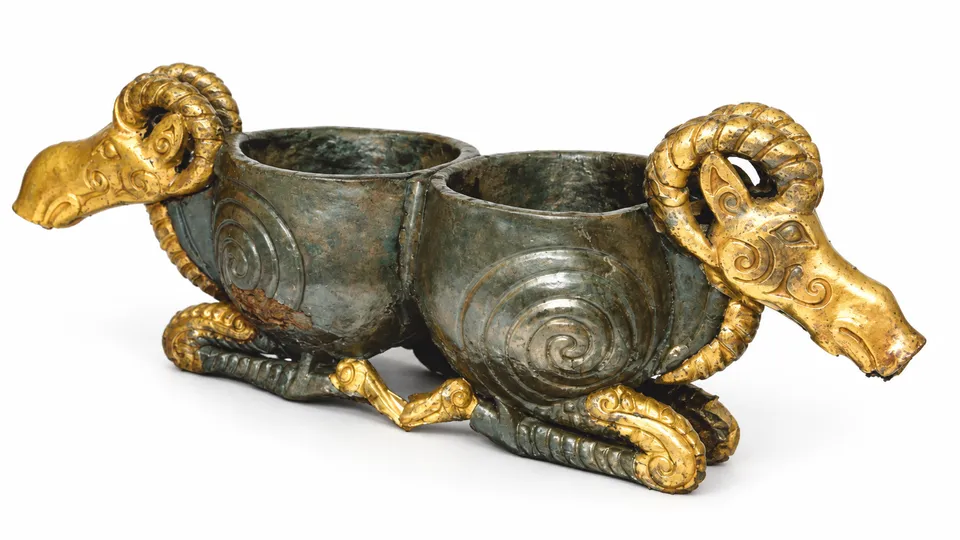
The object is hard to describe and harder to look away from. It is a vessel roughly 2,400 years old, pulled from a burial mound in the southern Urals, carved from willow wood and then dressed in gold and silver. From above, its two joined bowls form a neat figure eight, sixty-two point seven centimeters end to end. Flanking the bowls are two sculpted animal heads — identified as a mountain goat and a mountain ram — with curving horns, almond-shaped eyes and spiral patterns worked into their cheeks. One head measures about 20 centimeters from nose to horn tips; the other is a slightly smaller 18. The animals’ folded legs double as the stand the whole thing rests on.
Nothing else quite like it is known from fourth-century BCE graves in the region. And according to a new study described by Arkeonews, the strangest thing about it — the double bowl — may be the whole point.
The study, by Olga Melnikova of the Orenburg Governor’s Museum of Local Lore and Konstantin Okorokov of the Russian Academy of Sciences, appears in the 2026 volume of the Ufa Archaeological Herald. The vessel came from the central burial of Kurgan 4, the second-largest mound at the Filippovka 1 cemetery in Russia’s Southern Urals — a mound that originally stood about eight meters high and roughly 80 meters across, housing an elaborate wooden burial chamber.
The excavation, in 2006, was partly a rescue job. Looters had hit the mound the year before, using heavy machinery to cut two trenches through it and destroying parts of its wooden structures. Even so, the archaeologists recovered a remarkable assemblage from the northern sector, between two wooden coffin frames: beside the vessel stood a bronze lamp shaped like a zebu bull, and beneath it a woven basket held several iron knives — one with a silver handle in the form of a deer, another with a gold element topped by a wolf’s head — plus a small bone spoon ending in a deer’s head and a decorated piece that may have come from a whip.
Taken with the vessel itself, the grave goods speak of the highest rank of a nomadic society — and of long-distance cultural traffic. The balanced, opposing animal heads echo the heraldic pairs common in Achaemenid Persian art, the sort seen in the architectural sculpture and luxury objects of Persepolis. The silver deer-shaped handle and diamond-patterned gold work point the same way. But the researchers are careful here: these things need not have been imported from Persia. What traveled was the idea of the thing — prestige aesthetics moving between the Achaemenid realm and nomadic peoples far beyond its borders, then being reworked in a distinctly steppe animal style.
That blending went deeper than decoration. Restoration work showed the vessel’s core was carved from willow wood, with thin sheets of precious metal fixed on using tiny forged gold and silver nails; the relief decoration was modeled in the wood first and then worked into the metal with repoussé techniques. Chemical analysis found high-purity silver on the bowls and gold of varying composition on the heads and extremities. And the wood identification — the genus Salix, willow — turned out to matter, because the same wood was used for the famous golden deer sculptures found in another Filippovka mound. Shared methods and style lead Melnikova and Okorokov to suggest the vessel and at least one of those deer sets may have come from the same workshop: specialists, presumably, in the employ of the nomadic elite.
Which brings us to the intriguing part. Other cups from Filippovka burials are small, individual, single-person affairs. This one has two bowls. The authors’ suggestion — and they are explicit that it is a working hypothesis, not a proven conclusion — is that the vessel was made for collective ceremonies, perhaps ones that sealed symbolic bonds of brotherhood. One object, two mouths; the joining is the meaning. They do not speculate about what liquid the bowls held, if any, or describe the rites at all. What supports the reading is context: the vessel sat among other objects interpreted as sacrificial or ceremonial equipment, in the kind of grave nobody ordinary got.
The vessel was extensively restored at the State Hermitage Museum, rebuilt around an internal support frame, and now sits in the permanent exhibition “Gold of the Sarmatian Chiefs” at the Orenburg Governor’s Museum of Local Lore. Nearly two and a half millennia later, the central question is still the one no residue analysis can answer on its own: what happened when people gathered around it? What is clear is that whoever commissioned it commanded extraordinary craft, and belonged to a network of ideas stretching from the steppe to Persia — proof that cultural soft power, like the caravan routes, ran in every direction at once.