
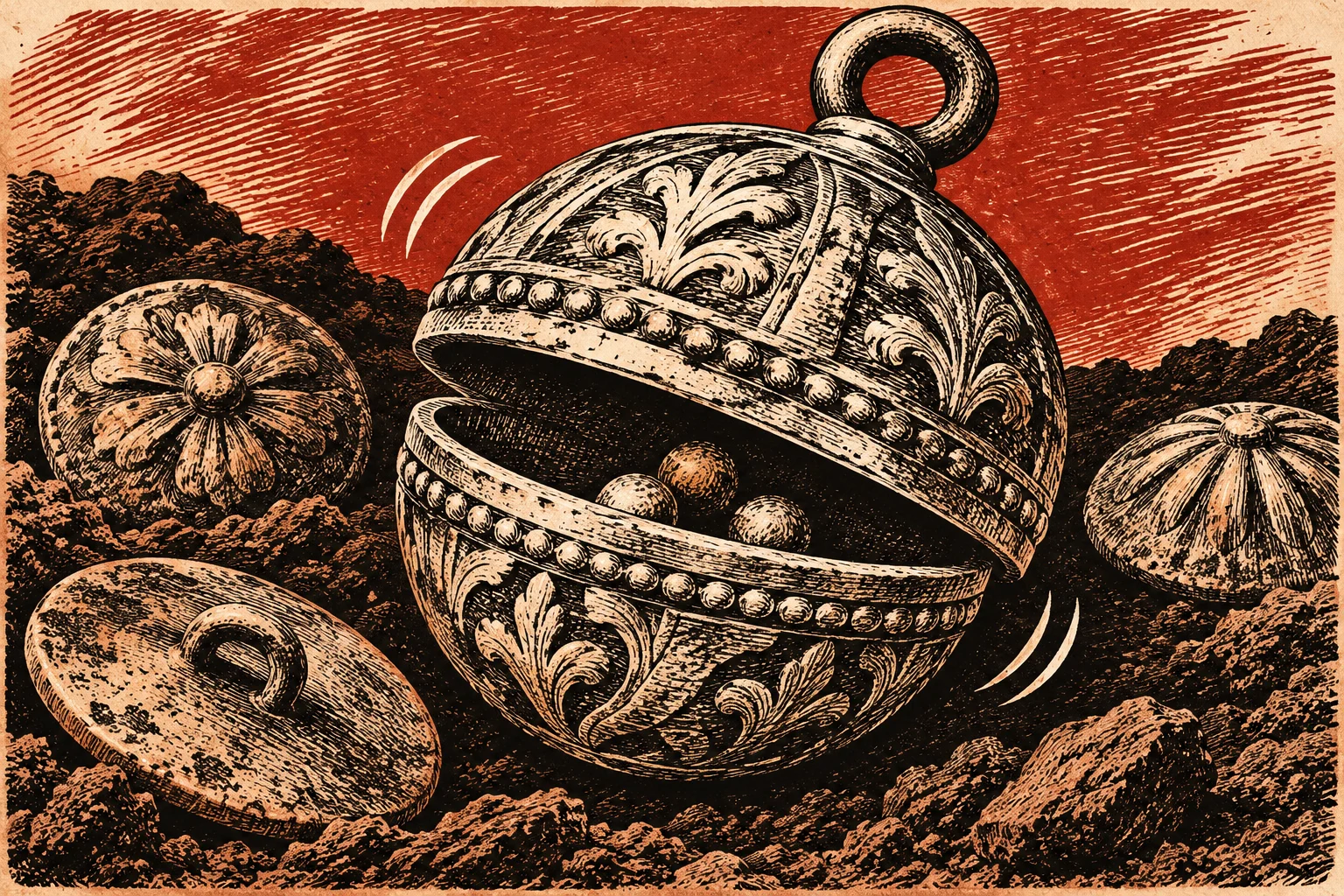
Seven silver buttons from a hoard dug up in Moldova are built like a child’s rattle: two hollow silver hemispheres, about 2.5 centimeters across, soldered together around loose metal pieces that click when the wearer moves. They are part of a 36-object silver collection that archaeologists excavated near the village of Ordășei, in Moldova’s Telenești district, and that a new study in Revista Arheologică dates to the late 16th or 17th century, most likely the first half of the 1600s.
The find turned up in autumn 2024 on a plateau between Ordășei and the neighboring village of Prodănești, during a dig that Moldova’s National Archaeological Agency ran with the Archaeological Centre of Olomouc in the Czech Republic, as historia.ro reported. That partnership explains the Czech name on the study’s author list, Jaroslav Peška, alongside Vlad Vornic, Sergiu Matveev, Sergiu Popovici, Ion Ursu and Lazari Dermenji. Their paper, published in July 2026, catalogs the hoard piece by piece and reads it, as arkeonews.net covered, as evidence that whoever owned it dressed to be heard as well as seen.
Why build a button that rattles
The study’s authors classify the seven large buttons and 21 smaller plain ones in the hoard as fasteners, not bells, because their shape and attachment points match clothing hardware rather than free-hanging pendants. The rattling versions are not unique to Ordășei: comparable large silver buttons have turned up in Moldovan hoards at Onești, Musaitu and Dezghingea, and the Dezghingea example also had internal metal pieces built to make noise. The researchers read the sound as functional rather than decorative, drawing on burial finds elsewhere that pair similar rattling accessories with women and children, and they propose an apotropaic reading: noise as a traditional device against harm. The paper stops short of tying that to a specific ritual, and it places the large rattling buttons on ceremonial rather than everyday dress, which is the more defensible half of the claim, since the ritual function rests on comparison, not direct evidence from this grave or cache.
A fastener with two snake heads
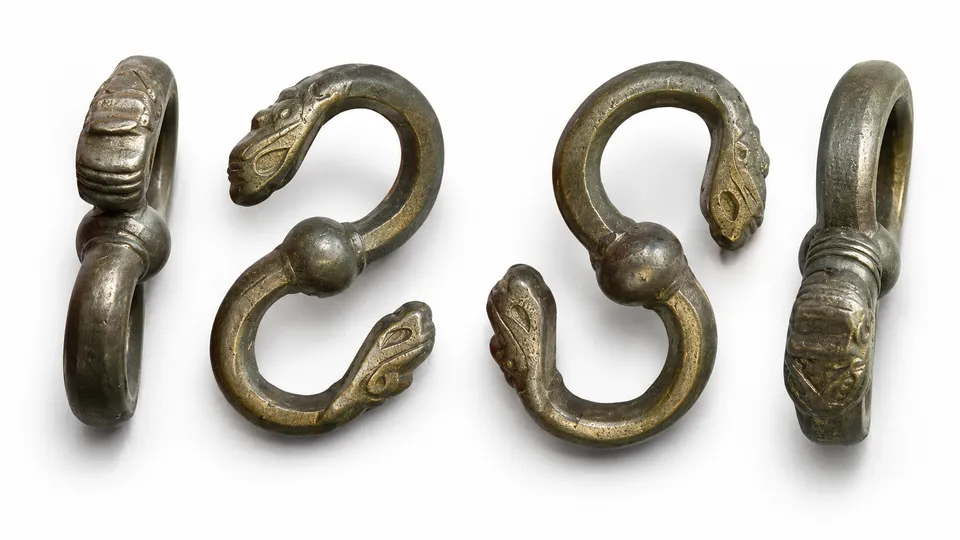
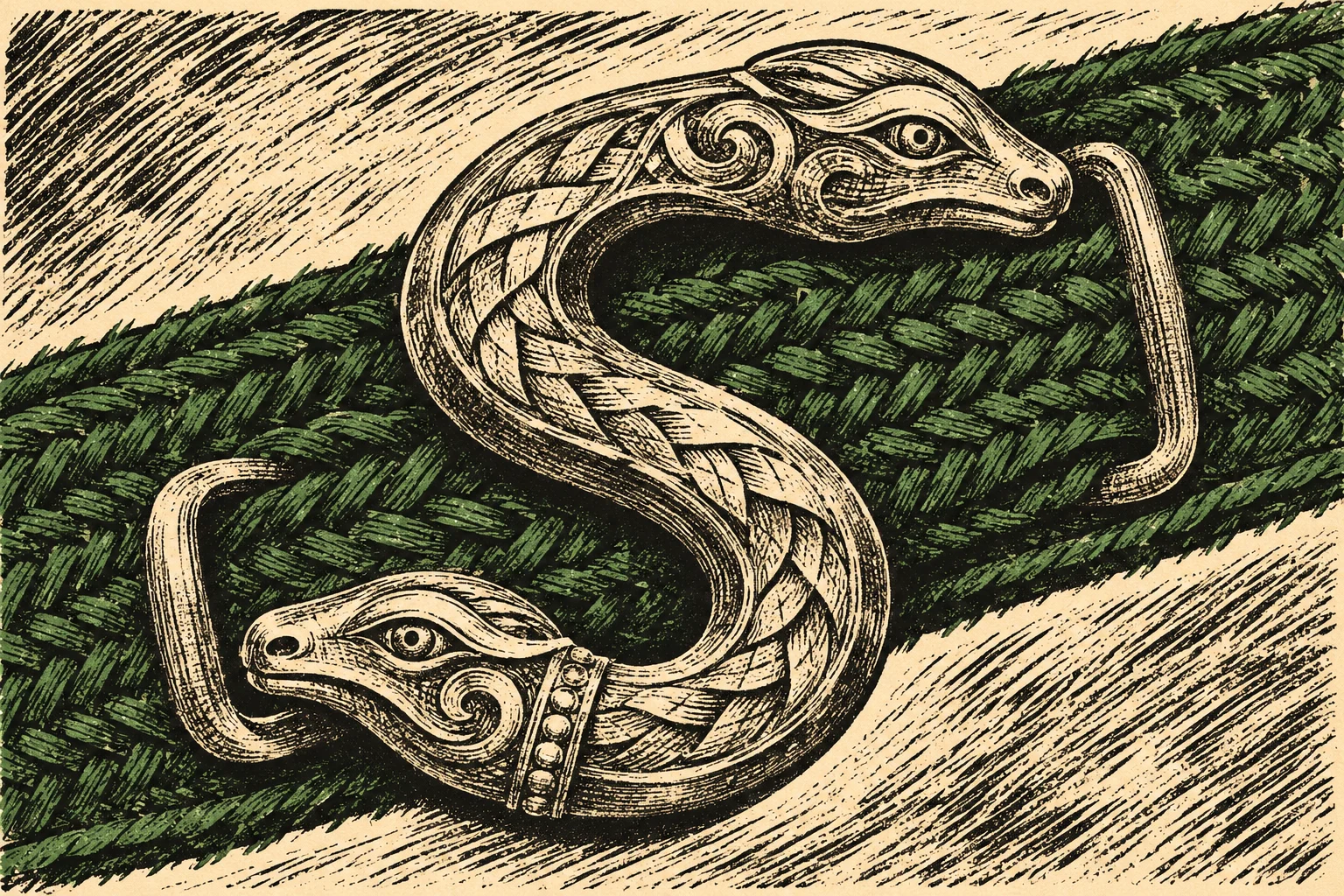
The hoard’s single belt clasp is 3.9 centimeters long and weighs just over 22 grams, its S-shaped body ending in two stylized snake heads with worked eyes and snouts. S-shaped clasps of this general type circulated across Eastern Europe from the late medieval period onward, and some researchers have linked them to ceremonial sword belts worn by 16th-to-18th-century soldiers and nobles. But similar clasps also show up on ordinary belts in graves of younger, non-elite individuals, so the form alone does not mark status. What the study flags as genuinely unusual is the size and the snake-head carving: the authors found no published match for it among late medieval hoards from the Carpathian-Dniester region, the kind of claim that is only as good as the catalog it is checked against, and will hold until someone finds its twin. Regional digs keep turning up single objects nobody can fully place: a Thracian temple in Bulgaria produced a bronze ring with four barbed hooks whose purpose is still unexplained.
What the X-ray fluorescence found
Researchers at the Institute of Applied Physics of Moldova State University ran X-ray fluorescence on the metal objects to measure what they were actually made of, as opposed to what they look like. The three earrings, finished with filigree and granulation, came out at 90 to 92 percent silver. Several of the other pieces, including the buttons and the clasp, carry considerably higher proportions of copper and tin, an alloy choice the study attributes to durability: fine filigree work wants high-purity silver, while buttons and fasteners that take daily mechanical stress want a harder mix. The measurement is useful precisely because it is boring: it tells you about workshop practice rather than wealth display, which is a different question from how impressive the objects looked on the body.
Buried without a pit
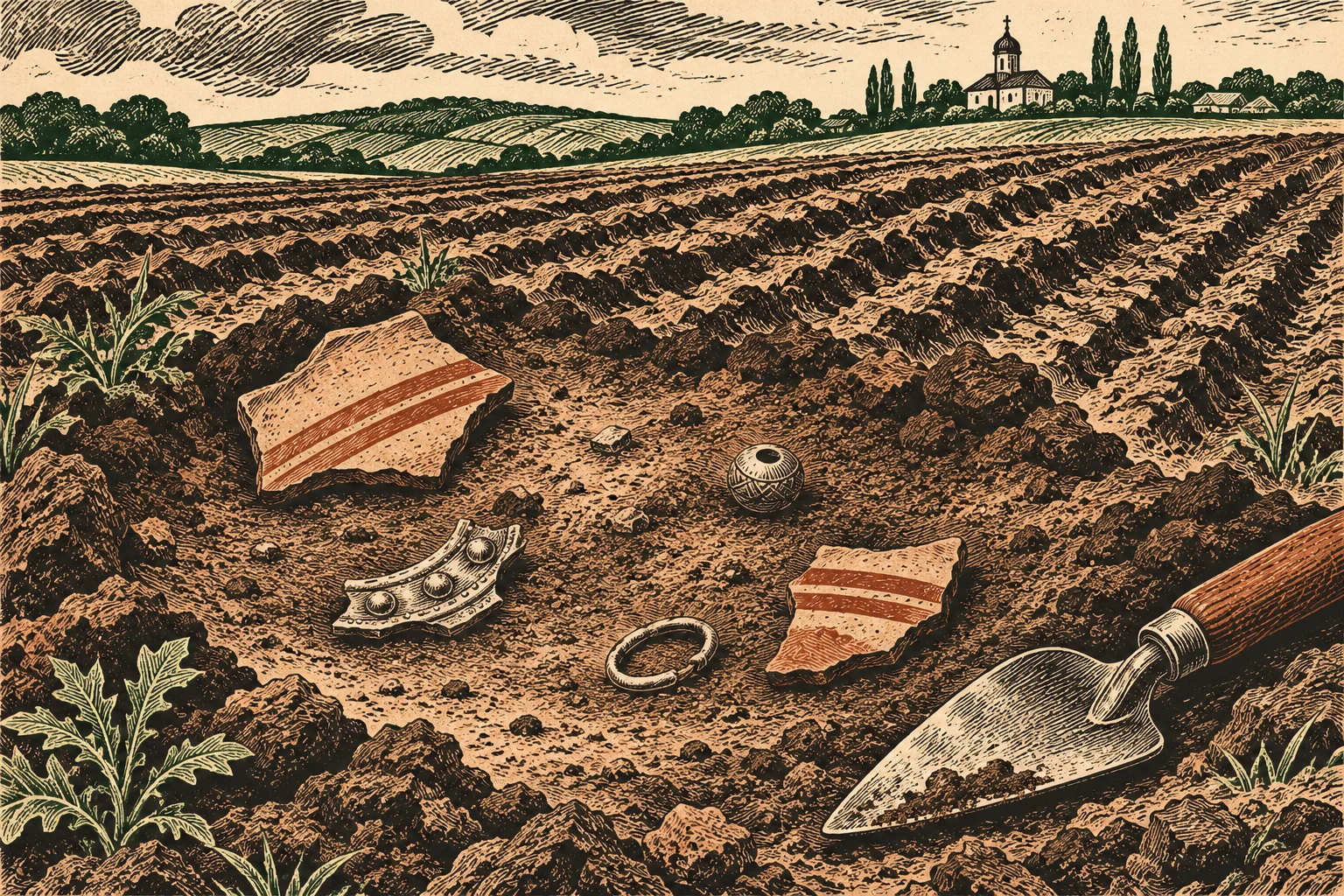
Plowing had scattered the pieces across an area roughly 15 by 15 meters before anyone noticed them. Archaeologists located the rest with a metal detector and then excavated the site to a depth of 80 centimeters looking for whatever hole or container originally held the hoard. They found no identifiable pit. Two pottery fragments nearby, from a wheel-made vessel decorated with horizontal red lines, are the closest thing to a clue: other medieval Moldovan hoards have turned up inside ceramic vessels, so a buried pot is plausible, but the fragments at Ordășei are not enough on their own to confirm it.
The site sits near older ground: a burial mound about 100 meters away, designated Mound 20, contains 19 burials spanning from the Yamnaya culture of the Early Bronze Age through the Sarmatians, who occupied parts of the region in the early centuries AD. A 2025 excavation near a separate mound found a rectangular ditch the researchers suspect was tied to Sarmatian commemorative rites. None of that connects to the silver hoard by any physical evidence; the study is explicit that the much later deposit and the much older burials share a landscape, not a documented relationship.
Nothing in the hoard carries a name, a mark, or an inscription, so the study cannot say who owned it, only that the clasp and the earrings point to someone with money and the large rattling buttons point to ceremonial dress rather than field clothes. Moldova’s 16th and 17th centuries had their share of war and political upheaval, the conventional backdrop for people burying valuables they meant to retrieve. The record at Ordășei does not identify which crisis, if any, explains this particular cache, or why its owner never came back for it.