

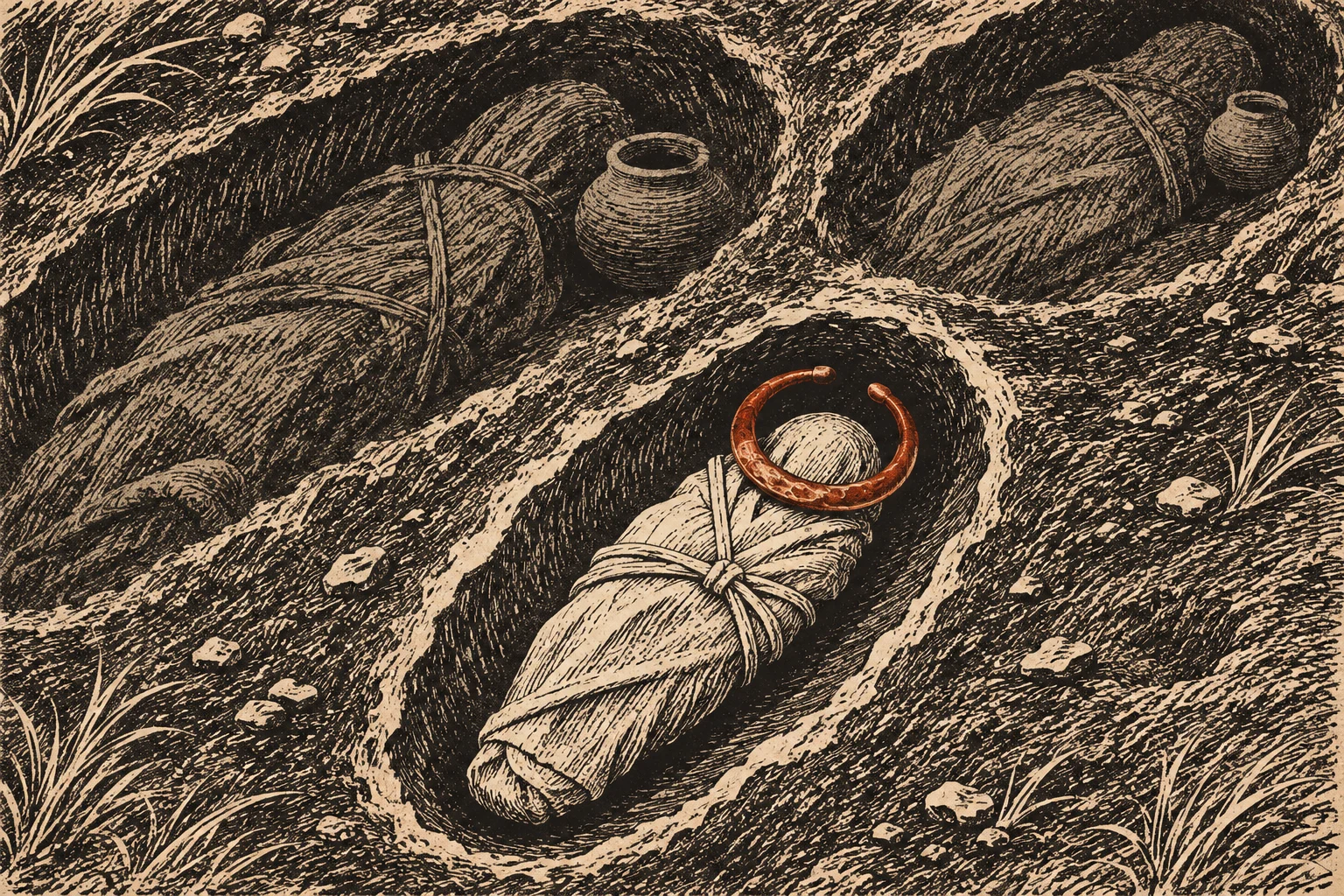
Grave 41 at Čachovice, in northwest Bohemia, holds a child between six months and five years old, probably a girl, wearing a rigid copper neck ring, a torc of a kind otherwise associated with the Iron Age Celts a thousand-plus years later. The grave dates to roughly 2,500 BCE and is the richest in a new study of 4,900-to-4,300-year-old Corded Ware culture burials in the Czech Republic, published November 10, 2026 in the Journal of Neolithic Archaeology by Mikkel Nørtoft of the University of Copenhagen and Adam B. Rohrlach of the Max Planck Institute for Evolutionary Anthropology. The question the paper asks: did a toddler earn that torc, or did her family?
The paper, reported on by Arkeonews, compiled 378 graves from Bohemia and Moravia. Of those, 317 preserved skeletal remains, and 283 single burials were complete enough to support statistical comparison by age and sex. The paper’s own press material, issued through the University of Copenhagen and distributed via EurekAlert, rounds this to “296 burials” when describing the Bohemia-only subset used for the lineage analysis — a smaller, cleaner set than the full 378-grave compilation. The two numbers describe different stages of the same funnel, not a contradiction: all graves found, then all with bones, then the subset usable for the headline statistics.
A method for pricing a 4,500-year-old funeral
Counting grave goods is a weak proxy for wealth: a pot and a stone axe are not interchangeable, and one copper tool from a source 500 km away is not worth the same as a local flint. Nørtoft built a scoring tool called QuantWealth during his doctoral research to get around this. It weights each grave on five axes: how rare and exclusive the goods are, how much skill and labor went into making them, how far the raw material traveled, how deep the grave pit was dug, and how much meat appears to have been offered at the funeral. The score is a composite, not a body count of artifacts, which is why a grave with one gold object can outrank a grave with two dozen pots.
Applied across the 283-grave sample, QuantWealth found that Bohemia did not run one social system for six centuries. It ran at least two, with a transition in between.
Three phases in 600 years
The earliest Corded Ware settlements in Bohemia, from roughly 2,900 to 2,700 BCE, show shallow, mostly age-linked wealth differences and little gender gap in grave goods — consistent, the authors argue, with migrant groups of different origins needing cooperation more than competition to secure new pasture and establish ties between communities. From 2,700 to 2,500 BCE, prestige goods, meat offerings and deeper graves multiply, adult men pull ahead in grave wealth, and the gender gap widens; skeletal trauma does not rise over the same period, so the competition visible in the graves did not translate into more measurable violence. From 2,500 to 2,300 BCE, a handful of children — like the girl in grave 41 — start receiving burials as rich as adults’, which the authors read as the first sign of status being handed down rather than earned.
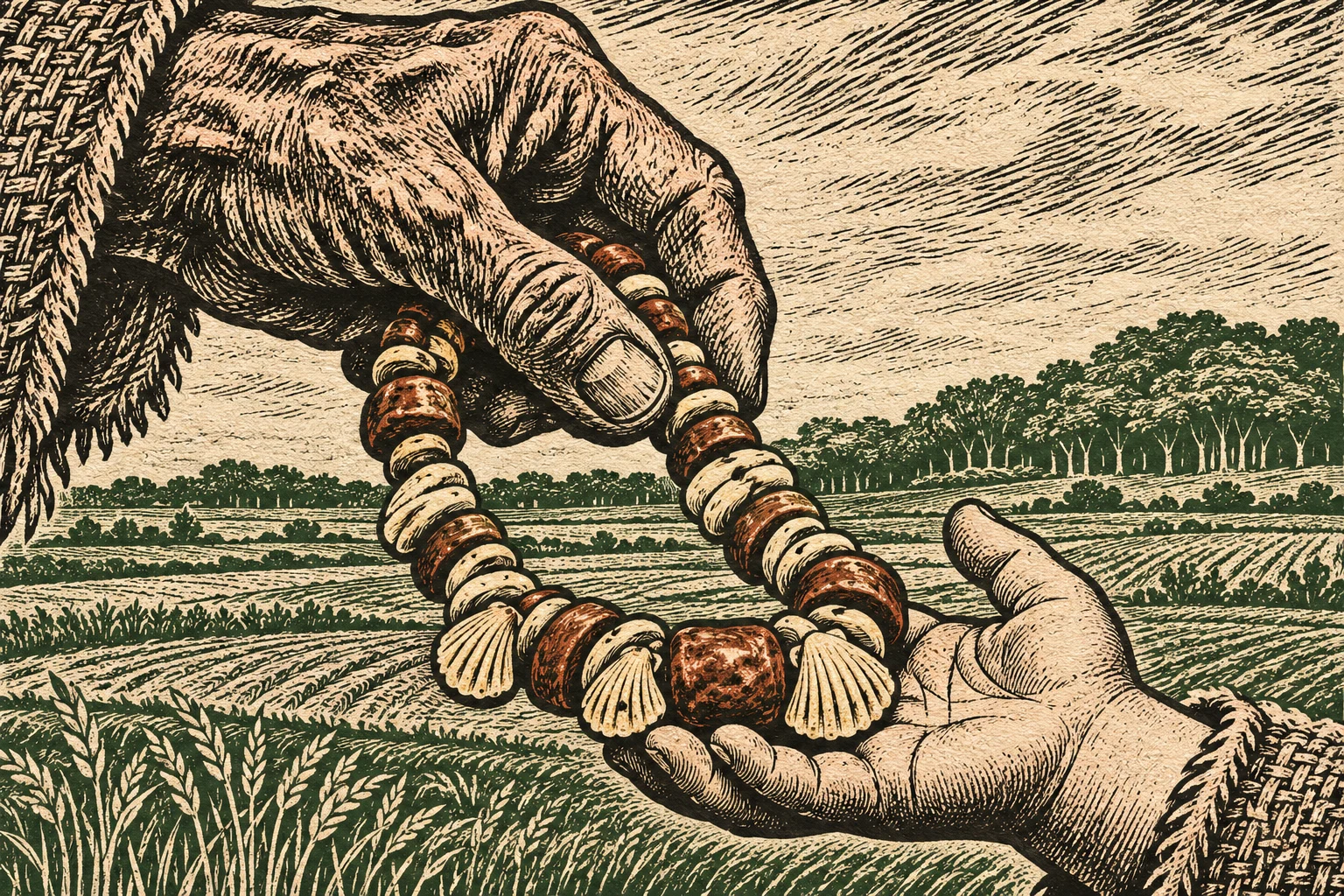
“Our results suggest a much more dynamic picture, where social differences developed gradually,” Nørtoft said in the University of Copenhagen’s statement. For the first roughly 400 years of the sequence, by his account, “achieving status through life-actions appears to have been more important than through inheritance” — status earned, not received.
The shift the study flags is genetic, not just archaeological. Early Bohemian Corded Ware burials carry several distinct Y-chromosome lineages among men, meaning multiple unrelated paternal lines coexisted. By the late phase, one lineage, R1a-M417, dominates the burial record. Nørtoft’s statement frames this plainly: “the previously new lineage now dominated the burial record,” and “the few rich child graves and this prevailing lineage could indicate more inherited wealth.” That is two correlated trends — one lineage’s dominance, a handful of rich child graves — read as a single process, not two independently confirmed facts.
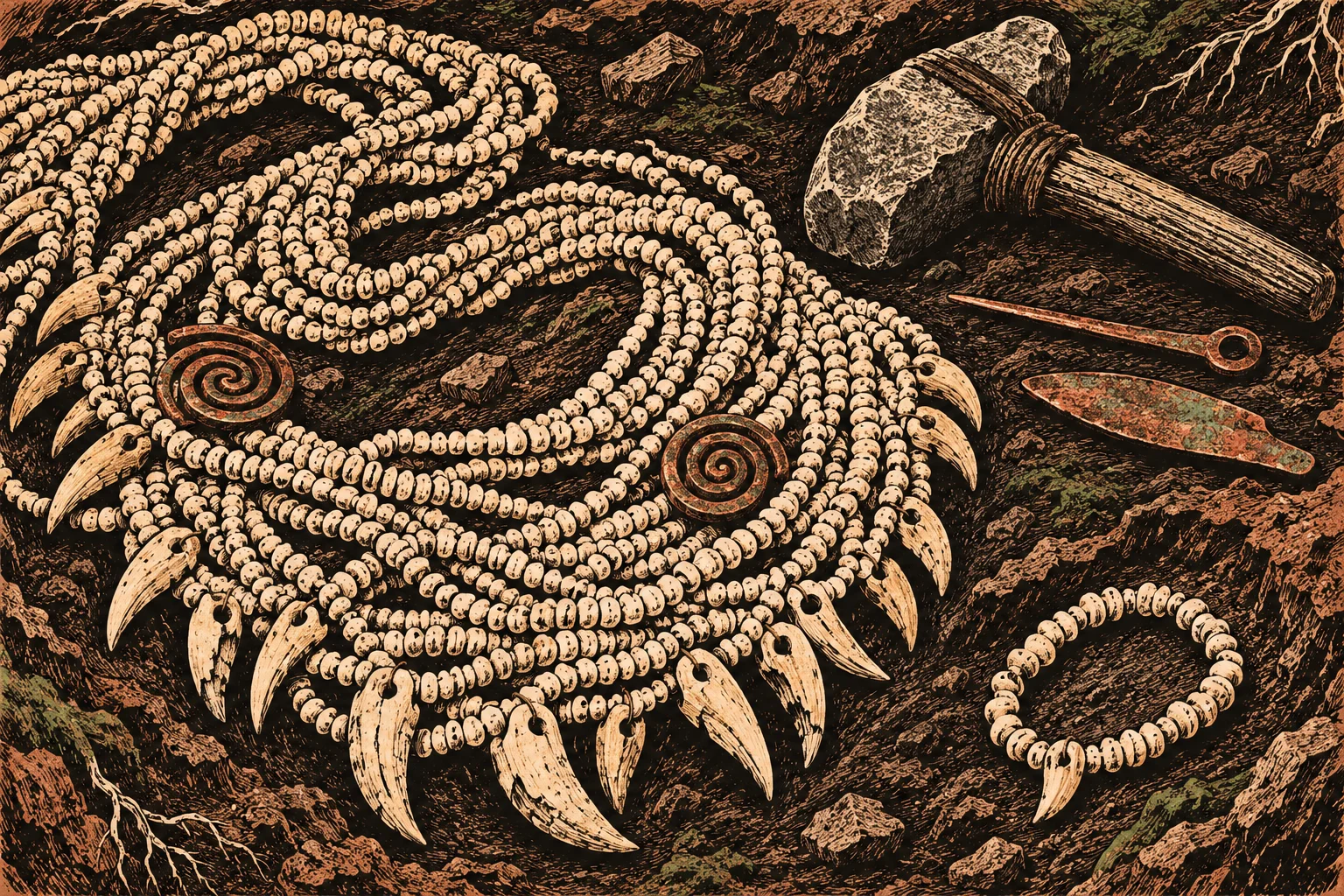
Outside Bohemia, the pattern of wealth not tracking strictly to sex is already visible. In Moravia, a roughly 20-year-old man at Letonice was buried with the only gold object in the entire 283-grave dataset, plus a stone axe-hammer, copper tools and jewelry, and wild boar teeth. An adult woman at Marefy, in the same region, was buried with hundreds of dog teeth, thousands of shell beads and copper jewelry the paper describes as extremely rich — a grave that by QuantWealth’s scoring outranks most male burials in Bohemia. A child’s grave at Vliněves, a girl who died between ages three and five, held 26 shell or mother-of-pearl beads and nine or ten dog or wolf teeth, goods the authors read as signaling either status or protective belief rather than certain proof of either.
What the data does not show
The paper’s own caveat matters more than its headline finding: across the full sample, grave wealth shows no consistent statistical relationship to genetic ancestry, close kinship, or the diseases and injuries visible on the skeleton. If status had become fully hereditary by 2,300 BCE, richer graves should cluster reliably within identifiable family lines and show up as a tight statistical correlation; the paper’s own multivariate test does not find that correlation at the level of individuals, only at the level of the dominant lineage as a whole. Nørtoft’s own gloss is a hedge, not a claim: “we need more DNA data to confirm this at the family level, and elsewhere.” One region’s data, however detailed, is a single case; the authors do not have a second Corded Ware cemetery outside Bohemia analyzed with the same method to check whether the same lineage-wealth shift shows up independently.
The comparison to the better-documented class systems of the later Bronze Age, where hereditary elites and metal wealth are unambiguous in the archaeological record, is the implicit target of the paper, and it is a comparison the data cannot yet support. What the 283-grave Bohemian sample shows is a 600-year window in which a society that started by needing cooperation ended by rewarding lineage — a trend line with three data points, from a single region, that a Bell Beaker or broader Central European dataset built the same way would either confirm or break.