
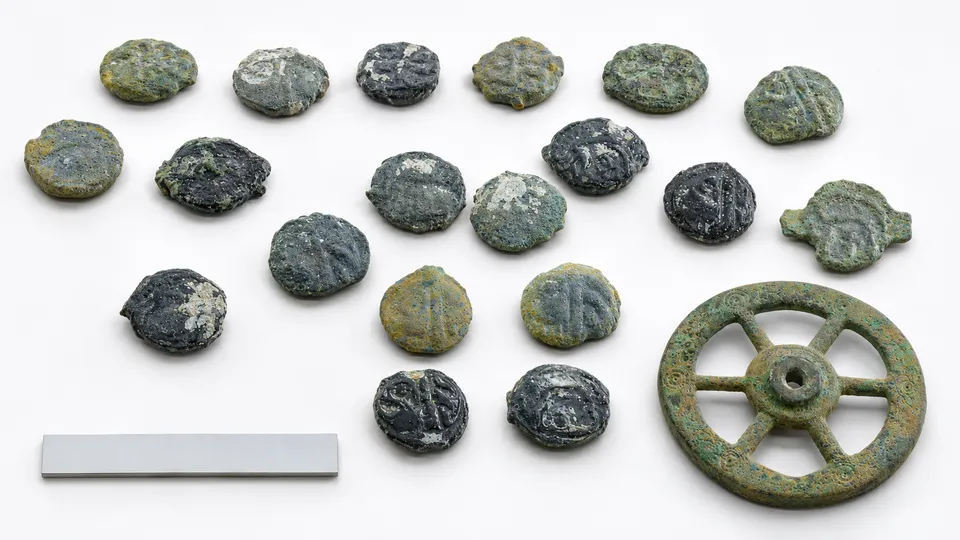
Four postholes, a bronze wheel 5cm across, 28 cast coins and fragments of a human skull and jaw: that is the inventory from a wooden building in Bure, northeastern France, that stood more than 2,000 years ago on ground that will eventually sit above 83,000 cubic metres of France’s highest-level nuclear waste. France’s National Institute for Preventive Archaeological Research (INRAP) excavated the plot as one of the preventive digs required ahead of Andra’s Cigéo deep geological repository, the facility France intends to bury at 500 metres depth on the Meuse/Haute-Marne border.
The coins are potins: cast in a mould rather than struck with a die, the standard low-value currency of late Iron Age Gaul. Some of the 28 still carry casting flash, the thin ridge of metal squeezed out where two mould halves met, a sign the coins saw little or no wear before they went into the ground. The portrait on most of them traces back to Philip II of Macedon, father of Alexander the Great, whose coin image Gallic mints copied and re-copied for generations until the head is barely recognisable as a head at all. A second motif on the same coins shows a boar standing on an inverted lily shape — a military or cult emblem, researchers say, functionally closer to the eagle on a Roman legionary standard than to a depiction of the animal itself. The type, known for its boar standard, is common across northeastern Gaul; a hoard recovered in its original dig context, rather than loose from a field or a collector, is not.
A pit, a posthole, and no fence
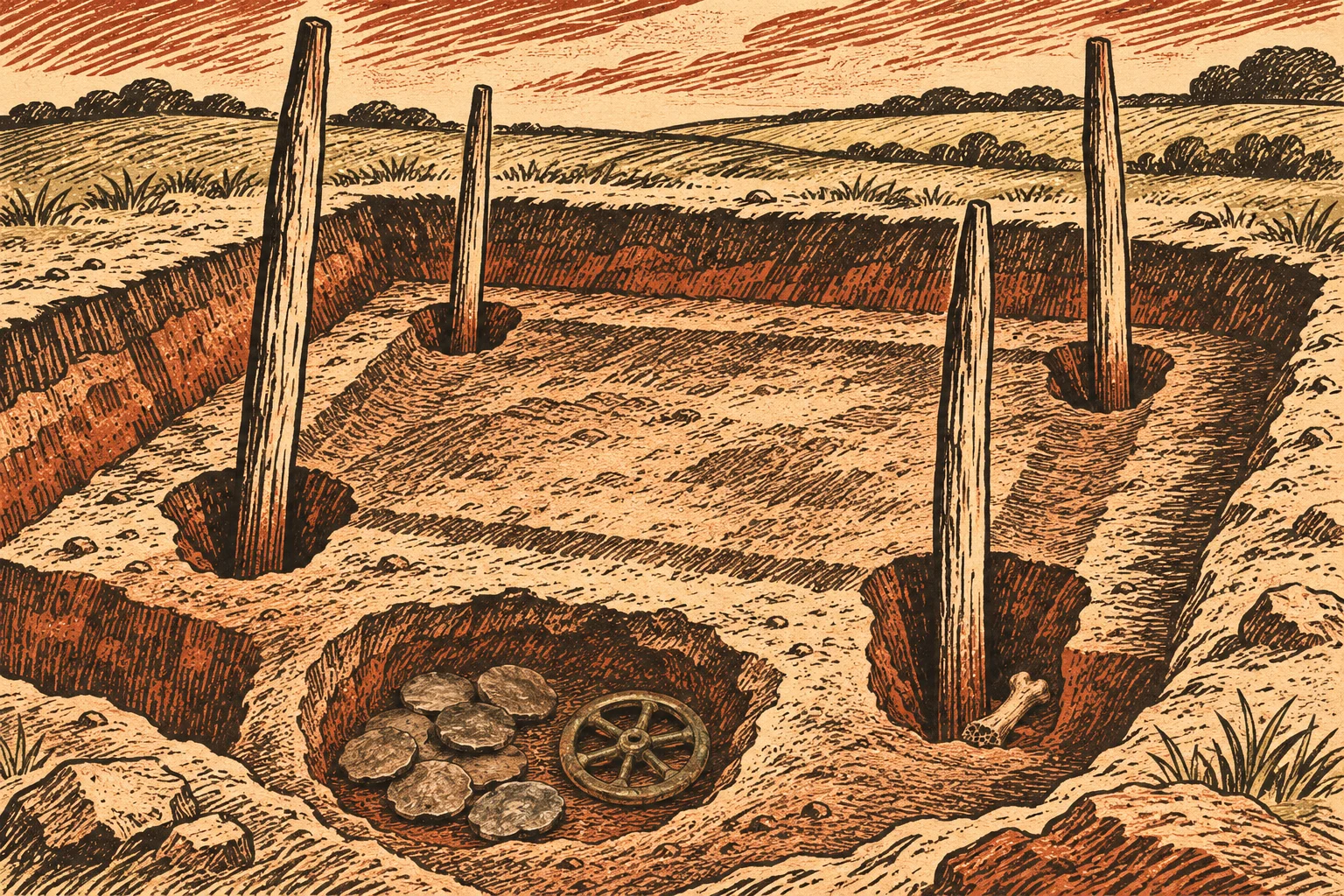
The building itself was modest: roughly 7.5 by 5.5 metres, its plan fixed by four large postholes, each about a metre across and more than 80 centimetres deep. Erosion since the Iron Age means the posts were probably driven deeper originally. The holes lean slightly inward, which is the evidence for a tapered, pyramid- or prism-shaped structure rather than a flat-roofed shed. The 28 coins and the bronze wheel came out of a small pit dug along one of the building’s long sides; more coins turned up loose in nearby postholes, which tells excavators the deposit was not confined to a single cache. The skull and jaw fragments came from a posthole at a different corner of the building, away from the coin pit.
Human skull fragments are not, on their own, proof of a cult site. They turn up at Gournay-sur-Aronde and Ribemont-sur-Ancre, the two reference sites for pre-Roman Gallic religion in northern France, where ancient writers’ accounts of severed heads displayed at sanctuary entrances match what archaeologists have dug up: at Gournay, several hundred human and animal bones came out of an enclosure ditch 4 metres long and 2 metres deep built in front of what researchers read as an altar. But skull fragments also show up in ordinary domestic contexts in Iron Age Gaul, and INRAP’s own account is explicit that Bure’s building “may have” served a religious function, not that it did. The feature that would settle the question — a boundary ditch or fence enclosing the structure, the near-universal marker of a documented Gallic sanctuary — is the one thing missing. A geophysical survey run a month after the excavation found no trace of one, though researchers note that shallow ditches are exactly what erosion erases first.
Where it sits
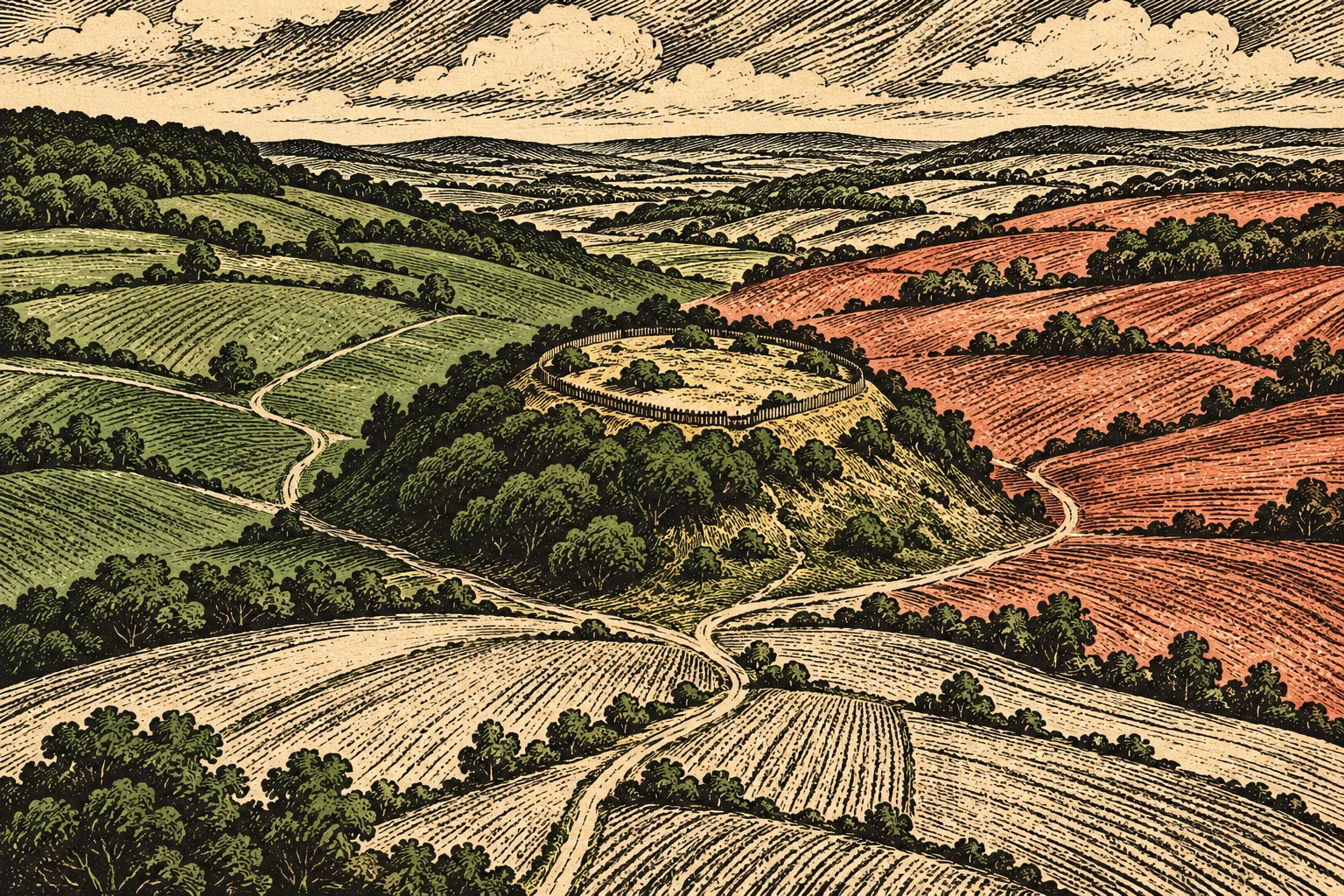
Bure lies about 20 kilometres south of the oppidum of Boviolles, the main settlement of the Leuci, the Gallic people who held the upper stretch of Lorraine between the Moselle and Meuse rivers, according to the historical account of the tribe. The site also sits roughly 15 kilometres from the territorial borders of the Remi and the Lingones, the Leuci’s neighbours to the west and south. No sanctuary combined with an in-situ coin hoard has previously been documented on Leuci land, and INRAP calls that combination rare across Belgic Gaul generally — a claim that rests on the absence of a comparable find in the regional excavation record so far, not on an exhaustive survey of everything ever dug up in the area.
The dig was led for INRAP by Luc Sanson, under the supervision of the Grand Est regional archaeology service, which prescribes every excavation ahead of Cigéo. That pipeline has already produced one Gallic find in the same stretch of ground this year — a cremation area INRAP dated to the 1st century AD, also near Bure, unusual less for the cremation itself than for the condition of the pyre. The repository above all this is substantial by design: Andra plans for Cigéo to hold 83,000 cubic metres of high-level and long-lived intermediate waste, with disposal running for more than a century before the site is sealed. France’s nuclear safety authority has had Andra’s construction application under technical review since 2023, and the construction-and-commissioning cost — last estimated at between €7.9 billion and €9.6 billion, down from an earlier full-lifecycle figure of €34.4 billion quoted in 2012 prices — is due to be finalised by France’s industry minister. Every metre of ground Andra clears before pouring concrete gets dug first, which is why a nuclear waste project has become, almost incidentally, one of the more productive sources of Iron Age archaeology in eastern France: an earlier Cigéo-linked dig surfaced a Celtic silver hoard in a similar infrastructure context, if on the other side of the former Roman frontier in Hungary.
What happens next is laboratory work, not fieldwork: numismatic analysis of the 28 coins’ alloy and die links, and osteological study of the skull and jaw fragments to say how many individuals they represent and whether cut marks or other signs of violence are present, the kind of evidence that settled the sanctuary question at Gournay decades ago. Until that analysis is in, INRAP’s own framing stands: a possibility, not a sanctuary.