
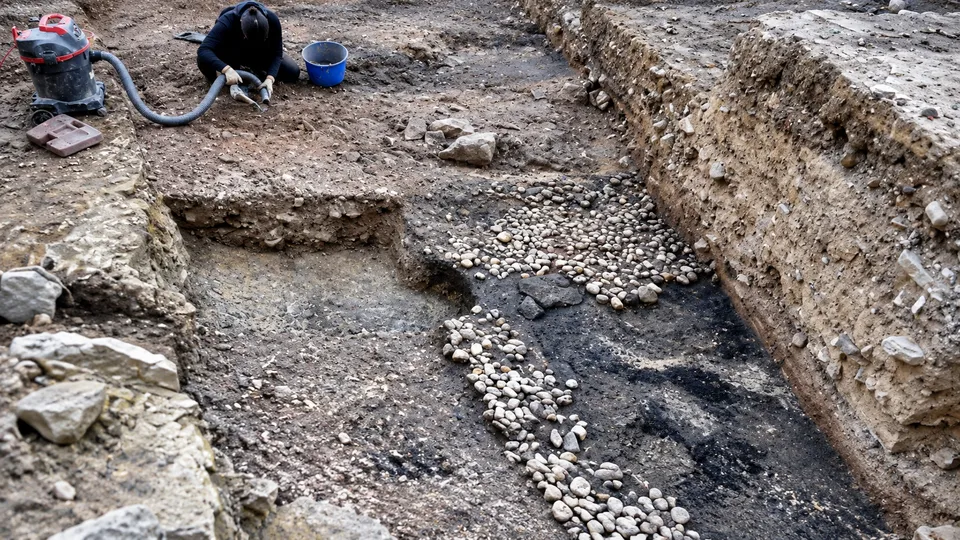
Archaeologists digging at a medieval monastery in eastern Germany have uncovered a rare 14th-century clay water pipeline, part of a cluster of finds from this year’s excavations that suggests the community was investing in comfort and engineering long after it was thought to be fading.
The discovery comes from Posa Hill near Zeitz in Saxony-Anhalt, where researchers found that the monastic complex extended well beyond what they had mapped. Along with the pipeline, the team documented two warm-air heating systems and high-quality flooring, all dating to the 1300s, in an area once dismissed as peripheral.
The water system carried water through wheel-thrown ceramic pipes about 12 centimeters in diameter and roughly 70 centimeters long. Craftspeople shaped the ends to standard forms so one section slotted into the next, then sealed the joints with clay. Archaeologists have traced about five meters of it so far.
Water systems of this type and date are exceptionally rare, according to the State Office for Heritage Management and Archaeology Saxony-Anhalt. Ceramic pipelines this early are known from only a small number of monasteries and castles in southern Germany.
Posa was no stranger to plumbing. Diggers have already documented many wooden water pipes across the site, and written records describe a system built in 1168 that carried water to the monastery from more than four kilometers away. The new pipeline is a later stage of the same infrastructure, rebuilt in ceramic centuries on.
The dig also redrew the monastery’s map. The hillside’s topography had led researchers to treat a courtyard paved in the 16th century as the complex’s southern edge. This year the team found a second monastic courtyard beyond it, bordered on almost every side by buildings.
Those buildings were not storerooms. One held a high-quality red screed floor, and the remains of two warm-air heating systems from the 14th century turned up nearby. Medieval systems of that kind pushed heated air through purpose-built channels, a relatively sophisticated amenity for the period. One small Romanesque building in the area remains difficult to interpret, the archaeologists said.
Taken together, the pipes, the heated rooms and the extra courtyard amount to a pattern of spending that does not sit easily with the older account of a monastery losing its economic footing in the late Middle Ages. The Saxony-Anhalt heritage authority argues the new infrastructure instead reflects a high level of development and a healthy economic position in that period.
The hill’s history runs much further back. A fortified complex covering more than eight hectares stood there from the 9th century, with a central stronghold and an outer enclosure above the floodplain of the White Elster River. In the 10th century it became the seat of the Bishopric of Zeitz, founded in 968 under Emperor Otto I; excavators have traced a bishop’s palace at least 18 meters wide and about 30 meters long so far, with evidence of glass windows, an expensive feature at the time.
After the bishopric moved to Naumburg in 1028, Bishop Dietrich I of Naumburg founded a Benedictine monastery at Posa in 1114, bringing monks from Hirsau in the northern Black Forest. Excavations have run on the hill since 2017, making it one of the most extensively investigated monastic sites in central Germany, and the 2026 campaign has now pushed the known complex farther south than anyone had placed it.